- Joined
- May 20, 2019
- Posts
- 5,549
- Reaction score
- 16,626
- AFL Club
- Richmond

BANYA !! Farken
Follow along with the video below to see how to install our site as a web app on your home screen.
Note: This feature may not be available in some browsers.


Not a train on player that’s for sure.wonder where smilie wouldve gone this draft if it was his draft year and he was injured as he is

basically nfi / incompetentThis is a long but somewhat interesting one on PRE.
After talking to my experienced Physiotherapy mate from Vietnam, Chất Ge Bt, giving him every update we've been given about Smillie, from last years preseason to the latest update this is what he told me...
Smil's issue is a chronic quad tendon injury that never fully healed. The club spent basically the entire year trying every conservative option they had, conditioning blocks, reload phases, strength work, off-season running, but every time they pushed his kicking volume, it flared up again. That’s classic rectus femoris tendon behaviour, especially in a 196cm teenager with long levers. The force that runs through that tendon when he kicks is far higher than what a 183cm midfielder produces, and tendons in young tall athletes remodel more slowly.
The positive in all this is that the actual structure of the injury was always described as minor, and if it were a deep muscle injury or a proper tear he simply wouldn’t be running. Running after a quad injury is the hardest part to regain, and the club has explicitly said in the updates that he is “running at high speed” and is “in excellent aerobic condition.” If you're being optimistic that gives him a far better foundation than most returning from quad issues.
Surgery is basically the circuit-breaker to reset the tendon so it can finally heal properly. When they talk about a “February return,” it doesn’t mean he suddenly walks into the midfield as an AFL-ready player. It means he’ll be back, hopefully, training with the group, rebuilding football conditioning, playing managed minutes, and progressing the final stage of his kicking load through actual football rather than being stuck in a rehab lane.
The early post-op period explains why this timeline is reasonable. The first four to six weeks after surgery are focused on tendon protection. That period is filled with controlled isometrics, very light gym work, cycling and pool sessions, and no high-speed mechanics. That's why Caesar and track watchers most likely won't see him out on the track. At best he’ll be jogging late in that window. So he will need to recondition his strength and running rhythm after surgery, but he’s not rebuilding from zero because his aerobic base was already strong before they operated.
By January, the goals are straightforward: get him running in straight lines at volume again, add some high-speed strides, reintroduce early agility, bring back short-distance kicking in the 10 to 20 metre range, and put him through controlled skill drills while keeping his overall training heavily modified. If he is ticking those boxes cleanly, then the “return” they’re talking about in late January or early February looks more like him regaining full ground coverage, starting to handle repeated accelerations and decelerations, progressing into medium and eventually long kicking, and dipping into some match simulation or early contested work. But that still isn’t “full AFL training” in the true sense. It’s a return to the group with limitations.
The final piece of his rehab is exactly what February and March are designed for: rebuilding his long kicking under fatigue and tolerating repeated high-velocity leg swings without the tendon reacting. That’s the bit that can’t be rushed and the bit that failed during the year. Now that the tendon has been repaired, this last stage is simply about controlled progression.
All of this assumes the ideal timeline with no setbacks, but given the nature of the injury and the clarity of the club updates, it’s a logical and realistic pathway.
The main setbacks you’d watch for are predictable tendon responses. The most common is the tendon becoming reactive again when they increase kicking distance or kicking volume too quickly, which forces them to slow the progression. Another is discomfort during high-speed change of direction or deceleration work, because that loads the rectus femoris tendon heavily. A smaller risk is general quad strength lagging behind his running fitness, which can delay match-simulation loads. None of these are catastrophic, but each can push the timeline back by a few weeks if the tendon doesn’t tolerate the next jump in load.
As to why they didn’t call it a quad issue to start with, and instead labelled it a hamstring issue.
They probably did see it but early on it presents almost identically to a hamstring issue, and the scans often look minor or inconclusive. Symptoms are the same if not similar. Quad/hamstring junction injuries and proximal rectus femoris tendon problems are some of the hardest soft-tissue issues to classify early in a season, especially in a young, still developing athlete.
The first instinct when a big 196cm teenager says he’s sore is to treat it like load intolerance, especially by all reports he was working himself very hard
Log in to remove this Banner Ad

This is a long but somewhat interesting one on PRE.
After talking to my experienced Physiotherapy mate from Vietnam, Chất Ge Bt, giving him every update we've been given about Smillie, from last years preseason to the latest update this is what he told me...
Smil's issue is a chronic quad tendon injury that never fully healed. The club spent basically the entire year trying every conservative option they had, conditioning blocks, reload phases, strength work, off-season running, but every time they pushed his kicking volume, it flared up again. That’s classic rectus femoris tendon behaviour, especially in a 196cm teenager with long levers. The force that runs through that tendon when he kicks is far higher than what a 183cm midfielder produces, and tendons in young tall athletes remodel more slowly.
The positive in all this is that the actual structure of the injury was always described as minor, and if it were a deep muscle injury or a proper tear he simply wouldn’t be running. Running after a quad injury is the hardest part to regain, and the club has explicitly said in the updates that he is “running at high speed” and is “in excellent aerobic condition.” If you're being optimistic that gives him a far better foundation than most returning from quad issues.
Surgery is basically the circuit-breaker to reset the tendon so it can finally heal properly. When they talk about a “February return,” it doesn’t mean he suddenly walks into the midfield as an AFL-ready player. It means he’ll be back, hopefully, training with the group, rebuilding football conditioning, playing managed minutes, and progressing the final stage of his kicking load through actual football rather than being stuck in a rehab lane.
The early post-op period explains why this timeline is reasonable. The first four to six weeks after surgery are focused on tendon protection. That period is filled with controlled isometrics, very light gym work, cycling and pool sessions, and no high-speed mechanics. That's why Caesar and track watchers most likely won't see him out on the track. At best he’ll be jogging late in that window. So he will need to recondition his strength and running rhythm after surgery, but he’s not rebuilding from zero because his aerobic base was already strong before they operated.
By January, the goals are straightforward: get him running in straight lines at volume again, add some high-speed strides, reintroduce early agility, bring back short-distance kicking in the 10 to 20 metre range, and put him through controlled skill drills while keeping his overall training heavily modified. If he is ticking those boxes cleanly, then the “return” they’re talking about in late January or early February looks more like him regaining full ground coverage, starting to handle repeated accelerations and decelerations, progressing into medium and eventually long kicking, and dipping into some match simulation or early contested work. But that still isn’t “full AFL training” in the true sense. It’s a return to the group with limitations.
The final piece of his rehab is exactly what February and March are designed for: rebuilding his long kicking under fatigue and tolerating repeated high-velocity leg swings without the tendon reacting. That’s the bit that can’t be rushed and the bit that failed during the year. Now that the tendon has been repaired, this last stage is simply about controlled progression.
All of this assumes the ideal timeline with no setbacks, but given the nature of the injury and the clarity of the club updates, it’s a logical and realistic pathway.
The main setbacks you’d watch for are predictable tendon responses. The most common is the tendon becoming reactive again when they increase kicking distance or kicking volume too quickly, which forces them to slow the progression. Another is discomfort during high-speed change of direction or deceleration work, because that loads the rectus femoris tendon heavily. A smaller risk is general quad strength lagging behind his running fitness, which can delay match-simulation loads. None of these are catastrophic, but each can push the timeline back by a few weeks if the tendon doesn’t tolerate the next jump in load.
As to why they didn’t call it a quad issue to start with, and instead labelled it a hamstring issue.
They probably did see it but early on it presents almost identically to a hamstring issue, and the scans often look minor or inconclusive. Symptoms are the same if not similar. Quad/hamstring junction injuries and proximal rectus femoris tendon problems are some of the hardest soft-tissue issues to classify early in a season, especially in a young, still developing athlete.
The first instinct when a big 196cm teenager says he’s sore is to treat it like load intolerance, especially by all reports he was working himself very hard
Why NFI?basically nfi / incompetent

you know he said this was with AI right (Chat Ge Bt = ChatGPT)This is a long but somewhat interesting one on PRE.
After talking to my experienced Physiotherapy mate from Vietnam, Chất Ge Bt, giving him every update we've been given about Smillie, from last years preseason to the latest update this is what he told me...
Smil's issue is a chronic quad tendon injury that never fully healed. The club spent basically the entire year trying every conservative option they had, conditioning blocks, reload phases, strength work, off-season running, but every time they pushed his kicking volume, it flared up again. That’s classic rectus femoris tendon behaviour, especially in a 196cm teenager with long levers. The force that runs through that tendon when he kicks is far higher than what a 183cm midfielder produces, and tendons in young tall athletes remodel more slowly.
The positive in all this is that the actual structure of the injury was always described as minor, and if it were a deep muscle injury or a proper tear he simply wouldn’t be running. Running after a quad injury is the hardest part to regain, and the club has explicitly said in the updates that he is “running at high speed” and is “in excellent aerobic condition.” If you're being optimistic that gives him a far better foundation than most returning from quad issues.
Surgery is basically the circuit-breaker to reset the tendon so it can finally heal properly. When they talk about a “February return,” it doesn’t mean he suddenly walks into the midfield as an AFL-ready player. It means he’ll be back, hopefully, training with the group, rebuilding football conditioning, playing managed minutes, and progressing the final stage of his kicking load through actual football rather than being stuck in a rehab lane.
The early post-op period explains why this timeline is reasonable. The first four to six weeks after surgery are focused on tendon protection. That period is filled with controlled isometrics, very light gym work, cycling and pool sessions, and no high-speed mechanics. That's why Caesar and track watchers most likely won't see him out on the track. At best he’ll be jogging late in that window. So he will need to recondition his strength and running rhythm after surgery, but he’s not rebuilding from zero because his aerobic base was already strong before they operated.
By January, the goals are straightforward: get him running in straight lines at volume again, add some high-speed strides, reintroduce early agility, bring back short-distance kicking in the 10 to 20 metre range, and put him through controlled skill drills while keeping his overall training heavily modified. If he is ticking those boxes cleanly, then the “return” they’re talking about in late January or early February looks more like him regaining full ground coverage, starting to handle repeated accelerations and decelerations, progressing into medium and eventually long kicking, and dipping into some match simulation or early contested work. But that still isn’t “full AFL training” in the true sense. It’s a return to the group with limitations.
The final piece of his rehab is exactly what February and March are designed for: rebuilding his long kicking under fatigue and tolerating repeated high-velocity leg swings without the tendon reacting. That’s the bit that can’t be rushed and the bit that failed during the year. Now that the tendon has been repaired, this last stage is simply about controlled progression.
All of this assumes the ideal timeline with no setbacks, but given the nature of the injury and the clarity of the club updates, it’s a logical and realistic pathway.
The main setbacks you’d watch for are predictable tendon responses. The most common is the tendon becoming reactive again when they increase kicking distance or kicking volume too quickly, which forces them to slow the progression. Another is discomfort during high-speed change of direction or deceleration work, because that loads the rectus femoris tendon heavily. A smaller risk is general quad strength lagging behind his running fitness, which can delay match-simulation loads. None of these are catastrophic, but each can push the timeline back by a few weeks if the tendon doesn’t tolerate the next jump in load.
As to why they didn’t call it a quad issue to start with, and instead labelled it a hamstring issue.
They probably did see it but early on it presents almost identically to a hamstring issue, and the scans often look minor or inconclusive. Symptoms are the same if not similar. Quad/hamstring junction injuries and proximal rectus femoris tendon problems are some of the hardest soft-tissue issues to classify early in a season, especially in a young, still developing athlete.
The first instinct when a big 196cm teenager says he’s sore is to treat it like load intolerance, especially by all reports he was working himself very hard
Hahaha its got like 20 upvotes on PRE. Pretty decent interpolation of all the breadcrumbs the club has put out across the year I guessyou know he said this was with AI right (Chat Ge Bt = ChatGPT)

What does it mean in less than 50 words mateThis is a long but somewhat interesting one on PRE.
After talking to my experienced Physiotherapy mate from Vietnam, Chất Ge Bt, giving him every update we've been given about Smillie, from last years preseason to the latest update this is what he told me...
Smil's issue is a chronic quad tendon injury that never fully healed. The club spent basically the entire year trying every conservative option they had, conditioning blocks, reload phases, strength work, off-season running, but every time they pushed his kicking volume, it flared up again. That’s classic rectus femoris tendon behaviour, especially in a 196cm teenager with long levers. The force that runs through that tendon when he kicks is far higher than what a 183cm midfielder produces, and tendons in young tall athletes remodel more slowly.
The positive in all this is that the actual structure of the injury was always described as minor, and if it were a deep muscle injury or a proper tear he simply wouldn’t be running. Running after a quad injury is the hardest part to regain, and the club has explicitly said in the updates that he is “running at high speed” and is “in excellent aerobic condition.” If you're being optimistic that gives him a far better foundation than most returning from quad issues.
Surgery is basically the circuit-breaker to reset the tendon so it can finally heal properly. When they talk about a “February return,” it doesn’t mean he suddenly walks into the midfield as an AFL-ready player. It means he’ll be back, hopefully, training with the group, rebuilding football conditioning, playing managed minutes, and progressing the final stage of his kicking load through actual football rather than being stuck in a rehab lane.
The early post-op period explains why this timeline is reasonable. The first four to six weeks after surgery are focused on tendon protection. That period is filled with controlled isometrics, very light gym work, cycling and pool sessions, and no high-speed mechanics. That's why Caesar and track watchers most likely won't see him out on the track. At best he’ll be jogging late in that window. So he will need to recondition his strength and running rhythm after surgery, but he’s not rebuilding from zero because his aerobic base was already strong before they operated.
By January, the goals are straightforward: get him running in straight lines at volume again, add some high-speed strides, reintroduce early agility, bring back short-distance kicking in the 10 to 20 metre range, and put him through controlled skill drills while keeping his overall training heavily modified. If he is ticking those boxes cleanly, then the “return” they’re talking about in late January or early February looks more like him regaining full ground coverage, starting to handle repeated accelerations and decelerations, progressing into medium and eventually long kicking, and dipping into some match simulation or early contested work. But that still isn’t “full AFL training” in the true sense. It’s a return to the group with limitations.
The final piece of his rehab is exactly what February and March are designed for: rebuilding his long kicking under fatigue and tolerating repeated high-velocity leg swings without the tendon reacting. That’s the bit that can’t be rushed and the bit that failed during the year. Now that the tendon has been repaired, this last stage is simply about controlled progression.
All of this assumes the ideal timeline with no setbacks, but given the nature of the injury and the clarity of the club updates, it’s a logical and realistic pathway.
The main setbacks you’d watch for are predictable tendon responses. The most common is the tendon becoming reactive again when they increase kicking distance or kicking volume too quickly, which forces them to slow the progression. Another is discomfort during high-speed change of direction or deceleration work, because that loads the rectus femoris tendon heavily. A smaller risk is general quad strength lagging behind his running fitness, which can delay match-simulation loads. None of these are catastrophic, but each can push the timeline back by a few weeks if the tendon doesn’t tolerate the next jump in load.
As to why they didn’t call it a quad issue to start with, and instead labelled it a hamstring issue.
They probably did see it but early on it presents almost identically to a hamstring issue, and the scans often look minor or inconclusive. Symptoms are the same if not similar. Quad/hamstring junction injuries and proximal rectus femoris tendon problems are some of the hardest soft-tissue issues to classify early in a season, especially in a young, still developing athlete.
The first instinct when a big 196cm teenager says he’s sore is to treat it like load intolerance, especially by all reports he was working himself very hard
What does it mean in less than 50 words mate
Is he fecked
nah hes fine here's AI summarising that blokes AI in 200 words
Smillie’s year looks confusing because the injury didn’t present clearly at first. In January the club called it a “minor hamstring” linked to first-year load, which is common for an 18-year-old 196cm midfielder. Through February and March he was doing drills but being managed, and by late March the club said the hamstring “had not healed as well as we’d like,” which is usually the first sign that a soft-tissue issue isn’t behaving normally. He returned in April for a managed-minutes VFL debut, but in May he again reported soreness with no clear incident. They still called it “minor,” but shifted the messaging to long-term athletic development, which is what clubs do when they suspect a deeper load-tolerance issue.
From June to early August he lived in the “conditioning block” updates — 3–5 weeks, then 2–4, then 1–3 — which tells you he could run fast but couldn’t tolerate full football load. That’s exactly how rectus femoris tendon injuries behave: running is fine, kicking load isn’t. In mid-August they finally labelled it a “minor quad strain,” another hint it wasn’t a hamstring at all.
The November update confirms the pattern: scans showed little healing despite it being “minor,” running was excellent, kicking still flared, and surgery was the circuit-breaker. It was one chronic quad tendon issue all along, slowly revealing itself across the year.
I do know who that is ?Put it into Chất Ge Bt and ask it to summarise

no Chilli thoI do know who that is ?
and what am i putting in ?
View attachment 2486842
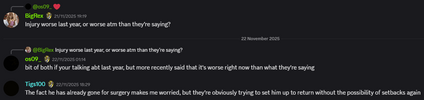
View attachment 2486843
No idea on how reliable this is, but figured I'd post it to feed the melts
come on. to me it shows how out of touch our rehavb staff are, our sports med people also. clueless.there's no further info necessarily, but it contextualises the stuff we have I guess. Explains there's no big conspiracy, that everything adds up to what they've told us. and there's a good chance he's gonna be alright

So you think the club should just hire internet experts who've never worked in an elite sporting environment before?come on. to me it shows how out of touch our rehavb staff are, our sports med people also. clueless.

yesSo you think the club should just hire internet experts who've never worked in an elite sporting environment before?

lol he had me goingyou know he said this was with AI right (Chat Ge Bt = ChatGPT)
nope. did I say that? hire someone that has a clue. we have flucked up the last 2 appoitments. clearlySo you think the club should just hire internet experts who've never worked in an elite sporting environment before?