Remove this Banner Ad

Discussion Prison Bars debate

Should Port be allowed to wear the PBs as their home jumper?


  • Total voters
    258

🥰 Love BigFooty? Join now for free.

Status
Not open for further replies.
The record is pretty clear. PAFC agreed to dropping the Magpies moniker and the black and white stripes as a condition of joining the AFL. Its in all the newspaper articles ahead of Port joining.

Nothing to do with colours of Geelong vs Carlton, Arsenal vs Liverpool, etc. etc. Port agreed and to their credit have lived up to their agreement.

The opinion of 13 year old Port fans who are ignorant of the agreement is irrelevant.
 
i have to laugh whenever people opposed to the bars whinge about how it's too similar design/same colours/blah blah blah considering West Ham, Aston Villa and Burnley (or 2 of the 3) have literally worn the exact same kit and colours in the EPL and no one has ever batted an eyelid
Port Adelaide agreed to changing their uniform as a condition of entry to the competition. WH, AV and Burnley did not. Why does that make you laugh?
 
The record is pretty clear. PAFC agreed to dropping the Magpies moniker and the black and white stripes as a condition of joining the AFL. Its in all the newspaper articles ahead of Port joining.

Nothing to do with colours of Geelong vs Carlton, Arsenal vs Liverpool, etc. etc. Port agreed and to their credit have lived up to their agreement.

The opinion of 13 year old Port fans who are ignorant of the agreement is irrelevant.
exactly fine with it being used on occasion but it has to have teal to be used as the home kit full time
 
i have to laugh whenever people opposed to the bars whinge about how it's too similar design/same colours/blah blah blah considering West Ham, Aston Villa and Burnley (or 2 of the 3) have literally worn the exact same kit and colours in the EPL and no one has ever batted an eyelid
Well, the AFL isn't a Promotion/Relegation league where new sides can enter and in some cases share the same kits/nicknames. If all the stars align, it's possible for an English football league/division to have all teams with "Blues" as their nickname and it wouldn't be by choice. Pro/Rel leagues don't care who's in, the AFL does for distinguishing the teams
 

Log in to remove this Banner Ad

i have to laugh whenever people opposed to the bars whinge about how it's too similar design/same colours/blah blah blah considering West Ham, Aston Villa and Burnley (or 2 of the 3) have literally worn the exact same kit and colours in the EPL and no one has ever batted an eyelid
Im only against it as a full-time kit unless it has teal im fine with it being worn every now and then, football is different to AFL they are more unique with alt kits, the AFL doesn't meaning no team can have the exact same set of colors and kit or name since its different, thus port had to rebrand
 
Well, the AFL isn't a Promotion/Relegation league where new sides can enter and in some cases share the same kits/nicknames. If all the stars align, it's possible for an English football league/division to have all teams with "Blues" as their nickname and it wouldn't be by choice. Pro/Rel leagues don't care who's in, the AFL does for distinguishing the teams
Exactly, way better job of explaining it than me
 
r409_0_2534_1596_w1200_h678_fmax.jpg

Minyip-Murtoa leading by example, this would have to happen if it is made the home kit, it's really a combo of the bars kit and ports first kit combining the history of both parts of port Adelaide
 
There are a lot of issues to consider in this debate that aren't just football related, since these clubs are also businesses and corporations.

First of all, personally I believe Port, like any AFL club, or any other elite sporting club in Australia, should have the right to choose whatever guernsey/jersey/uniform they wear. However, I also believe that no elite sporting club in Australia should be able to "steal" or "copy" the identity of another.

To most people who follow sport, we can easily tell the difference between Collingwood's traditional vertical stripes and Port's traditional vertical stripes. While they are both white on a black background and despite Collingwood having traditionally worn black stripes on white, both guernseys, from a sporting perspective, are distinct enough to tell the 2 apart in isolation.

However, if push came to shove and the issue were to be pursued legally, there is always the "reasonable person" that needs to be considered. This, ultimately, would be the person(s) who would need to be convinced that the guernseys and overall identities are not too similar.

There is the concept of "get-up" or "trade dress" (protecting businesses from competitors trying to "pass-off" their own products) in law, which considers the overall appearance of a product, not just the "details" of the design. We have seen this before with Kraft and Bega when Bega acquired the license from Kraft's Australian business, while a new company who licensed the Kraft brand separately was denied the right to the former Kraft's "get-up". There was also Cadbury's failed bid against Darrell Lea to prevent Darrell Lea (and probably by extension anyone else) from using purple for their chocolate products.

These cases revolved around two main questions: a) was there a distinct look-and-feel to the product exclusive to its owner and b) was that established look-and-feel infringed by the other.

What will complicate this issue, not just legally but within the "realm" of the Australian Football League, is the murky nature of determining the scope of consideration.

To understand things, we need to look at facts:
  • Collingwood FC were formed in 1892, were foundation members of the VFL (of which the AFL is a direct successor and intrinsically linked to) and have exclusively worn a black and white vertically-striped guernsey as its primary choice (and been known as the Magpies) since the first VFL season.
  • Port Adelaide FC were formed in 1870, were foundation members of the SANFL (then known as the SAFA) and joined the AFL in 1997, and had exclusively worn black and white vertically-striped guernseys (of several designs) as its primary choice (and been known as the Magpies) since 1902, wearing the "prison bar" design exclusively, in one form or another, for the periods of 1902-1922, 1928-1940 and 1953 until their AFL entry in 1997.
  • The AFL itself was formed in 1897 as the VFL and was originally exclusively contested by Victorian clubs and began expanding out of the state in 1982 (when SMFC moved to Sydney, NSW), before aggressively expanding nationally between 1987 and 1997 (the year in which PAFC joined the AFL).
  • The PAFC AFL entity is the same organisation that was founded in 1870, competed in the SANFL for over a century and then were admitted to the AFL in 1997.
  • The Collingwood AFL entity is the same organisation that was founded in 1892.
  • The AFL itself is the same organisation (or direct successor of such organisation) that was formed in 1897 and of which Collingwood was a foundation member.
  • A separate PAFC entity, the Port Adelaide Magpies FC, was created upon PAFC's AFL entry and competed in the SANFL, and was legally separate from the PAFC's AFL entity until late-2010 (when PAMFC was merged into PAFC). PAMFC, while assuming the former identity, branding and guernseys of PAFC (from their SANFL years) must be considered distinct from the PAFC proper.
  • The AFL, within reason and Australian law, has the right to set terms of entry into its competition (including the right to require a new club to avoid being too close to an existing club in identity, location, branding, etc.)
  • From 2007-2027, the AFL owns the trademark for a black and white vertically-striped guernsey with the AFL logo on the right breast.
  • The AFL also owns trademarks for most club branding and designs and has the right to license these as it sees fit.
  • The SANFL, nor any league excluding the VFL, is not considered as part of the lineage of the AFL.
There are further issues to consider, but these may not be factual (and therefore these are just my opinion):
  • The "Prison Bar" design, worn by PAFC and PAMFC in the SANFL, is geometrically and visually distinct from the vertically-striped design worn by Collingwood.
  • The black and white colours worn by both clubs are visually similar (if not identical).
  • Both clubs have at various points worn designs, guernseys and colours that are geometrically and/or visually similar to each other's own (including designs previously worn by the other club and those worn at the same time). However, at these times, the clubs were in different competitions at a time when exposure to both clubs at the time was either limited or unlikely.
  • There is no allegation, previous to the AFL entry of PAFC, that either club infringed the other's rights to the guernsey designs or colours.
  • PAFC was allegedly required to forfeit its right to wear black and white guernseys (including the Prison Bar design) and use of the Magpies nickname/mascot in the AFL due to its similarity to Collingwood.
  • Collingwood has allegedly, on some occasions, allowed PAFC to wear the Prison Bar guernsey and, on other occasions, denied such use.
  • The AFL allegedly has the right to allow or deny any club use of any guernsey, logo, etc., with or without reason.
  • Collingwood's "inversion" of colours in 2001 was a minor change to the design of the guernsey (from the front viewpoint especially) and in itself did not infringe on PAFC or any other club's designs and, further, was still visually distinct from all other club's guernseys.
  • Further to the above, Collingwood's "inversion" of colours did not affect it's "traditional" use of black and white vertically-striped guernseys, nor did it disqualify the need to distinguish Collingwood from PAFC.
  • While a number of teams within the AFL have similar colours (such as Collingwood's black and Carlton's navy, Melbourne's navy and red and Essendon's black and red, etc.), their designs are generally different enough as currently worn to be visually distinct from one another.
  • Often, even when colours are nearly identical (such as Geelong and Carlton both being navy and white, or Adelaide, Brisbane/Fitzroy and GC Suns wearing navy, red/maroon and gold), their designs are generally distinct enough to differentiate them.
  • Prison bar designs are, essentially, a vertically-striped design with the addition of a truncating bar at the top.
  • Where teams share the same design (such as Collingwood, Hawthorn and North Melbourne, or Essendon and Richmond), the colours are significantly different to one another.
  • There are a finite number of guernsey designs that have been worn at elite level - the main differentiator between clubs has traditionally been colours or the addition of other elements.
  • As the league expands over time, there is likely to be more similarities between teams which will need to be avoided, particularly if the league admits any other pre-existing teams.
  • For the majority of its history, the V/AFL has no precedent of 2 teams sharing both the same colours and guernsey design, nor nickname/mascot.
  • Requiring clubs to adopt new colours (in addition to or in lieu of their traditional ones) is an established practice in Australian sport when clubs are admitted to a new or higher league (Penrith and Cronulla in the NSWRFL, the Dolphins in the NRL, for example).
  • Unlike the NRL (formed in 1998 by the creation of the ARL-News co-owned NRL Partnership), for example, the VFL simply became the AFL by re-branding and, therefore, the AFL is a continuation of the VFL, rather than a distinct "national" league created for such purpose.
  • When guernseys and other merchandise is presented at retail, club logos and designs may be obscured, leaving club colours as the primary differentiator for buyers.
Having considered the above, these are my opinions on the debate:
  • Despite being established before Collingwood, PAFC's history in the AFL itself only dates back to 1997, while Collingwood's began a century-prior.
  • Based on the above, Collingwood had an incumbent "right" to black and white vertically-striped guernseys in the AFL which, until PAFC's admission, had previously been unchallenged.
  • In consideration of Collingwood's long-standing place in the AFL prior to the admission of PAFC, there should have been an amount of "protection" for Collingwood's identity upon the entry of PAFC, including exclusivity to the Magpies name and at least some element of their existing "trade dress". The terms and duration of this protection is unknown but assumed to be in perpetuity as it stands.
  • Further to the above, the AFL had assumed trademarks and licensing rights to club's identities and were, essentially, in control of these elements at the time of (and decades prior to) PAFC's admission to the AFL.
  • Having co-existed as separate, distinct entities in the AFL for over 25 years, the need for "protection" is lessened over time as both clubs have had plenty of time to distinguish themselves from each other and other clubs, and both clubs will continue to have those opportunities.
  • In the time between the AFL's expansion of the 1980s-1990s and the current, the AFL has assumed the role of the national league, rather than an expanded Victorian league. Having assumed a monopoly of elite football, the AFL should also begin to recognise the non-Victorian history of Australian football and its clubs from the other "top" leagues around the country (pre-AFL).
  • While the Magpie mascot and nickname should remain solely at Collingwood's discretion in the AFL (given their tenure in the V/AFL), there is likely scope, based on a common-sense "time and place" approach, for PAFC to be allowed more use of the Prison Bars and black-and-white colours should they want to, whilst not infringing upon Collingwood's long-standing use of the black and white colours, black and white vertically-striped guernseys.
My "time and place" approach suggestion:
  • The black and white "Prison Bars" guernsey will become exclusive for PAFC (i.e. Collingwood can't nick it).
  • The Prison Bars may be worn only for home games in SA (or, at least, anywhere but VIC), or for home finals or Grand Finals where PAFC is the designated home team (having "earnt the right" to wear it).
  • The Prison Bars may not be worn against Collingwood, except in the case of a Grand Final where PAFC is the designated home team (see above) against them.
  • The Prison Bars guernsey must be geometrically and visually distinct from a typical Collingwood guernsey and should feature a clear PAFC badge (to avoid as much potential "confusion" as possible).
  • PAFC should be discouraged from wearing an inverted Prison Bars guernsey which would similarly conflict with Collingwood's "traditional" black vertical stripes on white guernsey.
  • PAFC merchandise and branding will still feature teal and/or silver, with Collingwood still having the exclusive right to use black and white only.
  • Away, clash and other non-Prison Bars guernseys should still feature teal and/or silver.
  • There is also potential of the Prison Bars guernsey only being available from the club's own retail channels and not general channels, to help prevent "confusion".
tl;dr: Collingwood should have been protected back in 1997, should still have some protection now but PAFC should also be able to wear the PBs more often.
 
There are a lot of issues to consider in this debate that aren't just football related, since these clubs are also businesses and corporations.

First of all, personally I believe Port, like any AFL club, or any other elite sporting club in Australia, should have the right to choose whatever guernsey/jersey/uniform they wear. However, I also believe that no elite sporting club in Australia should be able to "steal" or "copy" the identity of another.

To most people who follow sport, we can easily tell the difference between Collingwood's traditional vertical stripes and Port's traditional vertical stripes. While they are both white on a black background and despite Collingwood having traditionally worn black stripes on white, both guernseys, from a sporting perspective, are distinct enough to tell the 2 apart in isolation.

However, if push came to shove and the issue were to be pursued legally, there is always the "reasonable person" that needs to be considered. This, ultimately, would be the person(s) who would need to be convinced that the guernseys and overall identities are not too similar.

There is the concept of "get-up" or "trade dress" (protecting businesses from competitors trying to "pass-off" their own products) in law, which considers the overall appearance of a product, not just the "details" of the design. We have seen this before with Kraft and Bega when Bega acquired the license from Kraft's Australian business, while a new company who licensed the Kraft brand separately was denied the right to the former Kraft's "get-up". There was also Cadbury's failed bid against Darrell Lea to prevent Darrell Lea (and probably by extension anyone else) from using purple for their chocolate products.

These cases revolved around two main questions: a) was there a distinct look-and-feel to the product exclusive to its owner and b) was that established look-and-feel infringed by the other.

What will complicate this issue, not just legally but within the "realm" of the Australian Football League, is the murky nature of determining the scope of consideration.

To understand things, we need to look at facts:
  • Collingwood FC were formed in 1892, were foundation members of the VFL (of which the AFL is a direct successor and intrinsically linked to) and have exclusively worn a black and white vertically-striped guernsey as its primary choice (and been known as the Magpies) since the first VFL season.
  • Port Adelaide FC were formed in 1870, were foundation members of the SANFL (then known as the SAFA) and joined the AFL in 1997, and had exclusively worn black and white vertically-striped guernseys (of several designs) as its primary choice (and been known as the Magpies) since 1902, wearing the "prison bar" design exclusively, in one form or another, for the periods of 1902-1922, 1928-1940 and 1953 until their AFL entry in 1997.
  • The AFL itself was formed in 1897 as the VFL and was originally exclusively contested by Victorian clubs and began expanding out of the state in 1982 (when SMFC moved to Sydney, NSW), before aggressively expanding nationally between 1987 and 1997 (the year in which PAFC joined the AFL).
  • The PAFC AFL entity is the same organisation that was founded in 1870, competed in the SANFL for over a century and then were admitted to the AFL in 1997.
  • The Collingwood AFL entity is the same organisation that was founded in 1892.
  • The AFL itself is the same organisation (or direct successor of such organisation) that was formed in 1897 and of which Collingwood was a foundation member.
  • A separate PAFC entity, the Port Adelaide Magpies FC, was created upon PAFC's AFL entry and competed in the SANFL, and was legally separate from the PAFC's AFL entity until late-2010 (when PAMFC was merged into PAFC). PAMFC, while assuming the former identity, branding and guernseys of PAFC (from their SANFL years) must be considered distinct from the PAFC proper.
  • The AFL, within reason and Australian law, has the right to set terms of entry into its competition (including the right to require a new club to avoid being too close to an existing club in identity, location, branding, etc.)
  • From 2007-2027, the AFL owns the trademark for a black and white vertically-striped guernsey with the AFL logo on the right breast.
  • The AFL also owns trademarks for most club branding and designs and has the right to license these as it sees fit.
  • The SANFL, nor any league excluding the VFL, is considered as part of the lineage of the AFL.
There are further issues to consider, but these may not be factual (and therefore these are just my opinion):
  • The "Prison Bar" design, worn by PAFC and PAMFC in the SANFL, is geometrically and visually distinct from the vertically-striped design worn by Collingwood.
  • The black and white colours worn by both clubs are visually similar (if not identical).
  • Both clubs have at various points worn designs, guernseys and colours that are geometrically and/or visually similar to each other's own (including designs previously worn by the other club and those worn at the same time). However, at these times, the clubs were in different competitions at a time when exposure to both clubs at the time was either limited or unlikely.
  • There is no allegation, previous to the AFL entry of PAFC, that either club infringed the other's rights to the guernsey designs or colours.
  • PAFC was allegedly required to forfeit its right to wear black and white guernseys (including the Prison Bar design) and use of the Magpies nickname/mascot in the AFL due to its similarity to Collingwood.
  • Collingwood has allegedly, on some occasions, allowed PAFC to wear the Prison Bar guernsey and, on other occasions, denied such use.
  • The AFL allegedly has the right to allow or deny any club use of any guernsey, logo, etc., with or without reason.
  • Collingwood's "inversion" of colours in 2001 was a minor change to the design of the guernsey (from the front viewpoint especially) and in itself did not infringe on PAFC or any other club's designs and, further, was still visually distinct from all other club's guernseys.
  • Further to the above, Collingwood's "inversion" of colours did not affect it's "traditional" use of black and white vertically-striped guernseys, nor did it disqualify the need to distinguish Collingwood from PAFC.
  • While a number of teams within the AFL have similar colours (such as Collingwood's black and Carlton's navy, Melbourne's navy and red and Essendon's black and red, etc.), their designs are generally different enough as currently worn to be visually distinct from one another.
  • Often, even when colours are nearly identical (such as Geelong and Carlton both being navy and white, or Adelaide, Brisbane/Fitzroy and GC Suns wearing navy, red/maroon and gold), their designs are generally distinct enough to differentiate them.
  • Prison bar designs are, essentially, a vertically-striped design with the addition of a truncating bar at the top.
  • Where teams share the same design (such as Collingwood, Hawthorn and North Melbourne, or Essendon and Richmond), the colours are significantly different to one another.
  • There are a finite number of guernsey designs that have been worn at elite level - the main differentiator between clubs has traditionally been colours or the addition of other elements.
  • As the league expands over time, there is likely to be more similarities between teams which will need to be avoided, particularly if the league admits any other pre-existing teams.
  • For the majority of its history, the V/AFL has no precedent of 2 teams sharing both the same colours and guernsey design, nor nickname/mascot.
  • Requiring clubs to adopt new colours (in addition to or in lieu of their traditional ones) is an established practice in Australian sport when clubs are admitted to a new or higher league (Penrith and Cronulla in the NSWRFL, the Dolphins in the NRL, for example).
  • Unlike the NRL (formed in 1998 by the creation of the ARL-News co-owned NRL Partnership), for example, the VFL simply became the AFL by re-branding and, therefore, the AFL is a continuation of the VFL, rather than a distinct "national" league created for such purpose.
  • When guernseys and other merchandise is presented at retail, club logos and designs may be obscured, leaving club colours as the primary differentiator for buyers.
Having considered the above, these are my opinions on the debate:
  • Despite being established before Collingwood, PAFC's history in the AFL itself only dates back to 1997, while Collingwood's began a century-prior.
  • Based on the above, Collingwood had an incumbent "right" to black and white vertically-striped guernseys in the AFL which, until PAFC's admission, had previously been unchallenged.
  • In consideration of Collingwood's long-standing place in the AFL prior to the admission of PAFC, there should have been an amount of "protection" for Collingwood's identity upon the entry of PAFC, including exclusivity to the Magpies name and at least some element of their existing "trade dress". The terms and duration of this protection is unknown but assumed to be in perpetuity as it stands.
  • Further to the above, the AFL had assumed trademarks and licensing rights to club's identities and were, essentially, in control of these elements at the time of (and decades prior to) PAFC's admission to the AFL.
  • Having co-existed as separate, distinct entities in the AFL for over 25 years, the need for "protection" is lessened over time as both clubs have had plenty of time to distinguish themselves from each other and other clubs, and both clubs will continue to have those opportunities.
  • In the time between the AFL's expansion of the 1980s-1990s and the current, the AFL has assumed the role of the national league, rather than an expanded Victorian league. Having assumed a monopoly of elite football, the AFL should also begin to recognise the non-Victorian history of Australian football and its clubs from the other "top" leagues around the country (pre-AFL).
  • While the Magpie mascot and nickname should remain solely at Collingwood's discretion in the AFL (given their tenure in the V/AFL), there is likely scope, based on a common-sense "time and place" approach, for PAFC to be allowed more use of the Prison Bars and black-and-white colours should they want to, whilst not infringing upon Collingwood's long-standing use of the black and white colours, black and white vertically-striped guernseys.
My "time and place" approach suggestion:
  • The black and white "Prison Bars" guernsey will become exclusive for PAFC (i.e. Collingwood can't nick it).
  • The Prison Bars may be worn only for home games in SA (or, at least, anywhere but VIC), or for home finals or Grand Finals where PAFC is the designated home team (having "earnt the right" to wear it).
  • The Prison Bars may not be worn against Collingwood, except in the case of a Grand Final where PAFC is the designated home team (see above) against them.
  • The Prison Bars guernsey must be geometrically and visually distinct from a typical Collingwood guernsey and should feature a clear PAFC badge (to avoid as much potential "confusion" as possible).
  • PAFC should be discouraged from wearing an inverted Prison Bars guernsey which would similarly conflict with Collingwood's "traditional" black vertical stripes on white guernsey.
  • PAFC merchandise and branding will still feature teal and/or silver, with Collingwood still having the exclusive right to use black and white only.
  • Away, clash and other non-Prison Bars guernseys should still feature teal and/or silver.
  • There is also potential of the Prison Bars guernsey only being available from the club's own retail channels and not general channels, to help prevent "confusion".
tl;dr: Collingwood should have been protected back in 1997, should still have some protection now but PAFC should also be able to wear the PBs more often.
agree but not as a full time kit, should be a must for the showdown
 
There are a lot of issues to consider in this debate that aren't just football related, since these clubs are also businesses and corporations.

First of all, personally I believe Port, like any AFL club, or any other elite sporting club in Australia, should have the right to choose whatever guernsey/jersey/uniform they wear. However, I also believe that no elite sporting club in Australia should be able to "steal" or "copy" the identity of another.

To most people who follow sport, we can easily tell the difference between Collingwood's traditional vertical stripes and Port's traditional vertical stripes. While they are both white on a black background and despite Collingwood having traditionally worn black stripes on white, both guernseys, from a sporting perspective, are distinct enough to tell the 2 apart in isolation.

However, if push came to shove and the issue were to be pursued legally, there is always the "reasonable person" that needs to be considered. This, ultimately, would be the person(s) who would need to be convinced that the guernseys and overall identities are not too similar.

There is the concept of "get-up" or "trade dress" (protecting businesses from competitors trying to "pass-off" their own products) in law, which considers the overall appearance of a product, not just the "details" of the design. We have seen this before with Kraft and Bega when Bega acquired the license from Kraft's Australian business, while a new company who licensed the Kraft brand separately was denied the right to the former Kraft's "get-up". There was also Cadbury's failed bid against Darrell Lea to prevent Darrell Lea (and probably by extension anyone else) from using purple for their chocolate products.

These cases revolved around two main questions: a) was there a distinct look-and-feel to the product exclusive to its owner and b) was that established look-and-feel infringed by the other.

What will complicate this issue, not just legally but within the "realm" of the Australian Football League, is the murky nature of determining the scope of consideration.

To understand things, we need to look at facts:
  • Collingwood FC were formed in 1892, were foundation members of the VFL (of which the AFL is a direct successor and intrinsically linked to) and have exclusively worn a black and white vertically-striped guernsey as its primary choice (and been known as the Magpies) since the first VFL season.
  • Port Adelaide FC were formed in 1870, were foundation members of the SANFL (then known as the SAFA) and joined the AFL in 1997, and had exclusively worn black and white vertically-striped guernseys (of several designs) as its primary choice (and been known as the Magpies) since 1902, wearing the "prison bar" design exclusively, in one form or another, for the periods of 1902-1922, 1928-1940 and 1953 until their AFL entry in 1997.
  • The AFL itself was formed in 1897 as the VFL and was originally exclusively contested by Victorian clubs and began expanding out of the state in 1982 (when SMFC moved to Sydney, NSW), before aggressively expanding nationally between 1987 and 1997 (the year in which PAFC joined the AFL).
  • The PAFC AFL entity is the same organisation that was founded in 1870, competed in the SANFL for over a century and then were admitted to the AFL in 1997.
  • The Collingwood AFL entity is the same organisation that was founded in 1892.
  • The AFL itself is the same organisation (or direct successor of such organisation) that was formed in 1897 and of which Collingwood was a foundation member.
  • A separate PAFC entity, the Port Adelaide Magpies FC, was created upon PAFC's AFL entry and competed in the SANFL, and was legally separate from the PAFC's AFL entity until late-2010 (when PAMFC was merged into PAFC). PAMFC, while assuming the former identity, branding and guernseys of PAFC (from their SANFL years) must be considered distinct from the PAFC proper.
  • The AFL, within reason and Australian law, has the right to set terms of entry into its competition (including the right to require a new club to avoid being too close to an existing club in identity, location, branding, etc.)
  • From 2007-2027, the AFL owns the trademark for a black and white vertically-striped guernsey with the AFL logo on the right breast.
  • The AFL also owns trademarks for most club branding and designs and has the right to license these as it sees fit.
  • The SANFL, nor any league excluding the VFL, is not considered as part of the lineage of the AFL.
There are further issues to consider, but these may not be factual (and therefore these are just my opinion):
  • The "Prison Bar" design, worn by PAFC and PAMFC in the SANFL, is geometrically and visually distinct from the vertically-striped design worn by Collingwood.
  • The black and white colours worn by both clubs are visually similar (if not identical).
  • Both clubs have at various points worn designs, guernseys and colours that are geometrically and/or visually similar to each other's own (including designs previously worn by the other club and those worn at the same time). However, at these times, the clubs were in different competitions at a time when exposure to both clubs at the time was either limited or unlikely.
  • There is no allegation, previous to the AFL entry of PAFC, that either club infringed the other's rights to the guernsey designs or colours.
  • PAFC was allegedly required to forfeit its right to wear black and white guernseys (including the Prison Bar design) and use of the Magpies nickname/mascot in the AFL due to its similarity to Collingwood.
  • Collingwood has allegedly, on some occasions, allowed PAFC to wear the Prison Bar guernsey and, on other occasions, denied such use.
  • The AFL allegedly has the right to allow or deny any club use of any guernsey, logo, etc., with or without reason.
  • Collingwood's "inversion" of colours in 2001 was a minor change to the design of the guernsey (from the front viewpoint especially) and in itself did not infringe on PAFC or any other club's designs and, further, was still visually distinct from all other club's guernseys.
  • Further to the above, Collingwood's "inversion" of colours did not affect it's "traditional" use of black and white vertically-striped guernseys, nor did it disqualify the need to distinguish Collingwood from PAFC.
  • While a number of teams within the AFL have similar colours (such as Collingwood's black and Carlton's navy, Melbourne's navy and red and Essendon's black and red, etc.), their designs are generally different enough as currently worn to be visually distinct from one another.
  • Often, even when colours are nearly identical (such as Geelong and Carlton both being navy and white, or Adelaide, Brisbane/Fitzroy and GC Suns wearing navy, red/maroon and gold), their designs are generally distinct enough to differentiate them.
  • Prison bar designs are, essentially, a vertically-striped design with the addition of a truncating bar at the top.
  • Where teams share the same design (such as Collingwood, Hawthorn and North Melbourne, or Essendon and Richmond), the colours are significantly different to one another.
  • There are a finite number of guernsey designs that have been worn at elite level - the main differentiator between clubs has traditionally been colours or the addition of other elements.
  • As the league expands over time, there is likely to be more similarities between teams which will need to be avoided, particularly if the league admits any other pre-existing teams.
  • For the majority of its history, the V/AFL has no precedent of 2 teams sharing both the same colours and guernsey design, nor nickname/mascot.
  • Requiring clubs to adopt new colours (in addition to or in lieu of their traditional ones) is an established practice in Australian sport when clubs are admitted to a new or higher league (Penrith and Cronulla in the NSWRFL, the Dolphins in the NRL, for example).
  • Unlike the NRL (formed in 1998 by the creation of the ARL-News co-owned NRL Partnership), for example, the VFL simply became the AFL by re-branding and, therefore, the AFL is a continuation of the VFL, rather than a distinct "national" league created for such purpose.
  • When guernseys and other merchandise is presented at retail, club logos and designs may be obscured, leaving club colours as the primary differentiator for buyers.
Having considered the above, these are my opinions on the debate:
  • Despite being established before Collingwood, PAFC's history in the AFL itself only dates back to 1997, while Collingwood's began a century-prior.
  • Based on the above, Collingwood had an incumbent "right" to black and white vertically-striped guernseys in the AFL which, until PAFC's admission, had previously been unchallenged.
  • In consideration of Collingwood's long-standing place in the AFL prior to the admission of PAFC, there should have been an amount of "protection" for Collingwood's identity upon the entry of PAFC, including exclusivity to the Magpies name and at least some element of their existing "trade dress". The terms and duration of this protection is unknown but assumed to be in perpetuity as it stands.
  • Further to the above, the AFL had assumed trademarks and licensing rights to club's identities and were, essentially, in control of these elements at the time of (and decades prior to) PAFC's admission to the AFL.
  • Having co-existed as separate, distinct entities in the AFL for over 25 years, the need for "protection" is lessened over time as both clubs have had plenty of time to distinguish themselves from each other and other clubs, and both clubs will continue to have those opportunities.
  • In the time between the AFL's expansion of the 1980s-1990s and the current, the AFL has assumed the role of the national league, rather than an expanded Victorian league. Having assumed a monopoly of elite football, the AFL should also begin to recognise the non-Victorian history of Australian football and its clubs from the other "top" leagues around the country (pre-AFL).
  • While the Magpie mascot and nickname should remain solely at Collingwood's discretion in the AFL (given their tenure in the V/AFL), there is likely scope, based on a common-sense "time and place" approach, for PAFC to be allowed more use of the Prison Bars and black-and-white colours should they want to, whilst not infringing upon Collingwood's long-standing use of the black and white colours, black and white vertically-striped guernseys.
My "time and place" approach suggestion:
  • The black and white "Prison Bars" guernsey will become exclusive for PAFC (i.e. Collingwood can't nick it).
  • The Prison Bars may be worn only for home games in SA (or, at least, anywhere but VIC), or for home finals or Grand Finals where PAFC is the designated home team (having "earnt the right" to wear it).
  • The Prison Bars may not be worn against Collingwood, except in the case of a Grand Final where PAFC is the designated home team (see above) against them.
  • The Prison Bars guernsey must be geometrically and visually distinct from a typical Collingwood guernsey and should feature a clear PAFC badge (to avoid as much potential "confusion" as possible).
  • PAFC should be discouraged from wearing an inverted Prison Bars guernsey which would similarly conflict with Collingwood's "traditional" black vertical stripes on white guernsey.
  • PAFC merchandise and branding will still feature teal and/or silver, with Collingwood still having the exclusive right to use black and white only.
  • Away, clash and other non-Prison Bars guernseys should still feature teal and/or silver.
  • There is also potential of the Prison Bars guernsey only being available from the club's own retail channels and not general channels, to help prevent "confusion".
tl;dr: Collingwood should have been protected back in 1997, should still have some protection now but PAFC should also be able to wear the PBs more often.
Well said!!!!
 
agree but not as a full time kit, should be a must for the showdown
Why not as a full-time home Guernsey? Except for when Port play Collingwood once every two years at home, why should the fact that they wear the same colours as a team playing against a different opponent matter?
 
There are a lot of issues to consider in this debate that aren't just football related, since these clubs are also businesses and corporations.

First of all, personally I believe Port, like any AFL club, or any other elite sporting club in Australia, should have the right to choose whatever guernsey/jersey/uniform they wear. However, I also believe that no elite sporting club in Australia should be able to "steal" or "copy" the identity of another.

To most people who follow sport, we can easily tell the difference between Collingwood's traditional vertical stripes and Port's traditional vertical stripes. While they are both white on a black background and despite Collingwood having traditionally worn black stripes on white, both guernseys, from a sporting perspective, are distinct enough to tell the 2 apart in isolation.

However, if push came to shove and the issue were to be pursued legally, there is always the "reasonable person" that needs to be considered. This, ultimately, would be the person(s) who would need to be convinced that the guernseys and overall identities are not too similar.

There is the concept of "get-up" or "trade dress" (protecting businesses from competitors trying to "pass-off" their own products) in law, which considers the overall appearance of a product, not just the "details" of the design. We have seen this before with Kraft and Bega when Bega acquired the license from Kraft's Australian business, while a new company who licensed the Kraft brand separately was denied the right to the former Kraft's "get-up". There was also Cadbury's failed bid against Darrell Lea to prevent Darrell Lea (and probably by extension anyone else) from using purple for their chocolate products.

These cases revolved around two main questions: a) was there a distinct look-and-feel to the product exclusive to its owner and b) was that established look-and-feel infringed by the other.

What will complicate this issue, not just legally but within the "realm" of the Australian Football League, is the murky nature of determining the scope of consideration.

To understand things, we need to look at facts:
  • Collingwood FC were formed in 1892, were foundation members of the VFL (of which the AFL is a direct successor and intrinsically linked to) and have exclusively worn a black and white vertically-striped guernsey as its primary choice (and been known as the Magpies) since the first VFL season.
  • Port Adelaide FC were formed in 1870, were foundation members of the SANFL (then known as the SAFA) and joined the AFL in 1997, and had exclusively worn black and white vertically-striped guernseys (of several designs) as its primary choice (and been known as the Magpies) since 1902, wearing the "prison bar" design exclusively, in one form or another, for the periods of 1902-1922, 1928-1940 and 1953 until their AFL entry in 1997.
  • The AFL itself was formed in 1897 as the VFL and was originally exclusively contested by Victorian clubs and began expanding out of the state in 1982 (when SMFC moved to Sydney, NSW), before aggressively expanding nationally between 1987 and 1997 (the year in which PAFC joined the AFL).
  • The PAFC AFL entity is the same organisation that was founded in 1870, competed in the SANFL for over a century and then were admitted to the AFL in 1997.
  • The Collingwood AFL entity is the same organisation that was founded in 1892.
  • The AFL itself is the same organisation (or direct successor of such organisation) that was formed in 1897 and of which Collingwood was a foundation member.
  • A separate PAFC entity, the Port Adelaide Magpies FC, was created upon PAFC's AFL entry and competed in the SANFL, and was legally separate from the PAFC's AFL entity until late-2010 (when PAMFC was merged into PAFC). PAMFC, while assuming the former identity, branding and guernseys of PAFC (from their SANFL years) must be considered distinct from the PAFC proper.
  • The AFL, within reason and Australian law, has the right to set terms of entry into its competition (including the right to require a new club to avoid being too close to an existing club in identity, location, branding, etc.)
  • From 2007-2027, the AFL owns the trademark for a black and white vertically-striped guernsey with the AFL logo on the right breast.
  • The AFL also owns trademarks for most club branding and designs and has the right to license these as it sees fit.
  • The SANFL, nor any league excluding the VFL, is not considered as part of the lineage of the AFL.
There are further issues to consider, but these may not be factual (and therefore these are just my opinion):
  • The "Prison Bar" design, worn by PAFC and PAMFC in the SANFL, is geometrically and visually distinct from the vertically-striped design worn by Collingwood.
  • The black and white colours worn by both clubs are visually similar (if not identical).
  • Both clubs have at various points worn designs, guernseys and colours that are geometrically and/or visually similar to each other's own (including designs previously worn by the other club and those worn at the same time). However, at these times, the clubs were in different competitions at a time when exposure to both clubs at the time was either limited or unlikely.
  • There is no allegation, previous to the AFL entry of PAFC, that either club infringed the other's rights to the guernsey designs or colours.
  • PAFC was allegedly required to forfeit its right to wear black and white guernseys (including the Prison Bar design) and use of the Magpies nickname/mascot in the AFL due to its similarity to Collingwood.
  • Collingwood has allegedly, on some occasions, allowed PAFC to wear the Prison Bar guernsey and, on other occasions, denied such use.
  • The AFL allegedly has the right to allow or deny any club use of any guernsey, logo, etc., with or without reason.
  • Collingwood's "inversion" of colours in 2001 was a minor change to the design of the guernsey (from the front viewpoint especially) and in itself did not infringe on PAFC or any other club's designs and, further, was still visually distinct from all other club's guernseys.
  • Further to the above, Collingwood's "inversion" of colours did not affect it's "traditional" use of black and white vertically-striped guernseys, nor did it disqualify the need to distinguish Collingwood from PAFC.
  • While a number of teams within the AFL have similar colours (such as Collingwood's black and Carlton's navy, Melbourne's navy and red and Essendon's black and red, etc.), their designs are generally different enough as currently worn to be visually distinct from one another.
  • Often, even when colours are nearly identical (such as Geelong and Carlton both being navy and white, or Adelaide, Brisbane/Fitzroy and GC Suns wearing navy, red/maroon and gold), their designs are generally distinct enough to differentiate them.
  • Prison bar designs are, essentially, a vertically-striped design with the addition of a truncating bar at the top.
  • Where teams share the same design (such as Collingwood, Hawthorn and North Melbourne, or Essendon and Richmond), the colours are significantly different to one another.
  • There are a finite number of guernsey designs that have been worn at elite level - the main differentiator between clubs has traditionally been colours or the addition of other elements.
  • As the league expands over time, there is likely to be more similarities between teams which will need to be avoided, particularly if the league admits any other pre-existing teams.
  • For the majority of its history, the V/AFL has no precedent of 2 teams sharing both the same colours and guernsey design, nor nickname/mascot.
  • Requiring clubs to adopt new colours (in addition to or in lieu of their traditional ones) is an established practice in Australian sport when clubs are admitted to a new or higher league (Penrith and Cronulla in the NSWRFL, the Dolphins in the NRL, for example).
  • Unlike the NRL (formed in 1998 by the creation of the ARL-News co-owned NRL Partnership), for example, the VFL simply became the AFL by re-branding and, therefore, the AFL is a continuation of the VFL, rather than a distinct "national" league created for such purpose.
  • When guernseys and other merchandise is presented at retail, club logos and designs may be obscured, leaving club colours as the primary differentiator for buyers.
Having considered the above, these are my opinions on the debate:
  • Despite being established before Collingwood, PAFC's history in the AFL itself only dates back to 1997, while Collingwood's began a century-prior.
  • Based on the above, Collingwood had an incumbent "right" to black and white vertically-striped guernseys in the AFL which, until PAFC's admission, had previously been unchallenged.
  • In consideration of Collingwood's long-standing place in the AFL prior to the admission of PAFC, there should have been an amount of "protection" for Collingwood's identity upon the entry of PAFC, including exclusivity to the Magpies name and at least some element of their existing "trade dress". The terms and duration of this protection is unknown but assumed to be in perpetuity as it stands.
  • Further to the above, the AFL had assumed trademarks and licensing rights to club's identities and were, essentially, in control of these elements at the time of (and decades prior to) PAFC's admission to the AFL.
  • Having co-existed as separate, distinct entities in the AFL for over 25 years, the need for "protection" is lessened over time as both clubs have had plenty of time to distinguish themselves from each other and other clubs, and both clubs will continue to have those opportunities.
  • In the time between the AFL's expansion of the 1980s-1990s and the current, the AFL has assumed the role of the national league, rather than an expanded Victorian league. Having assumed a monopoly of elite football, the AFL should also begin to recognise the non-Victorian history of Australian football and its clubs from the other "top" leagues around the country (pre-AFL).
  • While the Magpie mascot and nickname should remain solely at Collingwood's discretion in the AFL (given their tenure in the V/AFL), there is likely scope, based on a common-sense "time and place" approach, for PAFC to be allowed more use of the Prison Bars and black-and-white colours should they want to, whilst not infringing upon Collingwood's long-standing use of the black and white colours, black and white vertically-striped guernseys.
My "time and place" approach suggestion:
  • The black and white "Prison Bars" guernsey will become exclusive for PAFC (i.e. Collingwood can't nick it).
  • The Prison Bars may be worn only for home games in SA (or, at least, anywhere but VIC), or for home finals or Grand Finals where PAFC is the designated home team (having "earnt the right" to wear it).
  • The Prison Bars may not be worn against Collingwood, except in the case of a Grand Final where PAFC is the designated home team (see above) against them.
  • The Prison Bars guernsey must be geometrically and visually distinct from a typical Collingwood guernsey and should feature a clear PAFC badge (to avoid as much potential "confusion" as possible).
  • PAFC should be discouraged from wearing an inverted Prison Bars guernsey which would similarly conflict with Collingwood's "traditional" black vertical stripes on white guernsey.
  • PAFC merchandise and branding will still feature teal and/or silver, with Collingwood still having the exclusive right to use black and white only.
  • Away, clash and other non-Prison Bars guernseys should still feature teal and/or silver.
  • There is also potential of the Prison Bars guernsey only being available from the club's own retail channels and not general channels, to help prevent "confusion".
tl;dr: Collingwood should have been protected back in 1997, should still have some protection now but PAFC should also be able to wear the PBs more often.

Really good summary and conclusions.
 
The record is pretty clear. PAFC agreed to dropping the Magpies moniker and the black and white stripes as a condition of joining the AFL. Its in all the newspaper articles ahead of Port joining.

Nothing to do with colours of Geelong vs Carlton, Arsenal vs Liverpool, etc. etc. Port agreed and to their credit have lived up to their agreement.

The opinion of 13 year old Port fans who are ignorant of the agreement is irrelevant.
Brian Cunningham confirmed though they never signed any agreement to not wear the prison bar guernseys. It's ultimately an AFL decision, because they own all the clubs copyright and identities, that's why they've allowed Port to wear the prison bars once a year, now. If it were Collingwood's copyright, no way would Port be wearing the prison bars in The AFL ever.
 

Remove this Banner Ad

i have to laugh whenever people opposed to the bars whinge about how it's too similar design/same colours/blah blah blah considering West Ham, Aston Villa and Burnley (or 2 of the 3) have literally worn the exact same kit and colours in the EPL and no one has ever batted an eyelid
English Soccer has a pyramid of over 7000+ clubs that’s could theoretically be in the Premier League. Soccer clubs also use colours that aren’t club colours for away and third kits. This isn’t the comparison you think it is
 
A lot has happened since 1997 but one thing has remained a constant. Port Adelaide is a football power, since 1870.
View attachment 1905196
A lot of AFL clubs have moved competitions or changed identities. Some wanted to do revisionist history by putting VFA and VFL/AFL premierships together, even though they're 2 different competitions.
 
Last edited:

🥰 Love BigFooty? Join now for free.

agree but not as a full time kit, should be a must for the showdown
That's where we differ - I believe they should be able to use it on a regular basis, as any club should be able to determine their primary guernsey, except with the added "time-and-place" circumstances given the controversial and disputed nature of the issue. Basically a "meet in the middle" approach.
Brian Cunningham confirmed though they never signed any agreement to not wear the prison bar guernseys. It's ultimately an AFL decision, because they own all the clubs copyright and identities, that's why they've allowed Port to wear the prison bars once a year, now. If it were Collingwood's copyright, no way would Port be wearing the prison bars in The AFL ever.
Guernsey designs generally aren't "copyrighted" beyond the automatic protections under Australian law for designs of any type - what matters is the "trademark" which prevents another business or entity from profiting off of a registered mark or design. Collingwood cannot control what any other AFL club wears in the same way McDonalds can't make KFC workers wear magenta uniforms - the AFL can, however, say "Port can't wear a predominantly black and white vertically-striped guernsey" since they are the governing body (and essentially the franchiser) of the games in which Port play in the AFL.
English Soccer has a pyramid of over 7000+ clubs that’s could theoretically be in the Premier League. Soccer clubs also use colours that aren’t club colours for away and third kits. This isn’t the comparison you think it is
English football does not operate in a de facto-franchise manner as the AFL does. This is comparing apples and oranges since AFL clubs are essentially licensed to clubs to operate as an AFL entity (for commercial purposes). The same applies to most other sports leagues across the world outside of Australian (and USA/Canadian) elite sports. That's why Port will never be relegated to the SANFL, nor Collingwood to the VFL. They have a license (essentially in perpetuity) to participate in the AFL competition - in return, the AFL has greater control of the clubs.
View attachment 1905187Whatever you want to tell yourself at night.
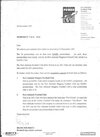
If Diane Pounsett said "Yeah, we own black and white" I don't suspect you'd accept this as gospel. We also don't know the contents of the "undated letter" and, quite clearly, the letter is referring specifically to AFL Premierships not to the legal entities or football clubs, except to clarify the premiership situations.
 
There are a lot of issues to consider in this debate that aren't just football related, since these clubs are also businesses and corporations.

First of all, personally I believe Port, like any AFL club, or any other elite sporting club in Australia, should have the right to choose whatever guernsey/jersey/uniform they wear. However, I also believe that no elite sporting club in Australia should be able to "steal" or "copy" the identity of another.

To most people who follow sport, we can easily tell the difference between Collingwood's traditional vertical stripes and Port's traditional vertical stripes. While they are both white on a black background and despite Collingwood having traditionally worn black stripes on white, both guernseys, from a sporting perspective, are distinct enough to tell the 2 apart in isolation.

However, if push came to shove and the issue were to be pursued legally, there is always the "reasonable person" that needs to be considered. This, ultimately, would be the person(s) who would need to be convinced that the guernseys and overall identities are not too similar.

There is the concept of "get-up" or "trade dress" (protecting businesses from competitors trying to "pass-off" their own products) in law, which considers the overall appearance of a product, not just the "details" of the design. We have seen this before with Kraft and Bega when Bega acquired the license from Kraft's Australian business, while a new company who licensed the Kraft brand separately was denied the right to the former Kraft's "get-up". There was also Cadbury's failed bid against Darrell Lea to prevent Darrell Lea (and probably by extension anyone else) from using purple for their chocolate products.

These cases revolved around two main questions: a) was there a distinct look-and-feel to the product exclusive to its owner and b) was that established look-and-feel infringed by the other.

What will complicate this issue, not just legally but within the "realm" of the Australian Football League, is the murky nature of determining the scope of consideration.

To understand things, we need to look at facts:
  • Collingwood FC were formed in 1892, were foundation members of the VFL (of which the AFL is a direct successor and intrinsically linked to) and have exclusively worn a black and white vertically-striped guernsey as its primary choice (and been known as the Magpies) since the first VFL season.
  • Port Adelaide FC were formed in 1870, were foundation members of the SANFL (then known as the SAFA) and joined the AFL in 1997, and had exclusively worn black and white vertically-striped guernseys (of several designs) as its primary choice (and been known as the Magpies) since 1902, wearing the "prison bar" design exclusively, in one form or another, for the periods of 1902-1922, 1928-1940 and 1953 until their AFL entry in 1997.
  • The AFL itself was formed in 1897 as the VFL and was originally exclusively contested by Victorian clubs and began expanding out of the state in 1982 (when SMFC moved to Sydney, NSW), before aggressively expanding nationally between 1987 and 1997 (the year in which PAFC joined the AFL).
  • The PAFC AFL entity is the same organisation that was founded in 1870, competed in the SANFL for over a century and then were admitted to the AFL in 1997.
  • The Collingwood AFL entity is the same organisation that was founded in 1892.
  • The AFL itself is the same organisation (or direct successor of such organisation) that was formed in 1897 and of which Collingwood was a foundation member.
  • A separate PAFC entity, the Port Adelaide Magpies FC, was created upon PAFC's AFL entry and competed in the SANFL, and was legally separate from the PAFC's AFL entity until late-2010 (when PAMFC was merged into PAFC). PAMFC, while assuming the former identity, branding and guernseys of PAFC (from their SANFL years) must be considered distinct from the PAFC proper.
  • The AFL, within reason and Australian law, has the right to set terms of entry into its competition (including the right to require a new club to avoid being too close to an existing club in identity, location, branding, etc.)
  • From 2007-2027, the AFL owns the trademark for a black and white vertically-striped guernsey with the AFL logo on the right breast.
  • The AFL also owns trademarks for most club branding and designs and has the right to license these as it sees fit.
  • The SANFL, nor any league excluding the VFL, is not considered as part of the lineage of the AFL.
There are further issues to consider, but these may not be factual (and therefore these are just my opinion):
  • The "Prison Bar" design, worn by PAFC and PAMFC in the SANFL, is geometrically and visually distinct from the vertically-striped design worn by Collingwood.
  • The black and white colours worn by both clubs are visually similar (if not identical).
  • Both clubs have at various points worn designs, guernseys and colours that are geometrically and/or visually similar to each other's own (including designs previously worn by the other club and those worn at the same time). However, at these times, the clubs were in different competitions at a time when exposure to both clubs at the time was either limited or unlikely.
  • There is no allegation, previous to the AFL entry of PAFC, that either club infringed the other's rights to the guernsey designs or colours.
  • PAFC was allegedly required to forfeit its right to wear black and white guernseys (including the Prison Bar design) and use of the Magpies nickname/mascot in the AFL due to its similarity to Collingwood.
  • Collingwood has allegedly, on some occasions, allowed PAFC to wear the Prison Bar guernsey and, on other occasions, denied such use.
  • The AFL allegedly has the right to allow or deny any club use of any guernsey, logo, etc., with or without reason.
  • Collingwood's "inversion" of colours in 2001 was a minor change to the design of the guernsey (from the front viewpoint especially) and in itself did not infringe on PAFC or any other club's designs and, further, was still visually distinct from all other club's guernseys.
  • Further to the above, Collingwood's "inversion" of colours did not affect it's "traditional" use of black and white vertically-striped guernseys, nor did it disqualify the need to distinguish Collingwood from PAFC.
  • While a number of teams within the AFL have similar colours (such as Collingwood's black and Carlton's navy, Melbourne's navy and red and Essendon's black and red, etc.), their designs are generally different enough as currently worn to be visually distinct from one another.
  • Often, even when colours are nearly identical (such as Geelong and Carlton both being navy and white, or Adelaide, Brisbane/Fitzroy and GC Suns wearing navy, red/maroon and gold), their designs are generally distinct enough to differentiate them.
  • Prison bar designs are, essentially, a vertically-striped design with the addition of a truncating bar at the top.
  • Where teams share the same design (such as Collingwood, Hawthorn and North Melbourne, or Essendon and Richmond), the colours are significantly different to one another.
  • There are a finite number of guernsey designs that have been worn at elite level - the main differentiator between clubs has traditionally been colours or the addition of other elements.
  • As the league expands over time, there is likely to be more similarities between teams which will need to be avoided, particularly if the league admits any other pre-existing teams.
  • For the majority of its history, the V/AFL has no precedent of 2 teams sharing both the same colours and guernsey design, nor nickname/mascot.
  • Requiring clubs to adopt new colours (in addition to or in lieu of their traditional ones) is an established practice in Australian sport when clubs are admitted to a new or higher league (Penrith and Cronulla in the NSWRFL, the Dolphins in the NRL, for example).
  • Unlike the NRL (formed in 1998 by the creation of the ARL-News co-owned NRL Partnership), for example, the VFL simply became the AFL by re-branding and, therefore, the AFL is a continuation of the VFL, rather than a distinct "national" league created for such purpose.
  • When guernseys and other merchandise is presented at retail, club logos and designs may be obscured, leaving club colours as the primary differentiator for buyers.
Having considered the above, these are my opinions on the debate:
  • Despite being established before Collingwood, PAFC's history in the AFL itself only dates back to 1997, while Collingwood's began a century-prior.
  • Based on the above, Collingwood had an incumbent "right" to black and white vertically-striped guernseys in the AFL which, until PAFC's admission, had previously been unchallenged.
  • In consideration of Collingwood's long-standing place in the AFL prior to the admission of PAFC, there should have been an amount of "protection" for Collingwood's identity upon the entry of PAFC, including exclusivity to the Magpies name and at least some element of their existing "trade dress". The terms and duration of this protection is unknown but assumed to be in perpetuity as it stands.
  • Further to the above, the AFL had assumed trademarks and licensing rights to club's identities and were, essentially, in control of these elements at the time of (and decades prior to) PAFC's admission to the AFL.
  • Having co-existed as separate, distinct entities in the AFL for over 25 years, the need for "protection" is lessened over time as both clubs have had plenty of time to distinguish themselves from each other and other clubs, and both clubs will continue to have those opportunities.
  • In the time between the AFL's expansion of the 1980s-1990s and the current, the AFL has assumed the role of the national league, rather than an expanded Victorian league. Having assumed a monopoly of elite football, the AFL should also begin to recognise the non-Victorian history of Australian football and its clubs from the other "top" leagues around the country (pre-AFL).
  • While the Magpie mascot and nickname should remain solely at Collingwood's discretion in the AFL (given their tenure in the V/AFL), there is likely scope, based on a common-sense "time and place" approach, for PAFC to be allowed more use of the Prison Bars and black-and-white colours should they want to, whilst not infringing upon Collingwood's long-standing use of the black and white colours, black and white vertically-striped guernseys.
My "time and place" approach suggestion:
  • The black and white "Prison Bars" guernsey will become exclusive for PAFC (i.e. Collingwood can't nick it).
  • The Prison Bars may be worn only for home games in SA (or, at least, anywhere but VIC), or for home finals or Grand Finals where PAFC is the designated home team (having "earnt the right" to wear it).
  • The Prison Bars may not be worn against Collingwood, except in the case of a Grand Final where PAFC is the designated home team (see above) against them.
  • The Prison Bars guernsey must be geometrically and visually distinct from a typical Collingwood guernsey and should feature a clear PAFC badge (to avoid as much potential "confusion" as possible).
  • PAFC should be discouraged from wearing an inverted Prison Bars guernsey which would similarly conflict with Collingwood's "traditional" black vertical stripes on white guernsey.
  • PAFC merchandise and branding will still feature teal and/or silver, with Collingwood still having the exclusive right to use black and white only.
  • Away, clash and other non-Prison Bars guernseys should still feature teal and/or silver.
  • There is also potential of the Prison Bars guernsey only being available from the club's own retail channels and not general channels, to help prevent "confusion".
tl;dr: Collingwood should have been protected back in 1997, should still have some protection now but PAFC should also be able to wear the PBs more often.
Really dont have a strong opinion on the topic but this is one of the most well thought out things Ive read on this site 👏🏽
 
Guernsey designs generally aren't "copyrighted" beyond the automatic protections under Australian law for designs of any type - what matters is the "trademark" which prevents another business or entity from profiting off of a registered mark or design. Collingwood cannot control what any other AFL club wears in the same way McDonalds can't make KFC workers wear magenta uniforms - the AFL can, however, say "Port can't wear a predominantly black and white vertically-striped guernsey" since they are the governing body (and essentially the franchiser) of the games in which Port play in the AFL.
Yes, I said it was ultimately up to The AFL, that's why Port are wearing the prison bars again, this year.
 
China deny anything happened at Tiananmen Square. Doesn’t mean it’s not true.
Whatever helps you sleep at night, champ.

The letter wasn't correct at the time and isn't correct (or relevant) now.

Gotta love these campaigners that think they know more about Port's history than those of us who have been following the club longer than they've been alive.
 
Whatever helps you sleep at night, champ.

The letter wasn't correct at the time and isn't correct (or relevant) now.

Gotta love these campaigners that think they know more about Port's history than those of us who have been following the club longer than they've been alive.
It was 100% correct at the time and it was correct to the club for about 14 years.

The only reason it wouldn’t be correct today is because the Power decided to kill the Magpies team by making it an AFL reserves side. The Magpies are virtually non-existent. All that exists today is an AFL team that’s won one Premiership.
This is just your opinion though. The fact is your club decided to rewrite history and everyone else can call a spade a spade but you can’t see that.

I feel sorry for all the diehard Magpies fans who hate the Power and the fact the AFL has destroyed their actual club.

You all like to go on and on about how much you care but when was the last team you actually went to an SANFL game?
 
Status
Not open for further replies.

Remove this Banner Ad

Remove this Banner Ad

🥰 Love BigFooty? Join now for free.

Back
Top Bottom