Remove this Banner Ad

Analysis Umpires

🥰 Love BigFooty? Join now for free.

Not necessarily. Hands can move at different speeds.

Say the left hand holding the ball goes above the head just fast enough the centrifugal force stops the ball falling out and the right hand moves to the ball at twice the speed, then the difference in speeds between the the hands is what will give the ball it's momentum.

On SM-F926B using BigFooty.com mobile app
and somehow people think umpiring is a difficult job.........
 
*Leigh Fisher exits the chat...

In regards to #22, I know it feels like he's biased when he does our games, but I've seen plenty of opposition supporters complain about him too, saying that he always makes calls against them. I'm getting the feeling that he's just not very good. Perhaps the speed of the game is too much for him, or his positioning is bad? I don't know, but it doesn't seem to be isolated to us.

The Freo supporters think he’s a cheat as well don’t worry about that, he’s done a couple of western derby’s[emoji6]


Sent from my iPhone using BigFooty.com
 

Log in to remove this Banner Ad

I guess it depends what you think needs to be 'clawed back' and why, i.e. what problem we are trying to solve. Are too many players getting away with throws as defined under the current law? Are players playing largely within the law but nevertheless getting rid of the ball 'too easily' (whatever we mean by that)? Is there some sort of lost art of a correct handball that we think needs to come back? Do we think the evolution & creativity of players to get rid of the ball in different ways but still within the law is a bad thing, and if so, why? Is it about the look? What exactly are we trying to fix?

Personally I think the first of that list probably needs improvement, but that doesn't require a law change. I'm not too fussed about the rest of it. If a player wants to handball over their head then good luck to them. It's a low percentage play since you can't see who's there, so it'll often end up being a turnover anyway. And would the game really be improved if Levi's handball for Murph's goal was deemed illegal because of, what, 'momentum'? Colour me unconvinced.
I don't think it's a change of the rule per se. I think the rule has always been that the ball must be punched from the holding hand with a closed fist.

What I'm saying is that when the hands are both moving in the same direction then it is no longer possible to discern which of the hands is actually imparting the momentum on the ball. So if the AFL "clarified" the rule, as they love doing for lots of other rules, then it simplifies things.

It's really obvious when both hands are moving. And I'm not referring to the 50/50's here, more the ones like the one in the gif from my previous post. There are loads of examples like that.

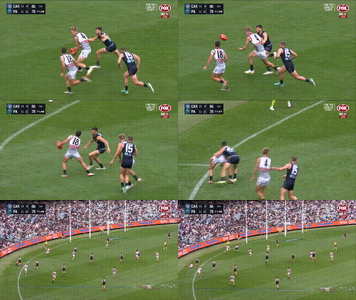
Here's another, even better one. Butters literally throws the ball underarm with his left hand and makes token contact with his right on the way through:
butters.gif

You can't tell me that this is what the original law makers of our game meant by a hand pass as the rule describes it.
 
I don't think it's a change of the rule per se. I think the rule has always been that the ball must be punched from the holding hand with a closed fist.

What I'm saying is that when the hands are both moving in the same direction then it is no longer possible to discern which of the hands is actually imparting the momentum on the ball. So if the AFL "clarified" the rule, as they love doing for lots of other rules, then it simplifies things.

But that's just it. The rule as it stands says nothing about how much momentum needs to be imparted by which hand. I'm not at all convinced that introducing momentum as a consideration would simplify things. It certainly wouldn't simplify the umpires' job since it would be one more thing to try to assess in the moment.

It's really obvious when both hands are moving. And I'm not referring to the 50/50's here, more the ones like the one in the gif from my previous post. There are loads of examples like that.

Here's another, even better one. Butters literally throws the ball underarm with his left hand and makes token contact with his right on the way through:
View attachment 1442212

No doubt there are obvious cases like the one you've shown. But there will be a lot more 50/50 cases. And the umpires will have to adjudicate each and every one. The thing about laws is that they're black & white -- either an action is OK or it's not. At the moment this particular line is clearly defined: the clenched fist must make contact with the ball. What is the alternative definition? How much momentum would need to be imparted by the holding hand for it to be considered illegal? 90% of the ball's total momentum? 50%? 10%? Whatever the answer, it introduces a degree of judgement / interpretation where previously the ruling was straightforward. That's the opposite of simplification.

IMO actions like this tend to be pretty low percentage plays anyway. It takes a fair bit of skill to impart momentum with the holding hand, make contact with the fist, all while in motion and probably at an awkward angle, and still get the ball to where you want it to go. Even in this case the pass doesn't hit the target. I think that places a natural limit on how often this sort of play is attempted. Players generally aren't going to do it when there's a safer option available.

You can't tell me that this is what the original law makers of our game meant by a hand pass as the rule describes it.

You're probably right. But I don't consider the original law makers (dare I say 'founding fathers'?) of the game to be the repositories of all wisdom. The game has evolved in innumerable ways since the original laws were set down. It's not clear to me why evolution in one specific area needs to be resisted.
 
I don't think it's a change of the rule per se. I think the rule has always been that the ball must be punched from the holding hand with a closed fist.

What I'm saying is that when the hands are both moving in the same direction then it is no longer possible to discern which of the hands is actually imparting the momentum on the ball. So if the AFL "clarified" the rule, as they love doing for lots of other rules, then it simplifies things.

It's really obvious when both hands are moving. And I'm not referring to the 50/50's here, more the ones like the one in the gif from my previous post. There are loads of examples like that.

Here's another, even better one. Butters literally throws the ball underarm with his left hand and makes token contact with his right on the way through:
View attachment 1442212

You can't tell me that this is what the original law makers of our game meant by a hand pass as the rule describes it.
Once upon a time the player would have hand balled with their left hand. Throwing it is an easier skill to learn
 
But that's just it. The rule as it stands says nothing about how much momentum needs to be imparted by which hand. I'm not at all convinced that introducing momentum as a consideration would simplify things. It certainly wouldn't simplify the umpires' job since it would be one more thing to try to assess in the moment.


No doubt there are obvious cases like the one you've shown. But there will be a lot more 50/50 cases. And the umpires will have to adjudicate each and every one. The thing about laws is that they're black & white -- either an action is OK or it's not. At the moment this particular line is clearly defined: the clenched fist must make contact with the ball. What is the alternative definition? How much momentum would need to be imparted by the holding hand for it to be considered illegal? 90% of the ball's total momentum? 50%? 10%? Whatever the answer, it introduces a degree of judgement / interpretation where previously the ruling was straightforward. That's the opposite of simplification.

IMO actions like this tend to be pretty low percentage plays anyway. It takes a fair bit of skill to impart momentum with the holding hand, make contact with the fist, all while in motion and probably at an awkward angle, and still get the ball to where you want it to go. Even in this case the pass doesn't hit the target. I think that places a natural limit on how often this sort of play is attempted. Players generally aren't going to do it when there's a safer option available.


You're probably right. But I don't consider the original law makers (dare I say 'founding fathers'?) of the game to be the repositories of all wisdom. The game has evolved in innumerable ways since the original laws were set down. It's not clear to me why evolution in one specific area needs to be resisted.
If you extend the evolution from the making of the rule to where we are now, another decade or so should see us as the third rugby code.
 
If you extend the evolution from the making of the rule to where we are now, another decade or so should see us as the third rugby code.

Hear hear!! This is exactly my point. Watering down this rule is changing a fundamental element of what makes our game distinct from every other sport.

But that's just it. The rule as it stands says nothing about how much momentum needs to be imparted by which hand. I'm not at all convinced that introducing momentum as a consideration would simplify things. It certainly wouldn't simplify the umpires' job since it would be one more thing to try to assess in the moment.

I think you're being a little obtuse here. The difference between a perfectly executed hand ball (think Greg Williams, Wayne Harmes, Bruce Doull etc etc) and these "tosses", is patently obvious.

No doubt there are obvious cases like the one you've shown. But there will be a lot more 50/50 cases. And the umpires will have to adjudicate each and every one. The thing about laws is that they're black & white -- either an action is OK or it's not. At the moment this particular line is clearly defined: the clenched fist must make contact with the ball. What is the alternative definition? How much momentum would need to be imparted by the holding hand for it to be considered illegal? 90% of the ball's total momentum? 50%? 10%? Whatever the answer, it introduces a degree of judgement / interpretation where previously the ruling was straightforward. That's the opposite of simplification.

Again, your percentages comment is clouding the argument. This is not a discussion about percentages.

Q: How much momentum should be imparted by the holding hand?
A: None! Zero! Nada!

Here's how I'd write the clarification: "When the umpire sees the holding hand moving in the same direction as the ball travels as part of a hand pass, then the umpire is to deem that the holding hand was used to create part or all of the ball's momentum and adjudicate the player's action as a throw, ie. illegal disposal.

IMO actions like this tend to be pretty low percentage plays anyway. It takes a fair bit of skill to impart momentum with the holding hand, make contact with the fist, all while in motion and probably at an awkward angle, and still get the ball to where you want it to go. Even in this case the pass doesn't hit the target. I think that places a natural limit on how often this sort of play is attempted. Players generally aren't going to do it when there's a safer option available.

I think you're selling professional sportsmen short here. Look at the St Kilda player example. He's being slung wildly, and yet manages to make sure that a) he gets a 15 metre "handpass", and b) that it lands where his teammate will be.

Why do cricketers prefer underarm as their throw of choice when trying to run out a player? Because it's the more accurate throw.

You're probably right. But I don't consider the original law makers (dare I say 'founding fathers'?) of the game to be the repositories of all wisdom. The game has evolved in innumerable ways since the original laws were set down. It's not clear to me why evolution in one specific area needs to be resisted.

This is also not a "founding fathers" thing. There used to be a thing called the "flick pass", but it was banned and only the hand pass remains. I think the folks who made that decision wanted to make the clear distinction between Australian Rules and every other so-called Football code.
 
Last edited:
Oh, and one more thing My Hat, as Sector 7G pointed out, the Butters example is one where the player can't use his non-preferred hand to execute a handpass, therefore the way the game is currently being adjudicated is diminishing the skills required to play the game. So it is actively reducing the quality of the game as a spectacle.

Players who can execute on both sides of their body should be rewarded for practicing/perfecting the skill; while those who can't should be disadvantaged. In exactly the same way that kicking is affected by the same mechanic.
 

Remove this Banner Ad

It shouldn't if you punch it, but the reality is that all the propulsion for the over over the head handball comes from the supporting hand, with the punching fist just touching the ball. Maybe I am just an old man howling at the moon but that is not a handball it is a throw.

We could just get rid of handball all together and just let players thrown the ball ( we are just about there) but then it makes it impossible to judge a dropping the ball free.
I've used this in games before, the ball is definitely propelled by the fist and not just touching the ball. Try and hit a target with an overhead handball with the fist barely touching, it's really difficult, you actually need to strike it pretty well for control or it just goes anywhere and yeah, that's a throw. grab a footy and give it a go, you definitely need to punch it and time it to make that kind of handball work.
 
Both hands are allowed to move together, providing one propels the ball with a fist.
didn't know that - let me go back and re-assess 55 years of watching footy............hold please...........
 
I've used this in games before, the ball is definitely propelled by the fist and not just touching the ball. Try and hit a target with an overhead handball with the fist barely touching, it's really difficult, you actually need to strike it pretty well for control or it just goes anywhere and yeah, that's a throw. grab a footy and give it a go, you definitely need to punch it and time it to make that kind of handball work.
Pretty easy to toss it over your head into space, especially if you run into an oncoming tackler, turn your back on them and just pop it over their head to a team mate .

Unless you are Kouta or Barry Round And can hold the ball in one hand it is nearly impossible to handball over the head with what would be a legal disposal 20 years ago
 
I think you're being a little obtuse here. The difference between a perfectly executed hand ball (think Greg Williams, Wayne Harmes, Bruce Doull etc etc) and these "tosses", is patently obvious.

You've cited the two extremes, and yes, no doubt the difference between those extremes is obvious. But think of it this way: the 'perfect' handball is at one end of the spectrum, the 'toss' is at the other. And in the middle there's everything else: imperfect, pressured, in motion, in the middle of a tackle, while being slung, while moving the holding hand to get the ball into position, while moving hands to avoid an opposition smother, while moving hands to break your fall, while moving hands because you've changed your mind halfway through the pass, etc etc etc.

My point is that umpires need to adjudicate everything, not just the extremes. And you can pretty much guarantee there'll be plenty of cases in the middle that just aren't obvious, just like there are for all those other rules that people complain about the umpiring of every week.

Again, your percentages comment is clouding the argument. This is not a discussion about percentages.

Q: How much momentum should be imparted by the holding hand?
A: None! Zero! Nada!

Here's how I'd write the clarification: "When the umpire sees the holding hand moving in the same direction as the ball travels as part of a hand pass, then the umpire is to deem that the holding hand was used to create part or all of the ball's momentum and adjudicate the player's action as a throw, ie. illegal disposal.

I mean, you could write the rule that way, but I'm not sure you'd like the result. Players often raise or extend the holding hand just before a handpass purely to get the ball in the right spot to be punched. I imagine there are plenty of near-perfect handpasses where in fact 5-10% of the ball's momentum has come from that positioning movement of the holding hand. If the umpire's brief is zero tolerance for the slightest amount of holding hand momentum then it's going to have pretty significant ramifications.

But let's suppose that that's the rule and you can't impart any momentum with the holding hand. What if your whole body is in motion and that imparts momentum? That pretty much has to be OK because it will be the case every time a player is running. So then what else is OK? Bodily momentum due to being tackled and slung? Momentum from diving in a particular direction (which could be done to evade a tackle or could be done solely to gain that extra momentum)? Twisting your upper body so that it's not just your arm imparting momentum?

I'm not saying all this just to be picky. These are the real world scenarios that will confront umpires in every game, and there are probably more besides because you just know that clubs and players will try to find an edge. It needs to be clear to umpires and fans alike what should be called in each situation. So maybe raising the ball into position for the pass is OK but giving it extra momentum beyond that is not. Then the umpire has to judge in every case whether the positioning action of the holding hand was 'too much'. Obvious in some cases, sure, but definitely not obvious in others.

I think you're selling professional sportsmen short here. Look at the St Kilda player example. He's being slung wildly, and yet manages to make sure that a) he gets a 15 metre "handpass", and b) that it lands where his teammate will be.

Why do cricketers prefer underarm as their throw of choice when trying to run out a player? Because it's the more accurate throw.

Even low percentage plays come off sometimes. We'd need a larger sample size to really make a data-based assessment, but in the absence of that I still feel it's a low percentage play.

I wouldn't think the relative merits of cricket throwing actions have much relevance here. Funnily enough, a better comparison would be rugby throws, given the similarly sized ball. I don't watch much rugby so am happy to be corrected on this, but I don't recall seeing a lot of one-handed underarm passes in rugby unless the receiver is standing quite close to the passer. It doesn't seem to be the passing method of choice for anything requiring distance and accuracy.

Oh, and one more thing @My Hat, as @Sector 7G pointed out, the Butters example is one where the player can't use his non-preferred hand to execute a handpass, therefore the way the game is currently being adjudicated is diminishing the skills required to play the game. So it is actively reducing the quality of the game as a spectacle.

Players who can execute on both sides of their body should be rewarded for practicing/perfecting the skill; while those who can't should be disadvantaged. In exactly the same way that kicking is affected by the same mechanic.

I've mentioned already that I see the Butters action as low percentage, so I'd say there's already a reward / disadvantage mechanism in place. If he was able to pass with his other hand then he'd have a better chance of hitting his target.

As for reducing the spectacle of the game, I guess that's a matter of opinion. I'm not sure too many people's first thought on seeing the Butters pass was that it wasn't a good enough spectacle.
 
You've cited the two extremes, and yes, no doubt the difference between those extremes is obvious. But think of it this way: the 'perfect' handball is at one end of the spectrum, the 'toss' is at the other. And in the middle there's everything else: imperfect, pressured, in motion, in the middle of a tackle, while being slung, while moving the holding hand to get the ball into position, while moving hands to avoid an opposition smother, while moving hands to break your fall, while moving hands because you've changed your mind halfway through the pass, etc etc etc.

My point is that umpires need to adjudicate everything, not just the extremes. And you can pretty much guarantee there'll be plenty of cases in the middle that just aren't obvious, just like there are for all those other rules that people complain about the umpiring of every week.

I mean, you could write the rule that way, but I'm not sure you'd like the result. Players often raise or extend the holding hand just before a handpass purely to get the ball in the right spot to be punched. I imagine there are plenty of near-perfect handpasses where in fact 5-10% of the ball's momentum has come from that positioning movement of the holding hand. If the umpire's brief is zero tolerance for the slightest amount of holding hand momentum then it's going to have pretty significant ramifications.

But let's suppose that that's the rule and you can't impart any momentum with the holding hand. What if your whole body is in motion and that imparts momentum? That pretty much has to be OK because it will be the case every time a player is running. So then what else is OK? Bodily momentum due to being tackled and slung? Momentum from diving in a particular direction (which could be done to evade a tackle or could be done solely to gain that extra momentum)? Twisting your upper body so that it's not just your arm imparting momentum?

I'm not saying all this just to be picky. These are the real world scenarios that will confront umpires in every game, and there are probably more besides because you just know that clubs and players will try to find an edge. It needs to be clear to umpires and fans alike what should be called in each situation. So maybe raising the ball into position for the pass is OK but giving it extra momentum beyond that is not. Then the umpire has to judge in every case whether the positioning action of the holding hand was 'too much'. Obvious in some cases, sure, but definitely not obvious in others.

This is all true, but the reality is that when moving the ball forward/the way your body is facing, the fist is going to give it far more momentum than the holding hand anyway. So most of those are going to be legal simply because they're the ones where the rule advantages the player.

As Thy and others have said, it's the one over the head and also the double handed scoop off the ground that are the immediately obvious ones. And on top of those, you have the ones like the examples I've shown here, holding hand moving in one direction, punching hand perpendicular and making token contact on the way through. They're all pretty easy to adjudicate I would think.


Even low percentage plays come off sometimes. We'd need a larger sample size to really make a data-based assessment, but in the absence of that I still feel it's a low percentage play.

I wouldn't think the relative merits of cricket throwing actions have much relevance here. Funnily enough, a better comparison would be rugby throws, given the similarly sized ball. I don't watch much rugby so am happy to be corrected on this, but I don't recall seeing a lot of one-handed underarm passes in rugby unless the receiver is standing quite close to the passer. It doesn't seem to be the passing method of choice for anything requiring distance and accuracy.

That's because rugby allows them to actually use two hands to throw the ball, and two hands are always going to be more accurate/controlled.

I've mentioned already that I see the Butters action as low percentage, so I'd say there's already a reward / disadvantage mechanism in place. If he was able to pass with his other hand then he'd have a better chance of hitting his target.

As for reducing the spectacle of the game, I guess that's a matter of opinion. I'm not sure too many people's first thought on seeing the Butters pass was that it wasn't a good enough spectacle.

By reduction in the spectacle, I mean losing the art of a genuinely well-executed handball, and also the sense of wonder at the ability of players who execute these skills seamlessly on either side of their body. I also mean, as Thy has alluded to, the reduction of our game to the level of rugby; a game that I personally find impossible to watch.

And just as an aside, while the Butters' example may indeed be low percentage, he was actually able to escape the much more significant penalty of getting caught holding the ball, or dare I say it, disposing of it illegally; resulting a free/clearing kick to Carlton, rather than a 50/50 boundary throw-in.
 
This is all true, but the reality is that when moving the ball forward/the way your body is facing, the fist is going to give it far more momentum than the holding hand anyway. So most of those are going to be legal simply because they're the ones where the rule advantages the player.

As Thy and others have said, it's the one over the head and also the double handed scoop off the ground that are the immediately obvious ones. And on top of those, you have the ones like the examples I've shown here, holding hand moving in one direction, punching hand perpendicular and making token contact on the way through. They're all pretty easy to adjudicate I would think.

'Far more momentum' -- yes, quite true. But that's different to the 'zero holding hand momentum' rule you suggested earlier. So now we're back to square one: I still don't know what is the new ruling / interpretation that we tell umpires to look for.

I feel that this discussion has fallen into a bit of a cycle. You say 'look at these obvious examples', I say 'yes, but what about the grey areas -- how and where do you draw the line?', you say 'yes, but look at these obvious examples', etc. Bottom line for me I guess is that unless and until I hear a solid and workable proposal for how to define and adjudicate the grey area, I'm not going to be in favour of a rule change.

That's because rugby allows them to actually use two hands to throw the ball, and two hands are always going to be more accurate/controlled.

I'd suggest that the above applies to our discussion as well. IMO two hands are always going to be more accurate / controlled even when one of the hands is punching, particularly when a player has spent years learning and honing that skill.

By reduction in the spectacle, I mean losing the art of a genuinely well-executed handball, and also the sense of wonder at the ability of players who execute these skills seamlessly on either side of their body. I also mean, as Thy has alluded to, the reduction of our game to the level of rugby; a game that I personally find impossible to watch.

And just as an aside, while the Butters' example may indeed be low percentage, he was actually able to escape the much more significant penalty of getting caught holding the ball, or dare I say it, disposing of it illegally; resulting a free/clearing kick to Carlton, rather than a 50/50 boundary throw-in.

Fair enough. No doubt different people find different things appealing as a spectacle or not. Personally I'm no fan of rugby either, but I don't feel that our game has been diminished by the evolution of the handball. Changed, yes, but IMO we've had gains as well as losses.

The fact that we're starting to repeat ourselves is probably a sign that this discussion has run its course. Appreciate the conversation, happy to leave it as agreeing to disagree.
 

🥰 Love BigFooty? Join now for free.

'Far more momentum' -- yes, quite true. But that's different to the 'zero holding hand momentum' rule you suggested earlier. So now we're back to square one: I still don't know what is the new ruling / interpretation that we tell umpires to look for.

I've been thinking about this, based on our discussion and so let me just say one more thing to try to clarify.

I'm not talking about the minor movements that a holding hand can and does make during the act of a handball. For example, the slight forward motion as the player leans into it, the wavering because one is being tackled/jostled etc etc. So these would never be called, and therefore don't represent a grey area for the umpire to adjudicate. Remember, I did say the hands moving "relative to each other".

I am instead referring to the holding hand moving because of a full swinging arm:
  1. In an underarm motion (Butters), or;
  2. An across the body sling with minimal fist contact (Gresham), or;
  3. A double-handed toss over the head (many players in the AFL), or;
  4. A double-handed scoop off the ground (again, many players in the AFL).
In all of these examples, the holding hand is moving just as much as - and sometimes more than (a la Butters and Gresham) - the punching hand; and they are very easy for the umpires to identify.

In each of these cases it is either patently obvious that the holding hand is providing the ball's momentum or it is impossible to tell whether the holding hand or fist is creating the momentum. I firmly believe that the spirit of the definition of a handball is that the fist provides all of the momentum for the ball, with the holding hand only influencing direction.

And if the AFL get back to that, then we get to hold on to a skill/art that only exists in our game and therefore makes it unique.

My biggest concern is that these "tosses", like the double-hander off the ground - that you refer to as "evolution of the handball" - taken to their logical extreme, will result in actual rugby tosses becoming acceptable, because "why not?". And then there'll be nothing left that makes Aussie Rules unique.
 
Can the AFL just start dishing out fines for players who blatantly throw the ball? Throwing the ball is cheating, if the umps miss it, why not fine the players?

Things need to be put in place to make officiating AFL games easier, start giving real fines to players who dive, stage and throw and players who constantly complain to umpires.

Seems like an easy fix to me.
 

Remove this Banner Ad

Analysis Umpires

🥰 Love BigFooty? Join now for free.

Back
Top