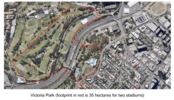
Populous, Herzog & de Meuron + Architectus, GMP (Gerkan, Marg & Partners) + Blight Rayner Architecture, and Warren and Mahoney are reportedly the four bids in contention for the principal architect partner position who will design the stadium according to the Courier Mail.
Four firms shortlisted for Victoria Park’s Brisbane 2032 stadium design - Des Houghton
Four firms shortlisted for Victoria Park’s Brisbane 2032 stadium design - Des Houghton
The Queensland firm that designed the 2012 London Olympic stadium is one of four teams shortlisted for the 2032 Brisbane Olympic stadium at Victoria Park.
Populous is considered a frontrunner by Brisbane architects because it has also recently completed the Kai Tak Sports Park in Hong Kong and the Tottenham Hotspur Stadium in London.
Kai Tak has a 50,000-seat stadium with a retractable roof, a separate 10,000-seat indoor arena, a school, a gallery, a hotel and community sports and recreational zones.
Kai Tak was inspected recently by Deputy Premier and Infrastructure Minister Jarrod Bleijie and Minister for Finance and Trade, Ros Bates, prompting speculation in the halls of power that the mega-park may offer a glimpse of what to expect at Victoria Park.
The new Tottenham Hotspur stadium in North London, has a seating capacity of 62,850, the same number the IOC requires for Brisbane.
Populous has other runs on the board. It designed the 69,500 seat Prince Moulay Abdellah Stadium in Rabat, in partnership with Moroccan firm Orange Atelier.
But Populous is no certainty to win the $3.8bn project.
Herzog & de Meuron, an international architectural firm based Switzerland, has teamed with Queensland firm Architectus, led by Dr Stephen Long, for a Brisbane entry. Herzog & de Meuron designed the Bird’s Nest stadium for the 2008 Beijing Olympics and won acclaim recently for designing the 70,000-seat Allianz Arena in Munich with a fluoropolymer plastic skin known as Ethylene tetrafluoroethylene, or ETFE, that changes colour.
Sports Minister Tim Mander said yesterday Queenslanders would be amazed when the winning scheme was unveiled. “Victoria Park is such a great site. It will be fantastic. I am confident that Queenslanders will see the stadium design and say, wow!
“When this stadium is constructed, Queenslanders will be very proud.’’
Little is known about the plans because the designs are still under wraps by the Brisbane Games Independent Infrastructure and Coordination Authority (GIICA) until the winner is announced early next year.
And like an Olympic sprint final the winner could come from an outside lane.
German firm Gerkan, Marg & Partners (GMP) has stunned the architectural community in recent years with a set of 20 “robust yet poetic” stadiums in China, Brazil, and South Africa. It has teamed with Brisbane’s Blight Rayner Architecture.
A New Zealand firm Warren and Mahoney is also in the mix.
The Brisbane Stadium will host the opening and closing ceremonies and athletics in 2032.
Mr Bleijie is looking past the Olympics.
“The Brisbane Stadium will deliver a new home for cricket, the Brisbane Lions and concerts, with world-class infrastructure and global event potential.”
Mac Stirling, the Brisbane architect who designed Lang Park with PDT Architects and HOK Sport said new building technologies have taken stadium construction to another level.
“It is time for Brisbane to be proud, to be excited by the amazing palette of 2032 Olympic Stadium venues which will soon be presented to us.
“The evolution of new technologies over the last decade or so have meant that the international stadiums of today, and for the future, are interactive and incredibly exciting entertainment hubs.
“Fully integrated digital technology enables patrons to connect from their seat directly to other Olympic venues i.e sitting watching the athletics in the new Olympic Stadium and live streaming, in real time, the Olympic swimming finals!
“The new stadiums are integrated in both light and sound, placing the spectators in an envelope of excitement, which includes the event of course.
“More than this, the global stadiums of today from London, Germany and the USA, are fully integrated community hubs. It is not just about sport but about lifestyle, passive recreation, new age urban design, education and environmental interaction.
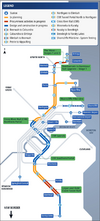
“The fact that Brisbane has three key stadiums ideally positioned close to each other and fully integrating with the public transport networks of heavy rail, light rail, bus, car and bike, will result in a seamless integration between venues. The mix of the RNA upgrade with the Olympic Village, the new Olympic Stadium and National Aquatic Centre provides a fantastic community opportunity which no other capital city can emulate.”
Last edited: