


MWPP
Flying High


- Joined
- Jul 5, 2011
- Posts
- 49,764
- Reaction score
- 120,366
- Location
- The Stadium in the Sky
- AFL Club
- West Coast
- Other Teams
- NZ, Scorchers

Every season, the race for the Top 4 is treated as the ultimate objective of the home-and-away schedule. We talk about the safety net, the insurance policy, and the statistical path to a Grand Final.
But looking closely at the historical ledger, the double chance is frequently an illusion.
I have conducted a full statistical audit of every finals series since the current Top 8 structure was introduced in Season 18. Across these 23 seasons, a Top 4 seed has failed to win a single finals game and exited in straight sets 22 times from a possible 46 times.
When looking at the numbers, the volatility of specific seeding reveals that your finals destiny is largely determined by which side of the bracket you land on.
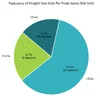
Frequency of Straight Sets Exits
Beyond individual seeding, an analysis of the macro-frequency per finals series reveals how consistently these collapses disrupt the bracket. Across the 23-season data set, a completely clean upper bracket is a relative anomaly, occurring in only 5 seasons (21.7%) where zero top-four teams suffered a straight-sets exit. The overwhelming structural norm is a single breakdown, with exactly 1 team crashing out in 14 separate finals series (60.9%). The remaining 4 seasons (17.4%) represent periods of maximum upper-bracket carnage, where systemic vulnerability peaked and 2 top-four teams were eliminated in straight sets simultaneously.
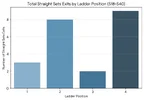
Probability by Home & Away Position
A thorough statistical audit of straight-sets exits across the 23 seasons of the modern top-eight structure reveals that the double chance is a highly volatile metric. During this period, a top-four seed has entered the finals and exited without a single win on 22 occasions. The risk of this catastrophic failure is not uniformly distributed across the top-four seeding. A clear risk hierarchy exists, with teams finishing 4th place being the most vulnerable, having exited in straight sets 9 times, accounting for 39.1% of all seasons. They are followed by the 2nd-place position, which has seen 8 exits (34.8%). Conversely, finishing 3rd appears to offer the greatest structural protection, with only 2 straight-sets exits (8.7%) recorded, followed by the 1st-place position with 3 exits (13.0%).
S34 Expansion Shift
When the league expanded in Season 34, the competitive balance changed. I split the data into Pre-Expansion (S18-S33, 16 seasons) and Post-Expansion (S34-S40, 7 seasons) to see if getting a double chance became harder or easier. Look at how the "choke rate" per season shifted:
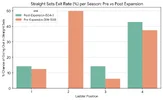
The data can be split into two distinct eras to analyze the impact of league expansion. During the pre-expansion era (S18–S33, 16 seasons), a remarkable statistical anomaly existed regarding the 2nd-place seeding. A team finishing 2nd went out in straight sets on 8 separate occasions, meaning a massive 50.0% of seasons saw the 2nd seed choke immediately. During this same 16-season period, 4th place followed with 6 exits (37.5%), while 1st saw 2 exits (12.5%) and 3rd place was almost entirely immune, recording just 1 exit (6.3%).
Following the league expansion in Season 34 (S34–S40, 7 seasons), the competitive landscape and finals strategy shifted dramatically. The most significant finding from this era is the complete eradication of the 2nd-place curse. Over these seven seasons, no 2nd-placed team has gone out in straight sets, meaning the vulnerability dropped to 0.0%. In contrast, the danger associated with 4th place intensified, climbing to 3 exits over just seven years, which is a 42.9% rate, making it the most lethal spot post-expansion. Both 1st and 3rd place recorded 1 exit each (14.3%), illustrating that while the structural protection of 3rd place lessened slightly, the primary risk now firmly resides with the 4th seed.


