


Chief
~ Shmalpha ~


- Staff
- #1
Shill Bidding on eBay: a Case Study
With a critical comment on the mechanics of eBay’s auction platform
31 March 2009; last revised 3 August 2009
Synopsis
The purpose of this narrative is to demonstrate that:
very little of the auction system security, that eBay claims to offer buyers, exists in fact;
contrary to their claim, it can be demonstrated that eBay has no “sophisticated” nor “proactive” system in place for the detection of undisclosed vendor (“shill”) bidding and indeed appears to do nothing about such criminal activity except as a reaction to a user’s report of suspicious bidding activity;
eBay appears to have no effective matter-of-course verification of users; unscrupulous users can apparently have as many user IDs as they may have email addresses;
many of eBay’s “rules”, concerning the retraction of bids, cancellation of auctions, etc, are nominal only and are no bar to the machinations of the unscrupulous seller;
as a result, eBay’s “proxy” bidding system is so open to abuse by such unscrupulous sellers that to use it, as eBay intends it to be used, can be an invitation to pay your maximum;
the lack of any such effectual security effectively “aids and abets” unscrupulous shill-bidding sellers to defraud naïve buyers;
the masking of user IDs with non-unique, absolutely anonymous, bidding aliases serves little other purpose than to obscure such shill bidding;
the quarterly changing of even these non-unique, absolutely anonymous, bidding aliases serves absolutely no other purpose than to stop experienced eBay users from tracking suspicious bidding activity over time;
the anonymous, individual bidder Bid History Detail pages, supposedly supplied to offset the absolute masking of bidding IDs, can present an ambiguous view and are therefore of dubious value;
anyone naïve enough to “nibble” bid on a seller-elected “private” auction (ie, “User ID kept private”), on the balance of probability, is going to be defrauded;
when suspected fraud is reported, and is found by eBay to be proved to their satisfaction, eBay will conceal that fact from the victim of the fraud; this then is the concealing of a crime after the fact, surely, a crime in itself;
eBay will never acknowledge to a victim that a fraud has been perpetrated, nor indeed will they acknowledge that such fraud is even a problem on eBay; eBay therefore sees no reason to provide any mechanism to aid in the recovery of any monies so defrauded;
if eBay did have any truly sophisticated and proactive system in place for the detection and control of shill bidding, we undoubtedly would not now be having this debate; and
for those buyers (and honest sellers) who embrace eBay believing that eBay acts as an “honest broker” between buyer and seller, I can only say that there are fairies at the bottom of your garden too.
Foreword
The original, very brief, version of what has developed into this detailed criticism of eBay lasted only about three hours before it was pulled from the eBay Australia “Round Table” forum—that alone should make it worthy of a read.
eBay is a listed public company; it’s only reason for being is to maximise the wealth of its stockholders, and on the basis of any improved performance is calculated the “performance” bonuses paid to the senior executives who make the decisions that produce any such improvement in wealth. Needless to say the top executives of eBay are currently not receiving any performance bonuses.
Some cynics even suggest that recent events in the world of commerce would indicate that the purpose of such public companies is actually to maximise the wealth of the managing executives; that any consideration for stockholders is incidental. Now, how could anyone possibly get that impression?
Regardless, in attempting to maximise that performance, eBay should not be allowed to knowingly facilitate the defrauding of the “buying” users of its service by those unscrupulous shill-bidding “selling” users, nor conceal such crime after the fact—which can be demonstrated to be presently the case.
eBay has most successfully exploited the internet; I think then that it is appropriate that that same medium be used to expose eBay for what it, as a public company, has become—or, possibly, has always been.
As well as one can from the outside, I have examined the detail of eBay’s auction mechanism. Much of what I see I do not like. I think that eBay’s effective facilitating, and subsequent deliberate covering up, of fraud on its buyers by unscrupulous sellers, is outrageous and needs never to be forgotten, and users should maintain pressure on eBay via the media and the various governmental consumer affairs regulators until eBay desists from such unconscionable behaviour.
And, please don’t misinterpret my reasons for publishing this criticism of eBay. I enjoy dabbling on eBay and I wish eBay no harm but I don’t like what eBay’s management is doing (or not doing) with eBay. It’s the principle of the matter that drives me.
I am predominantly a buyer and so these comments are primarily from a buyer’s perspective; the problems honest sellers have with eBay, frankly, are simply too many for a mere “buyer” to comprehend and deserve their own narrative.
Frankly, I have to wonder, where are all the consumer affairs regulators in this matter? Has eBay “bought” them all? I had the impression that the days of the unscrupulous “robber barons” were long gone, at least in the first-world countries. Apparently, I was wrong: it appears that our old friend Gordon Geko is alive and well and at the helm of the good ship “eBay”.
This is a “living” document. I will update it from time to time as more holes are found in eBay’s “clunky” auction structure. If anyone (including eBay) would like to dispute any of the facts that I here present or the conclusions that I drawn therefrom, or if anyone can point out any other flaws in the eBay auction system, and would prefer to communicate directly, my email address is formset@exemail.com.au.
I would also ask anyone who has noted a suspicious pattern of bidding on any auctions, that have ended within the past 90 days, to supply me with the auction numbers and the ID of the suspect bidder.
Introduction
Partially obscured by eBay’s introduction of “hidden bidders”, undisclosed vendor bidding (ie, “shill” bidding) now appears to be running rampant on eBay. Never before has so many “newby” IDs (and some not so new) been seen bidding on multiple items from the same sellers. And these are only the naïve shill bidders that are the only ones that can now be detected. With the introduction of “hidden bidders” (particularly in the non trackable “Bidder x” form still is use in the UK) I think that it can be said that the more sophisticated shillers can now go about their craft with effectively no risk of detection.
This case study initially involved two auctions from the same seller and I believe it demonstrates beyond any doubt that—contrary to eBay’s claims—eBay does not have any “proactive” system—let alone a “sophisticated” system—for the detection of even such blatantly obvious and naïve shill bidding as contained in the following several examples and, again, such examples can only reinforce the conclusion that, notwithstanding eBay’s statements about shill bidding being prohibited on eBay (it’s fraud and therefore it’s a crime, anyway), eBay appears to be concerned about shill bidding only to the extent that they cannot obscure it totally without appearing to be even less principled than they already appear to be, that is, without going into negative values for the measurement of such matters.
Auction 1
Seller ID: salguerosartsngifts
Auction Nr: 350181526972
Auction ended: 29 March 2009; 15:28:18
The “bid history” details that suggest that this underbidder is a shill are:
At that point the underbidder would also have understood that only one more incremental bid was required for him to win the item; but he did not make that one more bid. What then is the chance that this underbidder is not a most naïve and blatant shill bidder? Absolutely none!
In this particular instance the only genuine bidder’s bid was artificially increased from the starting price of $49.00 to the bidder’s final maximum proxy bid value of $205.00, and the effect is that the buyer was defrauded of the difference, $156.00.
And, what then about the many other items from this same seller that it is indicated that this same underbidder placed bids on but undoubtedly failed to win?
Have a look at the below auction Bid History page (Fig 1) which displays one of the most blatant and naïve examples of “nibble” shill bidding that could possibly be observed, and then have a look at the “Bid History Detail” page for this underbidder (Fig 2) whose masked alias was at the time “h***r (133)”, but will be different in real time next quarter. (I’ve not been able to find an eBay announcement regarding this periodic changing of these already masked aliases, nor the reason they give therefor; the cycle of change appears to be quarterly.)
Fig 1: Auction 1 “Bid History”


Fig 2: The underbidder’s “Bid History Details”

Auction 2
Seller ID: salguerosartsngifts
Auction Nr: 350181570367
Auction ended: 29 March 2009; 20:41:20
In this subsequent auction, that finished five hours later, the shill made 25 nibble bids and stopped his nibble bidding at $200.00 and the high bidder won the item at $202.50.
Knowing from the previous auction that the same genuine bidder had bid a maximum of $205, the shill obviously thought it prudent to not go the whole hog again. Still the buyer was defrauded of a further $153.50.
And still the genuine bidder did not tumble to what was going on. But have no fear, eBay with their “sophisticated, proactive” shill-bidding detection tools will protect us, after all “shill” bidding is prohibited on eBay; we know that because eBay tells us so!
Fig 1A: Auction 2 “Bid History”


Auction 3
Seller ID: salguerosartsngifts
Auction Nr: 350210763708
Auction ended: 16 June 2009
This same seller appears to be still at it (see Figs 3, 4, 5, below); the underbidder “_***9”, a newby, is, on the balance of probability, another naive shill; of the 17 items that he has bid on, 11 of them are from this one same seller, all of different types of goods. On this auction, it’s only a petty single-bid shill, but the point is that with “hidden bidders” the more sophisticated shillers are now undetectable, and eBay is, in effect, knowingly aiding and abetting them.
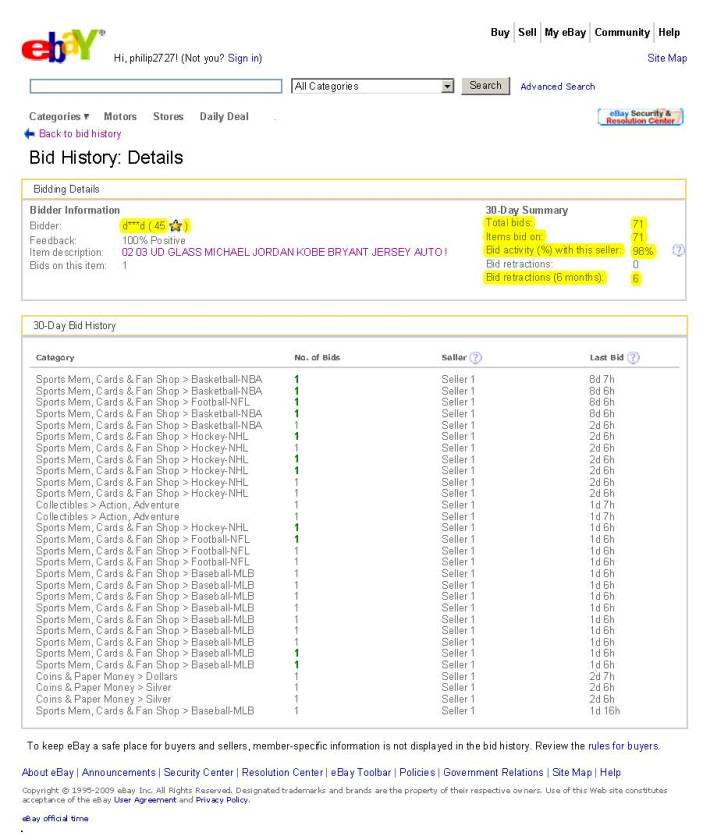
In this instance the shill has been bidding on more than one sellers’ items. eBay does not flag this seller’s auctions in the bidder’s 30-Day Bid History list—we have to try and work that out by ourselves, and it is only possible to ascertain that the shill is bidding on eleven of this seller’s items by tediously comparing the item “category” on the Item page with that of items on the Bid History Detail page, and even then they don’t match exactly, the Item page indicates the category is “Antiques > Furniture > Chairs” while the only possible match in the Category column on the Bid History Details page is a truncated item description “Antiques > Chairs”. How much more ambiguous and/or obscure can eBay make it?
This seller is still trading on eBay (albeit without any more blatantly obvious shill bidding from bidder “h***r”; but we can’t be sure of that as we cannot ascertain the shiller’s unique anonymous ID, so we can’t look up his feedback, nor track him over time). And, not even restricted to fixed-price selling. Let’s face it, eBay cannot afford to de-register all the shill bidders, as I suspect such an action would have a noticeable detrimental effect on their bottom line, and more importantly, those executive performance bonuses: you know, those “performance” bonuses that they aren’t presently getting—because they aren’t performing!
Fig 3: Auction 3 “View Item” page

Fig 4: Auction 3 “Bid History” page

Fig 5: Auction 3 “Bid History Detail” page

The generalities of the matter
This ever diminishing transparency of the bidding process serves only one purpose and that is to obscure matters, the effect of which, if not deliberately to aid and abet the fraudsters, is to hide such activity so that eBay does not have to do anything about it. But, then, if you don’t know that you are being defrauded, what’s the worry?
Let’s not bother asking eBay why they cannot proactively detect such blatantly obvious shill bidding activity from such damning statistics because most of us already know that eBay simply is not concerned about shill bidding—it has, per se, no detrimental effect on eBay’s “bottom line”—at least not in the short term. The long term, surely, will be another matter. One can only conclude that, so long as such abuse of the system is not noticed and reported by users, eBay sees no problem—for them that is! An unconscionable attitude: quite unbelievable—well, maybe not!
With respect to enabling genuine bidders to protect themselves from shill bidders, the current periodically-dynamic alias (ie, “a***b”) is only marginally better than the original, outrageous, absolutely anonymous, per-auction dynamic alias (ie, “Bidder x”) that was previously in use (and is still in use on the UK site).
I would not then be surprised if the next devious step by eBay in “solving the problem of shill bidding” was the removal of the bidder’s accompanying feedback count so that, in combination with the periodic changing of these masked aliases and the fact that these aliases are not unique and may therefore be duplicated, it would then be impossible for anyone to track a suspected shill bidder over any period of time. Even with the supposed balancing of the lack of uniqueness of these aliases by the addition of the feedback count it is still possible, however unlikely, to have two bidders with the same alias.
The shill-bidding seller with a little more “grey matter” can very easily develop bid histories for his shilling IDs (arrange feedback too, with some like-minded friends) and rotate them during the (too short) 30-Day Summary period.
And, now that the “winning” bidder also has been masked, other alert users cannot easily warn an unsuspecting “winner” that they have been taken to the cleaners. (And is it not strange that, notwithstanding the reasons given by eBay for the masking of the “winning” bidder elsewhere, in the UK the “winning” bidder was not there similarly anonymised until six months later in May 2009? And what does that tell us about the genuineness of eBay’s given reasons?)
Although an experienced eBayer would undoubtedly notice and be concerned about the activity of the underbidder in these two particular auctions, many unsuspecting buyers (including the winner of both these auctions) will not realize that they are being defrauded.
Also copied below is the “Bid History Details” page (Fig 6) for this same shill bidder as it appears seven weeks later on 21 May. Notice that all the 30-Day Summary and Bid History information that was previously so suggestive of shill bidding is no longer present. This shows how limited is the value of this information and how simple it is for an unscrupulous seller of any sophistication to manipulate same over a relatively short period of time.
The winning bidder’s “Bid History Details” page (Fig 7) indicates that he had the misfortune to bid on and ultimately win two items from this seller, “Seller 1” in this case. Notice that the data presented could lead some to think that he could be a shill for the seller.
eBay spends a great deal of PR effort in the media and elsewhere trying to convince users of the “security” of their system and that eBay is “a safe place to trade”. It would therefore be unfair to call anyone who makes use of eBay’s “proxy” bidding system to early-on lodge a maximum value bid, a fool; I would simply say that, given that eBay’s proxy bidding system is so clearly open to abuse by unscrupulous sellers, you would have to at least be naïve to the ways of eBay to do so.
The outrageousness then of this situation is that if a genuine bidder does not make the effort (and it is an effort) to dig into the other bidders’ individual Bid History pages and therefore is not made aware of (or, due to the sophistication of the shilling, cannot be made aware of) and does not report any suspicious activity, then eBay does nothing! That deserves repeating, eBay does nothing!
In three of these four studied auctions the human brain can very easily ascertain—beyond any doubt—that the underbidders are shills. I can appreciate that it is not simply a matter of a bit of “if, then” analysis of the auction data for eBay to produce an effective “shill probability” evaluation that could be applied to all bidders so that buyers could be more easily forewarned of any possible underlying untoward activity, but eBay has had many years to do something about this scourge on their system and, demonstrably, they have chosen to do nothing!
Much is said about the sensing of IP addresses. What would be the point: a matching IP address is not necessarily a definitive indicator of shill bidding: you could, for example, be on a dial-up connection, sharing the same IP address as your ISP; nor does everyone on a broadband connection necessarily have a static IP address. A matching IP address should be only one indicator that may indicate untoward activity. Such primitive record matching is probably what eBay refers to as their “sophisticated” tools. If the various user forums are anything to go on, eBay wrongly accuses many users of shill bidding on this basis.
The winning bidder’s “Bid History Details” page (Fig 7) indicates that he had the misfortune to bid on (and he ultimately won) two items from this seller, “Seller 1” in this case. Notice also that the data presented could actually lead some to think that this winner could be a shill for the seller. What better example does one need to appreciate that such data, when viewed in isolation on individual pages as it is currently presented, is of dubious value?
It’s “bidding patterns”, not simply the matching of IP addresses (or the presentation of potentially ambiguous data), that best exposes the various levels of likelihood of shill bidding: a shill could just as easily be operating from another country. The detection of such patterns requires that an algorithm of some sophistication be applied to the “live” data. The simple fact is, eBay, notwithstanding (or because of) its dominance of the industry, offers its buyers no such effective protection (some would suggest just the opposite). And that really should be unacceptable.
Fig 6: Auctions 1 and 2 underbidder’s “Bid History Details” +50 days

Fig 7: Auctions 1 and 2 winner’s “Bid History Details”

Bid retraction
Any practical examination of this bidding system will expose how easy it is for unscrupulous sellers and their shills to manipulate the system: the shill only has to “ask” his shill-master if he may retract his then highest winning bid to reinstate the previously highest bidder as the winner.
To be fair to the other genuine bidders, any such highest bid retraction should void all other bids by that bidder, and any other genuine bidders’ highest bid(s) should revert to what they would have been had all the voided bids never been made—and the other bidder(s) notified accordingly. If that was the case such “nibble” shill bidding would be pointless (unless multiple shill bidders were involved), but eBay’s final value fee (FVF) may then be somewhat reduced and we can not have that now, could we?
But, apparently, this is not the case; if a then highest bid is retracted all that bidder’s other lesser bids still remain effective, and the underbidder becomes the high bidder once again at his last automatic “proxy” bid.
This is a mechanism that is grossly unfair to “buyers” and is, in effect, the aiding and abetting of fraud on them—and eBay knows it …
Further, I am led to believe that a “mutually agreed” retraction of a bid is not recorded on a bidder’s Bid History Details page as a “Bid retraction”: only unilaterally withdrawn bids are so recorded! If indeed this is the case, what purpose then does that statistic (that may be of interest to a seller) serve for buyers who have to look at these pages to try to protect themselves from the shill bidders and where any bids that have been retracted by a shill will, of course, be “mutually agreed”? If this indeed is the case, that is simply one more of eBay’s disingenuous and deceptive mechanisms that buyers have to suffer.
Of course, the only time that such a bid retraction would appear be of any real concern to eBay is the mutually agreed retraction of a winning bid after the auction has ended, thus voiding the sale and putting at risk eBay’s “final value fee” (FVF).
Can an unscrupulous seller ascertain a high bidder’s maximum proxy bid without resorting to nibbling? Yes, and it’s even easier and less obvious: the shill simply places a ridiculously high bid, he is then displayed as the winning bidder, one increment above the proxy maximum of the previous highest bidder, he then retracts his high bid with an excuse such as “incorrect amount”. Some time later he then places another bid at or just below that maximum proxy amount of the genuine bidder. Of course, it would look less suspicious if the shill used yet another ID to place the subsequent bid.
And eBay would have us believe that this proxy system is secure—secure for them, maybe.
Auction cancellation
Another trick that can also be used by the unscrupulous seller is to “cancel all bids and end auction early” (Fig 8). That way the seller can get a good indication of what someone may be prepared to pay the next time the item is listed because, would you believe, when an auction and bids are so cancelled, eBay’s system then publishes not the highest “placed” bid(s), but the actual maximum bid amounts that the bidders were prepared to pay!
What possible purpose could the publishing of bidders’ maximum bid amounts serve other than to disadvantage them? Unbelievable. Not only are these people at eBay disingenuous, they are stupid too. You will notice also that this particular seller is also using eBay’s classic, seller-selected, shill bidders’ tool, “private listing – bidders’ identities’ protected”. (Anyone who wins an item from such a seller is, on the balance of probability, going to be defrauded.)
Fig 8: A “Bid retraction and cancellation history” page

Detection of shill bidding
For anyone that is interested, there is a brief discussion on “Using Data Mining to Detect Fraud in Auctions” at http://www.tgc.com/dsstar/00/0627/101834.html, vis:
http://www.abc.net.au/science/articles/2005/10/05/1467138.htm
This article is dated October 2005, and gives some indication of the attitude of the online “auctioneers” to this problem (being somewhat akin to the old Monty Python “dead parrot” skit); in particular the attitude of the major player, eBay, who has apparently consistently ignored Dr Trevathan’s advances.
I have corresponded with Dr Jarrod Trevathan from the Discipline of IT, School of Business, James Cook University, Queensland, Australia who, with Wayne Read, claims to have developed algorithms that would proactively help to detect and control such shill bidding, and I quote Trevathan:
http://citeseerx.ist.psu.edu/viewdoc/summary?doi=10.1.1.61.7728
http://citeseerx.ist.psu.edu/viewdoc/summary?doi=10.1.1.61.7072.
Clearly, this is the course that a principled organisation would be taking to detect and control the scourge of shill bidding, and it is a sad reflection on the ethics of eBay that they appear totally disinterested in doing so.
Indeed, it appears that eBay is not prepared to acknowledge that shill bidding is a problem at all, I presume because to do so, and to then allocate resources to the task of doing something effective about it, may detrimentally affect their “bottom line”. Why else is any mention of specific cases of obvious shill bidding usually removed so quickly from the eBay forums? Yes, I know, “privacy”. Even general discussions of shill bidding that expose eBay’s disingenuousness in this matter are usually removed. The fact is, with the introduction of “hidden bidders,” sophisticated shills now have sufficient “privacy” to practice their craft with absolutely no fear of detection.
In eBay’s “phony” war on shill bidding, eBay regularly reminds us that they have access to much more information (ie, registrant information such as users’ unique static IDs, email addresses, IP addresses, credit card / bank account numbers, etc) than the genuine bidder can ever have access to. Indeed, eBay does have all the records necessary to detect with some certainty all but the most sophisticated examples of such criminal activity; yet it can be demonstrated that eBay chooses to do nothing proactively, and will only act after a user, on the basis of the much more limited information available to them, reports a suspicious pattern of bidding.
If you have ever reported any suspicious bidding activity, you may recall that, if eBay cannot confirm to their satisfaction that anything untoward has taken place, they will advise you of that finding; however if the activity is such that even eBay cannot overlook it, then they may get the “feather” out and take some action—who knows what—but they will not tell you anything! Why is that so? Because they don’t want to actually admit that shill bidding is taking place. This is effectively the concealing of a crime after the fact, surely, a crime in itself.
On a seller-elected “private” auction (ie, “User ID kept private”), there is no way to ascertain if you are bidding against a “fly on the wall” as eBay supplies no information from which a genuine bidder could make such a judgment. Suffice to say that you may notice that a “private” auction will usually have a far higher number than usual of bids thereon which, on the balance of probability, indicates that someone is most probably being defrauded—and eBay knows it;
Clearly, these auction examples demonstrate that eBay does not have any “sophisticated” tools for the detection and control of shill bidding; it would appear that their only “tool” is some primitive post-auction data matching of records between seller and bidder(s), and then only if a user reports the matter. If there is no report, or no matching data, and there won’t be if the shill is at all smart, then there is no problem …
And then, even when there is matching data, blatant offenders are given multiple thrashings with the feather (“because people are basically honest …”) before any serious, albeit temporary, sanction is applied. I suspect that the people behind an “ID” are truly banned only when there is media coverage of such criminal activity—and it is criminal.
I could even accept that eBay has no idea of how much shill bidding goes on. How would they know? Demonstrably, they have no proactive nor sophisticated tools to evaluate the problem. And why would they care anyway: successful shill bidding increases their final value fee (that is, when stuff sells these days), and unless a user reports suspicious bidding activity, it’s no problem for eBay—indeed, it’s an asset!
Defending against the shill bidder
The point then is not simply that a bidder should “bid only what he is prepared to pay” but that they should never lodge a maximum value “proxy” bid early on in the auction, and only bid a maximum bid at the latest practicable moment, for to do otherwise can be an invitation to indeed pay the maximum that the bidder has indicated that he is prepared to pay. Of course, “sniping” defeats the concept of the open bidding process that one expects at an “auction” and turns it into the equivalent of a closed tender process.
Then, some have suggested that it is Captain Donahoe’s intention to kill off auctions in favour of fixed-price sales. I can only say that, when eBay runs their last auction, will someone please remember to turn out the lights.
“Hidden Bidders”
This is formally referred to by eBay as “Safeguarding Members’ Identities” (SMI). Some people naively believe eBay’s story that eBay introduced “hidden bidders” to, and I quote, “help keep the eBay community safe, enhance bidder privacy, and protect our members from fraudulent emails”.
This reason was always patently disingenuous: the problem of fraudulent “Second Chance Offers” (SCO), or any other scam emails, being targeted directly to underbidders or winners was effectively solved by eBay’s blocking of access to users’ direct email addresses.
I have never received a fraudulent SCO. The only SCO that I have ever received was a “genuine” one that resulted from a seller’s failed attempt to shill bid me higher on a piece of unique artwork by an artist whose surname just happened to also be part of the previous user ID (traceable at that time) of the winning bidder who subsequently “did not pay”. Needless to say, when I reported the matter to eBay, eBay reported that they could see no connection.
And, I am not interested in hearing the nonsensical story about people who, even after access to users’ direct email addresses was blocked, were supposedly still being taken in by fraudulent text messages being sent to them via the eBay text messaging system. You would have to be a total idiot to be taken in by such a text message from another “registered” (ho, ho, ho, see “Verification of users” below) user who was identifiably not the seller, and such a user’s mental defect should not be eBay’s problem.
The fact is that the replacing of the unique bidding ID with a non-unique ID makes it impossible for users to track suspicious activity by sophisticated shill bidders. Even with the additional information that has been supplied in lieu (the Bid History pages), it is now only possible to detect suspicious bidding by particularly naïve shill bidders.
eBay could have just as easily have used a unique alias; but then users would have been able to keep track of suspected shill bidders over time, and I suspect that that does not suit eBay.
And, of course, the latest devious action by eBay—if you have not already noticed—is the periodic (quarterly?) changing of even these non-unique, masked, bidding aliases, ie, “a***b”. (The “Bidder x” form of alias, still in use in the UK, already changes every auction!)
What possible purpose then does the periodic changing of this already anonymously masked bidding alias serve? Absolutely no purpose, other than to make it impossible for genuine bidders to keep track of suspected shill bidders over any extended period of time.
The introduction of “hidden bidders” has also stopped third-parties (eg, Goofbay) from providing sophisticated “shill probability” analysis services to eBay buyers—a service that eBay itself should be providing to protect its consumers, but doesn’t.
The conclusion then must be that “hidden bidders” never had any purpose other than to do what, in fact, it does do: obscure all but the most naïve of shill bidding and stop the tracking of such activity over time, so that eBay can avoid having to waste any of their valuable resources doing anything effective about it. Indeed, in October 2008 eBay announced 1600 redundancies to come mainly from customer service.
Having said that, eBay’s introduction of the convoluted “Bid History” pages, supposedly to offset the masking of bidder IDs, at least makes it marginally easier to spot the habitual, blatant, naïve, shill bidder. But even that information, presently contained in separate pages, could have been more effectively presented, as is suggested further below.
“Winning” bidders also hidden
Then there is the equally disingenuous reason given for the subsequent further anonymising of the “winning” bidder also. Once again, as eBay has blocked access to users’ direct email addresses, a winning bidder is no more likely to receive a scam email targeted directly to them than is any other registered eBay user. Indeed, regardless, a winning bidder is still going to receive the same non-targeted scam “eBay” emails that even non-eBay users regularly receive. The masking of winning bidders therefore, serves no other purpose than to simply further obscure matters.
eBay’s classic shill bidders’ tool: the “private” auction
This is another outrageous, devious, eBay device: the seller-selected “User ID kept private”; what I describe as eBay’s “classic shill bidders’ tool”. If ever a device shouted “I am a cheat and if you bid on this auction I am going to cheat you”, this is it—and eBay knows it.
Now that all bidders are anonymous, what possible purpose can be served by eBay retaining this devious device—other than to continue to enable unscrupulous sellers to completely obscure their shill bidding? And, if ever there was a totally useless “Bid History” page, this is it (see Fig 9).
Even sans the “private” auction, who then would want to go to the trouble of looking up a seller’s feedback to try to identify a buyer of a particular item? And then, even if you found the buyer, you still have only an anonymous user ID and a vague geographic location; you still don’t know who the buyer actually is; you could, of course, then send them a message through the eBay messaging system, and ask them who they are, but why would anyone bother?
If a buyer is so concerned about their privacy maybe they could choose to have “private” feedback (if that is indeed the purpose of choosing to have private feedback). When the seller chooses such “privacy”, I say, buyer beware, on the balance of probability, if you bid on such an auction you are going to be taken to the cleaners.
Surely, only the most naïve of buyers would “nibble” bid on such an auction; then, such naïve buyers are probably the ones who are the least likely to notice that they may be being shilled. If the eBay forums are any indication, some don’t even know what shill bidding is, let alone that it appears to occur much more often than eBay would acknowledge.
The only purpose that was ever really served by eBay’s introduction of “private” auctions was the aiding and abetting of unscrupulous sellers to hide their shill bidding activity, and I have no doubt that this device has always been given a great deal more use by shill-bidding sellers than by any seller genuinely concerned about the “privacy” of the buyer.
You have to ask the question, can the people running this organisation all be so incompetent, negligent, or simply stupid? Surely, those at the top cannot all be so handicapped, and therefore the reason for the creation of such a devious device has to be simply disingenuousness and unscrupulousness.
Fig 9: Private auction “Bid History” page

Verification of users
There is, as a matter of course, no verification of users on eBay; any verification that there is, is of a secondary nature. That is, a “seller” will at least have to supply details of a bank account or credit card from which eBay will draw its fees (likewise to open a PayPal account). Whereas, an unscrupulous seller, never intending to actually buy or pay for any items bid upon with his shilling ID(s), pays no eBay fees and has no need for a PayPal account, and will therefore, apparently, never be “verified” in any way, and can therefore have as many “bidding” IDs as he may have email addresses.
Shills can develop a bid history by simply bidding early on every 99c item that they come across (even it they won a one, no seller actually wants to sell a 99c item at that price; too much unpaid effort involved in dispatching same).
Conspiring users can even develop a feedback count by “buying” 99c items from each other, but no money actually changes hands so not even a secondary eBay “verification” results therefrom. Some are even blatant enough to advertise for such feedback on the internet, see
http://www.getafreelancer.com/projects/marhber_458813.html
Buyers should therefore be particularly wary of bidding against any bidder with zero or very low feedback as this could be an indication that the ID has not been “verified”.
Does anyone think it is ever likely that eBay would consider showing whether or not a bidder had been “verified,” by at least such a signing up for PayPal? I doubt such a move would be contemplated as it would not immediately improve eBay’s bottom line.
A comment on the structure of the “Bid History” pages
Because of the anonymity of the information on bidders’ Bid History “Details” pages and, particularly, the “rolling” nature of a bidder’s 30-Day Summary and Bid History list, this information can be of dubious value: there is no way of knowing even if any of the auctions in the list are still current or have ended; only, apparently, that the bidder is/was winning an auction (the green numerals) at some stage in the past 30 days; what purpose does that serve if you don’t know if the auction is current or not? And of what value is the “Last Bid” time, again, when you don’t know if the auction is current or not? And how are we supposed to know which of the anonymously listed sellers is the seller in the particular auction? Or is that simply another deliberate hurdle placed in the path of genuine bidders trying to protect themselves? And what purpose does such anonymity of seller serve anyway—other than to obscure matters?
Bear in mind that, alone, a high percentage of “Bid activity (%) with this seller” may or may not be an indicator of shill bidding: 100% of bid activity on only one auction with this seller, may not be significant; 100% of a total of 190 bids (on 41 auctions) with one seller only is obviously very significant. Certainly, as the number of auctions of the seller that a bidder is bidding on increases, regardless of the number of bids on each auction, the probability that it could be shill bidding increases.
I wonder why it is then that eBay does not also supply that simple statistic (ie, “Items bid on with this seller”), nor why it is that they do not directly identify the seller in the “30 Day Bid History” list (you have to try and figure that out yourself)? Could I be so cynical as to suggest that the information is supplied in such a clumsy format deliberately so as to make it as difficult as possible for genuine bidders to work it all out?
Bear in mind also that it is usually not possible to identify a shill with any great degree of certainty; it can usually only be “proved” on the “balance of probability”: that’s good enough for the civil courts. However, having said that, in some instances the shill bidding is so blatant that not only it can be proved “beyond reasonable doubt” but “beyond any doubt,” as is the case with the auctions 1, 2 and 4, the subjects of this study.
Unfortunately, the sophisticated shill can very easily work around this 30-day cycle (see Fig 6, above) and develop appropriate bid histories for his shill IDs under such a scheme. Completed auction data is available online for 90 days and, clearly, these Bid History Details summaries should cover, at least, that same 90-day period, but eBay supplies only a 30-day summary. I wonder why? Regardless, the Bid History “list” contains a maximum of only 30 items.
All bidders are now completely anonymous so that it is impossible to check a bidder’s feedback for any historical indications of untoward activity with a particular seller. We are now limited solely to the information supplied on the Bid History Detail page—a retrograde step if ever there was one.
All in all, these Bid History pages are a shambles that, in my humble opinion, could only have been designed by either a disingenuous or thoughtless person. If they were not deliberately designed to obfuscate the issue, that certainly is the effect.
Frankly, I think that these Bid History Detail pages, as they are currently presented, can be ambiguous in the extreme, can, at a glance, too easily give a false impression that a genuine bidder is a shill, and they are undoubtedly doing more damage to eBay, in the eyes of buyers, that even eBay deserves. (Well, maybe they deserve it anyway, for their total disregard for their consumers.)
Now, if eBay had actually intended that this information be of any real value in making it easier for buyers to notice at least the suspicious patterns of bidding of the naïve shill bidders, instead of burying this information on multiple pages, deep where many won’t see it, they could have, just as easily, also included the most material of this bidder information on the primary “Bid History” page (see Fig 9); and some of that same material information for the current high bidder could have also been included on the primary Item View page to aid in exposing a shill bidder who has surreptitiously set a “reserve” (see Auction 4 below).
Fig 9: What a primary “Bid History” page should have contained

But, as I have previously stated, the facts suggest that “hidden bidders” was most likely introduced primarily to obscure all but the most blatant of shill bidding, because that is the only shill bidding, sans exposure in the media, that eBay will do anything about, so I would not hold my breath waiting for anything logical to emerge. eBay management is presently too busy trying to figure out how they can get the quarterly financials to give the appearance that eBay is actually making progress; when, of course, most regular eBay users know the very opposite is now the case …
Auction 4: The surreptitious shill setting of a “reserve”
Seller ID: nobledepaul99
Auction Nr: 160344678456
Auction ended: 5 July 2009
As a matter of interest, this auction (see Figs 10, 11, 12, below) is an example of a shill bidder (“d***d”) who uses a single shill bid to surreptitiously set a “reserve” on his own auctions, in this case $899 (a “losing” type value bid). Such additional information about the current high bidder on the Item View page would have immediately exposed such suspect activity. And, most of the individual Bid Histories of the bidders on this particular auction look somewhat abnormal to me. …
The winning bidder, “s***m” ultimately paid USD909. Figure 11 shows that the next highest genuine bid (by “e***e”) was USD300. Had the shill reserve not been set by the seller, which falsely gave the impression that there was interest in the item by others, the buyer may well have won the item at one increment above that amount (ie, USD310), which means that the winner was effectively defrauded of USD599.
Now, I know that some may say that the buyer paid no more than he was prepared to pay, and to that I can only respond that if you think that that is the way a sale by auction is supposed to work then you are undoubtedly qualified for a job at eBay—assuming that you are not already working for eBay (or you are a shill-bidding seller).
Not all eBay sites are the same, for instance, in the US it appears that a seller can put a reserve on almost any item (for a fee, of course), whereas in Australia a reserve can only be placed on items in the Motors category. Not that the unscrupulous sellers would worry about that as they prefer to surreptitiously set a reserve with a shill bid; that way they can also, dishonestly, represent that there is other interest in the item.
Fig 10: Auction 4 “View Item”

Fig 11: Auction 4 “Bid History”

Fig 12: Auction 4 “Bid History Detail”
In conclusion
eBay’s has ever had a disingenuous attitude to the crime of shill bidding, and eBay has either deliberately (or stupidly) exacerbated the situation with the introduction of “hidden bidders”, and undoubtedly this action will hurt both the honest sellers and eBay itself in the long term. Unfortunately, the good Captain Donahoe and his subordinate officers are apparently intellectually incapable appreciating this. (My God, have any of these people ever actually bought or sold anything on eBay? Do they have any understanding of what “eBay” actually is?)
Then, eBay is still making a lot of money, very easily, too easily, apparently, to be worried about their de facto facilitating, and the later deliberate concealing, of such noticed fraud on their users. But, the financial accounts of this public company are now indicating that the chickens are starting to come home to roost, and the indications are that it is not simply the economic situation but the poor decision making of these unscrupulous and/or incompetent executives that is tipping this once-greater company down the toilet. Of course, the eBay shareholders have every right to allow this downward spiral to continue but, in the meantime, eBay should not be knowingly aiding and abetting nor concealing the defrauding of its buying consumers.
The Australian Competition & Consumer Commission (ACCC), assuming that they actually read and understood the gist of my earlier submission to them on “hidden bidders” [link thereto], has expressed the opinion [link thereto] that the eBay auction operating structure is “sufficiently transparent” and therefore not something that they are prepared to do anything about. Obviously, they have a peculiar idea of what the word “transparent” means. So much for the protection of consumers from unscrupulous traders and their facilitators. And what about all the other consumer protection agencies throughout the rest of the world? Are they doing anything? Apparently not.
Regrettably, in the final analysis, when you peel away all the eBay “spin”, eBay is exposed as a greedy, most unscrupulous, disingenuous and unprincipled organisation that is quite prepared to do absolutely anything (or nothing) to protect its “bottom line”, and is quite happy to “aid and abet” unscrupulous shill-bidding sellers to defraud consumers, because they are not prepared to waste any of their valuable resources to do otherwise. eBay simply has no incentive to remove fraudsters from their “bulletin board” because these fraudsters contribute to eBay’s revenues, and if users don’t notice any such untoward activity, then eBay does nothing. Quite unconscionable!
Now, if eBay did invest in an effective proactive algorithm for the detection of shill bidding then they could probably get rid of most of the remaining (2000?) “trust and safety” staff that are presently employed doing non-income-producing manual investigations of user reports of same, or whatever they do do. (Hello, did I hear John’s ears prick up?) That might even help to rebuild the confidence of eBay users … (Even an expanded primary Bid History “report”, as suggested above would be a great improvement on the present state; but I won’t hold my breathe, obviously, there are far too many more cosmetic changes still to be made …)
For people buying on eBay, eBay is definitely no longer “a safe and fun place to trade.” Not that it ever actually was that, but it’s simply much less safe now.
With a critical comment on the mechanics of eBay’s auction platform
31 March 2009; last revised 3 August 2009
Synopsis
The purpose of this narrative is to demonstrate that:
very little of the auction system security, that eBay claims to offer buyers, exists in fact;
contrary to their claim, it can be demonstrated that eBay has no “sophisticated” nor “proactive” system in place for the detection of undisclosed vendor (“shill”) bidding and indeed appears to do nothing about such criminal activity except as a reaction to a user’s report of suspicious bidding activity;
eBay appears to have no effective matter-of-course verification of users; unscrupulous users can apparently have as many user IDs as they may have email addresses;
many of eBay’s “rules”, concerning the retraction of bids, cancellation of auctions, etc, are nominal only and are no bar to the machinations of the unscrupulous seller;
as a result, eBay’s “proxy” bidding system is so open to abuse by such unscrupulous sellers that to use it, as eBay intends it to be used, can be an invitation to pay your maximum;
the lack of any such effectual security effectively “aids and abets” unscrupulous shill-bidding sellers to defraud naïve buyers;
the masking of user IDs with non-unique, absolutely anonymous, bidding aliases serves little other purpose than to obscure such shill bidding;
the quarterly changing of even these non-unique, absolutely anonymous, bidding aliases serves absolutely no other purpose than to stop experienced eBay users from tracking suspicious bidding activity over time;
the anonymous, individual bidder Bid History Detail pages, supposedly supplied to offset the absolute masking of bidding IDs, can present an ambiguous view and are therefore of dubious value;
anyone naïve enough to “nibble” bid on a seller-elected “private” auction (ie, “User ID kept private”), on the balance of probability, is going to be defrauded;
when suspected fraud is reported, and is found by eBay to be proved to their satisfaction, eBay will conceal that fact from the victim of the fraud; this then is the concealing of a crime after the fact, surely, a crime in itself;
eBay will never acknowledge to a victim that a fraud has been perpetrated, nor indeed will they acknowledge that such fraud is even a problem on eBay; eBay therefore sees no reason to provide any mechanism to aid in the recovery of any monies so defrauded;
if eBay did have any truly sophisticated and proactive system in place for the detection and control of shill bidding, we undoubtedly would not now be having this debate; and
for those buyers (and honest sellers) who embrace eBay believing that eBay acts as an “honest broker” between buyer and seller, I can only say that there are fairies at the bottom of your garden too.
Foreword
The original, very brief, version of what has developed into this detailed criticism of eBay lasted only about three hours before it was pulled from the eBay Australia “Round Table” forum—that alone should make it worthy of a read.
eBay is a listed public company; it’s only reason for being is to maximise the wealth of its stockholders, and on the basis of any improved performance is calculated the “performance” bonuses paid to the senior executives who make the decisions that produce any such improvement in wealth. Needless to say the top executives of eBay are currently not receiving any performance bonuses.
Some cynics even suggest that recent events in the world of commerce would indicate that the purpose of such public companies is actually to maximise the wealth of the managing executives; that any consideration for stockholders is incidental. Now, how could anyone possibly get that impression?
Regardless, in attempting to maximise that performance, eBay should not be allowed to knowingly facilitate the defrauding of the “buying” users of its service by those unscrupulous shill-bidding “selling” users, nor conceal such crime after the fact—which can be demonstrated to be presently the case.
eBay has most successfully exploited the internet; I think then that it is appropriate that that same medium be used to expose eBay for what it, as a public company, has become—or, possibly, has always been.
As well as one can from the outside, I have examined the detail of eBay’s auction mechanism. Much of what I see I do not like. I think that eBay’s effective facilitating, and subsequent deliberate covering up, of fraud on its buyers by unscrupulous sellers, is outrageous and needs never to be forgotten, and users should maintain pressure on eBay via the media and the various governmental consumer affairs regulators until eBay desists from such unconscionable behaviour.
And, please don’t misinterpret my reasons for publishing this criticism of eBay. I enjoy dabbling on eBay and I wish eBay no harm but I don’t like what eBay’s management is doing (or not doing) with eBay. It’s the principle of the matter that drives me.
I am predominantly a buyer and so these comments are primarily from a buyer’s perspective; the problems honest sellers have with eBay, frankly, are simply too many for a mere “buyer” to comprehend and deserve their own narrative.
Frankly, I have to wonder, where are all the consumer affairs regulators in this matter? Has eBay “bought” them all? I had the impression that the days of the unscrupulous “robber barons” were long gone, at least in the first-world countries. Apparently, I was wrong: it appears that our old friend Gordon Geko is alive and well and at the helm of the good ship “eBay”.
This is a “living” document. I will update it from time to time as more holes are found in eBay’s “clunky” auction structure. If anyone (including eBay) would like to dispute any of the facts that I here present or the conclusions that I drawn therefrom, or if anyone can point out any other flaws in the eBay auction system, and would prefer to communicate directly, my email address is formset@exemail.com.au.
I would also ask anyone who has noted a suspicious pattern of bidding on any auctions, that have ended within the past 90 days, to supply me with the auction numbers and the ID of the suspect bidder.
Introduction
Partially obscured by eBay’s introduction of “hidden bidders”, undisclosed vendor bidding (ie, “shill” bidding) now appears to be running rampant on eBay. Never before has so many “newby” IDs (and some not so new) been seen bidding on multiple items from the same sellers. And these are only the naïve shill bidders that are the only ones that can now be detected. With the introduction of “hidden bidders” (particularly in the non trackable “Bidder x” form still is use in the UK) I think that it can be said that the more sophisticated shillers can now go about their craft with effectively no risk of detection.
This case study initially involved two auctions from the same seller and I believe it demonstrates beyond any doubt that—contrary to eBay’s claims—eBay does not have any “proactive” system—let alone a “sophisticated” system—for the detection of even such blatantly obvious and naïve shill bidding as contained in the following several examples and, again, such examples can only reinforce the conclusion that, notwithstanding eBay’s statements about shill bidding being prohibited on eBay (it’s fraud and therefore it’s a crime, anyway), eBay appears to be concerned about shill bidding only to the extent that they cannot obscure it totally without appearing to be even less principled than they already appear to be, that is, without going into negative values for the measurement of such matters.
Auction 1
Seller ID: salguerosartsngifts
Auction Nr: 350181526972
Auction ended: 29 March 2009; 15:28:18
The “bid history” details that suggest that this underbidder is a shill are:
- Bidder Information
Bids on this item: 34 [‘nibble’ bids to ascertain the genuine bidder’s proxy bid maximum]
30-Day Summary
Total bids: 190 [That’s a lot of ‘nibbling’]
Items bid on: 41 [And all from only one seller!]
Bid activity (%) with this seller: 100% [Maybe it’s a Wal-Mart outlet?]
At that point the underbidder would also have understood that only one more incremental bid was required for him to win the item; but he did not make that one more bid. What then is the chance that this underbidder is not a most naïve and blatant shill bidder? Absolutely none!
In this particular instance the only genuine bidder’s bid was artificially increased from the starting price of $49.00 to the bidder’s final maximum proxy bid value of $205.00, and the effect is that the buyer was defrauded of the difference, $156.00.
And, what then about the many other items from this same seller that it is indicated that this same underbidder placed bids on but undoubtedly failed to win?
Have a look at the below auction Bid History page (Fig 1) which displays one of the most blatant and naïve examples of “nibble” shill bidding that could possibly be observed, and then have a look at the “Bid History Detail” page for this underbidder (Fig 2) whose masked alias was at the time “h***r (133)”, but will be different in real time next quarter. (I’ve not been able to find an eBay announcement regarding this periodic changing of these already masked aliases, nor the reason they give therefor; the cycle of change appears to be quarterly.)
Fig 1: Auction 1 “Bid History”


Fig 2: The underbidder’s “Bid History Details”

Auction 2
Seller ID: salguerosartsngifts
Auction Nr: 350181570367
Auction ended: 29 March 2009; 20:41:20
In this subsequent auction, that finished five hours later, the shill made 25 nibble bids and stopped his nibble bidding at $200.00 and the high bidder won the item at $202.50.
Knowing from the previous auction that the same genuine bidder had bid a maximum of $205, the shill obviously thought it prudent to not go the whole hog again. Still the buyer was defrauded of a further $153.50.
And still the genuine bidder did not tumble to what was going on. But have no fear, eBay with their “sophisticated, proactive” shill-bidding detection tools will protect us, after all “shill” bidding is prohibited on eBay; we know that because eBay tells us so!
Fig 1A: Auction 2 “Bid History”


Auction 3
Seller ID: salguerosartsngifts
Auction Nr: 350210763708
Auction ended: 16 June 2009
This same seller appears to be still at it (see Figs 3, 4, 5, below); the underbidder “_***9”, a newby, is, on the balance of probability, another naive shill; of the 17 items that he has bid on, 11 of them are from this one same seller, all of different types of goods. On this auction, it’s only a petty single-bid shill, but the point is that with “hidden bidders” the more sophisticated shillers are now undetectable, and eBay is, in effect, knowingly aiding and abetting them.
In this instance the shill has been bidding on more than one sellers’ items. eBay does not flag this seller’s auctions in the bidder’s 30-Day Bid History list—we have to try and work that out by ourselves, and it is only possible to ascertain that the shill is bidding on eleven of this seller’s items by tediously comparing the item “category” on the Item page with that of items on the Bid History Detail page, and even then they don’t match exactly, the Item page indicates the category is “Antiques > Furniture > Chairs” while the only possible match in the Category column on the Bid History Details page is a truncated item description “Antiques > Chairs”. How much more ambiguous and/or obscure can eBay make it?
This seller is still trading on eBay (albeit without any more blatantly obvious shill bidding from bidder “h***r”; but we can’t be sure of that as we cannot ascertain the shiller’s unique anonymous ID, so we can’t look up his feedback, nor track him over time). And, not even restricted to fixed-price selling. Let’s face it, eBay cannot afford to de-register all the shill bidders, as I suspect such an action would have a noticeable detrimental effect on their bottom line, and more importantly, those executive performance bonuses: you know, those “performance” bonuses that they aren’t presently getting—because they aren’t performing!
Fig 3: Auction 3 “View Item” page

Fig 4: Auction 3 “Bid History” page

Fig 5: Auction 3 “Bid History Detail” page

The generalities of the matter
This ever diminishing transparency of the bidding process serves only one purpose and that is to obscure matters, the effect of which, if not deliberately to aid and abet the fraudsters, is to hide such activity so that eBay does not have to do anything about it. But, then, if you don’t know that you are being defrauded, what’s the worry?
Let’s not bother asking eBay why they cannot proactively detect such blatantly obvious shill bidding activity from such damning statistics because most of us already know that eBay simply is not concerned about shill bidding—it has, per se, no detrimental effect on eBay’s “bottom line”—at least not in the short term. The long term, surely, will be another matter. One can only conclude that, so long as such abuse of the system is not noticed and reported by users, eBay sees no problem—for them that is! An unconscionable attitude: quite unbelievable—well, maybe not!
With respect to enabling genuine bidders to protect themselves from shill bidders, the current periodically-dynamic alias (ie, “a***b”) is only marginally better than the original, outrageous, absolutely anonymous, per-auction dynamic alias (ie, “Bidder x”) that was previously in use (and is still in use on the UK site).
I would not then be surprised if the next devious step by eBay in “solving the problem of shill bidding” was the removal of the bidder’s accompanying feedback count so that, in combination with the periodic changing of these masked aliases and the fact that these aliases are not unique and may therefore be duplicated, it would then be impossible for anyone to track a suspected shill bidder over any period of time. Even with the supposed balancing of the lack of uniqueness of these aliases by the addition of the feedback count it is still possible, however unlikely, to have two bidders with the same alias.
The shill-bidding seller with a little more “grey matter” can very easily develop bid histories for his shilling IDs (arrange feedback too, with some like-minded friends) and rotate them during the (too short) 30-Day Summary period.
And, now that the “winning” bidder also has been masked, other alert users cannot easily warn an unsuspecting “winner” that they have been taken to the cleaners. (And is it not strange that, notwithstanding the reasons given by eBay for the masking of the “winning” bidder elsewhere, in the UK the “winning” bidder was not there similarly anonymised until six months later in May 2009? And what does that tell us about the genuineness of eBay’s given reasons?)
Although an experienced eBayer would undoubtedly notice and be concerned about the activity of the underbidder in these two particular auctions, many unsuspecting buyers (including the winner of both these auctions) will not realize that they are being defrauded.
Also copied below is the “Bid History Details” page (Fig 6) for this same shill bidder as it appears seven weeks later on 21 May. Notice that all the 30-Day Summary and Bid History information that was previously so suggestive of shill bidding is no longer present. This shows how limited is the value of this information and how simple it is for an unscrupulous seller of any sophistication to manipulate same over a relatively short period of time.
The winning bidder’s “Bid History Details” page (Fig 7) indicates that he had the misfortune to bid on and ultimately win two items from this seller, “Seller 1” in this case. Notice that the data presented could lead some to think that he could be a shill for the seller.
eBay spends a great deal of PR effort in the media and elsewhere trying to convince users of the “security” of their system and that eBay is “a safe place to trade”. It would therefore be unfair to call anyone who makes use of eBay’s “proxy” bidding system to early-on lodge a maximum value bid, a fool; I would simply say that, given that eBay’s proxy bidding system is so clearly open to abuse by unscrupulous sellers, you would have to at least be naïve to the ways of eBay to do so.
The outrageousness then of this situation is that if a genuine bidder does not make the effort (and it is an effort) to dig into the other bidders’ individual Bid History pages and therefore is not made aware of (or, due to the sophistication of the shilling, cannot be made aware of) and does not report any suspicious activity, then eBay does nothing! That deserves repeating, eBay does nothing!
In three of these four studied auctions the human brain can very easily ascertain—beyond any doubt—that the underbidders are shills. I can appreciate that it is not simply a matter of a bit of “if, then” analysis of the auction data for eBay to produce an effective “shill probability” evaluation that could be applied to all bidders so that buyers could be more easily forewarned of any possible underlying untoward activity, but eBay has had many years to do something about this scourge on their system and, demonstrably, they have chosen to do nothing!
Much is said about the sensing of IP addresses. What would be the point: a matching IP address is not necessarily a definitive indicator of shill bidding: you could, for example, be on a dial-up connection, sharing the same IP address as your ISP; nor does everyone on a broadband connection necessarily have a static IP address. A matching IP address should be only one indicator that may indicate untoward activity. Such primitive record matching is probably what eBay refers to as their “sophisticated” tools. If the various user forums are anything to go on, eBay wrongly accuses many users of shill bidding on this basis.
The winning bidder’s “Bid History Details” page (Fig 7) indicates that he had the misfortune to bid on (and he ultimately won) two items from this seller, “Seller 1” in this case. Notice also that the data presented could actually lead some to think that this winner could be a shill for the seller. What better example does one need to appreciate that such data, when viewed in isolation on individual pages as it is currently presented, is of dubious value?
It’s “bidding patterns”, not simply the matching of IP addresses (or the presentation of potentially ambiguous data), that best exposes the various levels of likelihood of shill bidding: a shill could just as easily be operating from another country. The detection of such patterns requires that an algorithm of some sophistication be applied to the “live” data. The simple fact is, eBay, notwithstanding (or because of) its dominance of the industry, offers its buyers no such effective protection (some would suggest just the opposite). And that really should be unacceptable.
Fig 6: Auctions 1 and 2 underbidder’s “Bid History Details” +50 days

Fig 7: Auctions 1 and 2 winner’s “Bid History Details”

Bid retraction
Any practical examination of this bidding system will expose how easy it is for unscrupulous sellers and their shills to manipulate the system: the shill only has to “ask” his shill-master if he may retract his then highest winning bid to reinstate the previously highest bidder as the winner.
To be fair to the other genuine bidders, any such highest bid retraction should void all other bids by that bidder, and any other genuine bidders’ highest bid(s) should revert to what they would have been had all the voided bids never been made—and the other bidder(s) notified accordingly. If that was the case such “nibble” shill bidding would be pointless (unless multiple shill bidders were involved), but eBay’s final value fee (FVF) may then be somewhat reduced and we can not have that now, could we?
But, apparently, this is not the case; if a then highest bid is retracted all that bidder’s other lesser bids still remain effective, and the underbidder becomes the high bidder once again at his last automatic “proxy” bid.
This is a mechanism that is grossly unfair to “buyers” and is, in effect, the aiding and abetting of fraud on them—and eBay knows it …
Further, I am led to believe that a “mutually agreed” retraction of a bid is not recorded on a bidder’s Bid History Details page as a “Bid retraction”: only unilaterally withdrawn bids are so recorded! If indeed this is the case, what purpose then does that statistic (that may be of interest to a seller) serve for buyers who have to look at these pages to try to protect themselves from the shill bidders and where any bids that have been retracted by a shill will, of course, be “mutually agreed”? If this indeed is the case, that is simply one more of eBay’s disingenuous and deceptive mechanisms that buyers have to suffer.
Of course, the only time that such a bid retraction would appear be of any real concern to eBay is the mutually agreed retraction of a winning bid after the auction has ended, thus voiding the sale and putting at risk eBay’s “final value fee” (FVF).
Can an unscrupulous seller ascertain a high bidder’s maximum proxy bid without resorting to nibbling? Yes, and it’s even easier and less obvious: the shill simply places a ridiculously high bid, he is then displayed as the winning bidder, one increment above the proxy maximum of the previous highest bidder, he then retracts his high bid with an excuse such as “incorrect amount”. Some time later he then places another bid at or just below that maximum proxy amount of the genuine bidder. Of course, it would look less suspicious if the shill used yet another ID to place the subsequent bid.
And eBay would have us believe that this proxy system is secure—secure for them, maybe.
Auction cancellation
Another trick that can also be used by the unscrupulous seller is to “cancel all bids and end auction early” (Fig 8). That way the seller can get a good indication of what someone may be prepared to pay the next time the item is listed because, would you believe, when an auction and bids are so cancelled, eBay’s system then publishes not the highest “placed” bid(s), but the actual maximum bid amounts that the bidders were prepared to pay!
What possible purpose could the publishing of bidders’ maximum bid amounts serve other than to disadvantage them? Unbelievable. Not only are these people at eBay disingenuous, they are stupid too. You will notice also that this particular seller is also using eBay’s classic, seller-selected, shill bidders’ tool, “private listing – bidders’ identities’ protected”. (Anyone who wins an item from such a seller is, on the balance of probability, going to be defrauded.)
Fig 8: A “Bid retraction and cancellation history” page

Detection of shill bidding
For anyone that is interested, there is a brief discussion on “Using Data Mining to Detect Fraud in Auctions” at http://www.tgc.com/dsstar/00/0627/101834.html, vis:
- “The large-scale nature of auction transactions can make it difficult to ferret out fraudulent practices using standard analytical methods. On eBay, bidding histories and user feedback records are not stored for long, … due to cost considerations and storage capacity limitations. It appears that whatever analysis eBay does conduct is on a limited data set and performed after the auction has been closed. A better approach would be to detect fraud dynamically (live) because sales need not be voided, and more data need not be stored if capacity and costs still remain an issue.”
http://www.abc.net.au/science/articles/2005/10/05/1467138.htm
This article is dated October 2005, and gives some indication of the attitude of the online “auctioneers” to this problem (being somewhat akin to the old Monty Python “dead parrot” skit); in particular the attitude of the major player, eBay, who has apparently consistently ignored Dr Trevathan’s advances.
I have corresponded with Dr Jarrod Trevathan from the Discipline of IT, School of Business, James Cook University, Queensland, Australia who, with Wayne Read, claims to have developed algorithms that would proactively help to detect and control such shill bidding, and I quote Trevathan:
- “One of the most common and disingenuous types of e-commerce fraud is undisclosed vendor (shill) bidding. Shill bidding is a devious practice in online auctions whereby the seller inserts fake bids into his/her own auction in an attempt to artificially inflate the auction’s final price. This is a problem as it forces legitimate bidders to pay more for an item. The prospect of bidding against shill bidders undermines confidence in the auctioning process. In 2008, up to $250 million may have been lost to shill bidding scams.
“While online auctioneers claim to monitor their auctions for signs of shill bidding, they do not make it clear exactly how such monitoring operates, nor can they justify how to unequivocally incriminate someone for shill bidding. … Most suspect shill bidding incidents are only investigated when a complaint is made by a legitimate bidder who feels that something is not right.
“To help identify dubious bidding practices in online auctions, we devised the Shill Score algorithm. The Shill Score is the first serious attempt to define and quantify shill bidding behaviour. A rating between 0 and 10 is given to each bidder indicating the likelihood that s/he is engaging in shill behaviour. The higher the rating, the more likely that a bidder is a shill. This rating is based on factors such as how many auctions the bidder has participated in, the number of times s/he has won, how quick s/he is to bid, what stage in the auction s/he submits most of his/her bids, etc. An individual can then determine whether s/he wants to participate in an auction depending on how high other bidders’ Shill Scores are. The Shill Score acts as both a detection and prevention mechanism for shilling.”
http://citeseerx.ist.psu.edu/viewdoc/summary?doi=10.1.1.61.7728
http://citeseerx.ist.psu.edu/viewdoc/summary?doi=10.1.1.61.7072.
Clearly, this is the course that a principled organisation would be taking to detect and control the scourge of shill bidding, and it is a sad reflection on the ethics of eBay that they appear totally disinterested in doing so.
Indeed, it appears that eBay is not prepared to acknowledge that shill bidding is a problem at all, I presume because to do so, and to then allocate resources to the task of doing something effective about it, may detrimentally affect their “bottom line”. Why else is any mention of specific cases of obvious shill bidding usually removed so quickly from the eBay forums? Yes, I know, “privacy”. Even general discussions of shill bidding that expose eBay’s disingenuousness in this matter are usually removed. The fact is, with the introduction of “hidden bidders,” sophisticated shills now have sufficient “privacy” to practice their craft with absolutely no fear of detection.
In eBay’s “phony” war on shill bidding, eBay regularly reminds us that they have access to much more information (ie, registrant information such as users’ unique static IDs, email addresses, IP addresses, credit card / bank account numbers, etc) than the genuine bidder can ever have access to. Indeed, eBay does have all the records necessary to detect with some certainty all but the most sophisticated examples of such criminal activity; yet it can be demonstrated that eBay chooses to do nothing proactively, and will only act after a user, on the basis of the much more limited information available to them, reports a suspicious pattern of bidding.
If you have ever reported any suspicious bidding activity, you may recall that, if eBay cannot confirm to their satisfaction that anything untoward has taken place, they will advise you of that finding; however if the activity is such that even eBay cannot overlook it, then they may get the “feather” out and take some action—who knows what—but they will not tell you anything! Why is that so? Because they don’t want to actually admit that shill bidding is taking place. This is effectively the concealing of a crime after the fact, surely, a crime in itself.
On a seller-elected “private” auction (ie, “User ID kept private”), there is no way to ascertain if you are bidding against a “fly on the wall” as eBay supplies no information from which a genuine bidder could make such a judgment. Suffice to say that you may notice that a “private” auction will usually have a far higher number than usual of bids thereon which, on the balance of probability, indicates that someone is most probably being defrauded—and eBay knows it;
Clearly, these auction examples demonstrate that eBay does not have any “sophisticated” tools for the detection and control of shill bidding; it would appear that their only “tool” is some primitive post-auction data matching of records between seller and bidder(s), and then only if a user reports the matter. If there is no report, or no matching data, and there won’t be if the shill is at all smart, then there is no problem …
And then, even when there is matching data, blatant offenders are given multiple thrashings with the feather (“because people are basically honest …”) before any serious, albeit temporary, sanction is applied. I suspect that the people behind an “ID” are truly banned only when there is media coverage of such criminal activity—and it is criminal.
I could even accept that eBay has no idea of how much shill bidding goes on. How would they know? Demonstrably, they have no proactive nor sophisticated tools to evaluate the problem. And why would they care anyway: successful shill bidding increases their final value fee (that is, when stuff sells these days), and unless a user reports suspicious bidding activity, it’s no problem for eBay—indeed, it’s an asset!
Defending against the shill bidder
The point then is not simply that a bidder should “bid only what he is prepared to pay” but that they should never lodge a maximum value “proxy” bid early on in the auction, and only bid a maximum bid at the latest practicable moment, for to do otherwise can be an invitation to indeed pay the maximum that the bidder has indicated that he is prepared to pay. Of course, “sniping” defeats the concept of the open bidding process that one expects at an “auction” and turns it into the equivalent of a closed tender process.
Then, some have suggested that it is Captain Donahoe’s intention to kill off auctions in favour of fixed-price sales. I can only say that, when eBay runs their last auction, will someone please remember to turn out the lights.
“Hidden Bidders”
This is formally referred to by eBay as “Safeguarding Members’ Identities” (SMI). Some people naively believe eBay’s story that eBay introduced “hidden bidders” to, and I quote, “help keep the eBay community safe, enhance bidder privacy, and protect our members from fraudulent emails”.
This reason was always patently disingenuous: the problem of fraudulent “Second Chance Offers” (SCO), or any other scam emails, being targeted directly to underbidders or winners was effectively solved by eBay’s blocking of access to users’ direct email addresses.
I have never received a fraudulent SCO. The only SCO that I have ever received was a “genuine” one that resulted from a seller’s failed attempt to shill bid me higher on a piece of unique artwork by an artist whose surname just happened to also be part of the previous user ID (traceable at that time) of the winning bidder who subsequently “did not pay”. Needless to say, when I reported the matter to eBay, eBay reported that they could see no connection.
And, I am not interested in hearing the nonsensical story about people who, even after access to users’ direct email addresses was blocked, were supposedly still being taken in by fraudulent text messages being sent to them via the eBay text messaging system. You would have to be a total idiot to be taken in by such a text message from another “registered” (ho, ho, ho, see “Verification of users” below) user who was identifiably not the seller, and such a user’s mental defect should not be eBay’s problem.
The fact is that the replacing of the unique bidding ID with a non-unique ID makes it impossible for users to track suspicious activity by sophisticated shill bidders. Even with the additional information that has been supplied in lieu (the Bid History pages), it is now only possible to detect suspicious bidding by particularly naïve shill bidders.
eBay could have just as easily have used a unique alias; but then users would have been able to keep track of suspected shill bidders over time, and I suspect that that does not suit eBay.
And, of course, the latest devious action by eBay—if you have not already noticed—is the periodic (quarterly?) changing of even these non-unique, masked, bidding aliases, ie, “a***b”. (The “Bidder x” form of alias, still in use in the UK, already changes every auction!)
What possible purpose then does the periodic changing of this already anonymously masked bidding alias serve? Absolutely no purpose, other than to make it impossible for genuine bidders to keep track of suspected shill bidders over any extended period of time.
The introduction of “hidden bidders” has also stopped third-parties (eg, Goofbay) from providing sophisticated “shill probability” analysis services to eBay buyers—a service that eBay itself should be providing to protect its consumers, but doesn’t.
The conclusion then must be that “hidden bidders” never had any purpose other than to do what, in fact, it does do: obscure all but the most naïve of shill bidding and stop the tracking of such activity over time, so that eBay can avoid having to waste any of their valuable resources doing anything effective about it. Indeed, in October 2008 eBay announced 1600 redundancies to come mainly from customer service.
Having said that, eBay’s introduction of the convoluted “Bid History” pages, supposedly to offset the masking of bidder IDs, at least makes it marginally easier to spot the habitual, blatant, naïve, shill bidder. But even that information, presently contained in separate pages, could have been more effectively presented, as is suggested further below.
“Winning” bidders also hidden
Then there is the equally disingenuous reason given for the subsequent further anonymising of the “winning” bidder also. Once again, as eBay has blocked access to users’ direct email addresses, a winning bidder is no more likely to receive a scam email targeted directly to them than is any other registered eBay user. Indeed, regardless, a winning bidder is still going to receive the same non-targeted scam “eBay” emails that even non-eBay users regularly receive. The masking of winning bidders therefore, serves no other purpose than to simply further obscure matters.
eBay’s classic shill bidders’ tool: the “private” auction
This is another outrageous, devious, eBay device: the seller-selected “User ID kept private”; what I describe as eBay’s “classic shill bidders’ tool”. If ever a device shouted “I am a cheat and if you bid on this auction I am going to cheat you”, this is it—and eBay knows it.
Now that all bidders are anonymous, what possible purpose can be served by eBay retaining this devious device—other than to continue to enable unscrupulous sellers to completely obscure their shill bidding? And, if ever there was a totally useless “Bid History” page, this is it (see Fig 9).
Even sans the “private” auction, who then would want to go to the trouble of looking up a seller’s feedback to try to identify a buyer of a particular item? And then, even if you found the buyer, you still have only an anonymous user ID and a vague geographic location; you still don’t know who the buyer actually is; you could, of course, then send them a message through the eBay messaging system, and ask them who they are, but why would anyone bother?
If a buyer is so concerned about their privacy maybe they could choose to have “private” feedback (if that is indeed the purpose of choosing to have private feedback). When the seller chooses such “privacy”, I say, buyer beware, on the balance of probability, if you bid on such an auction you are going to be taken to the cleaners.
Surely, only the most naïve of buyers would “nibble” bid on such an auction; then, such naïve buyers are probably the ones who are the least likely to notice that they may be being shilled. If the eBay forums are any indication, some don’t even know what shill bidding is, let alone that it appears to occur much more often than eBay would acknowledge.
The only purpose that was ever really served by eBay’s introduction of “private” auctions was the aiding and abetting of unscrupulous sellers to hide their shill bidding activity, and I have no doubt that this device has always been given a great deal more use by shill-bidding sellers than by any seller genuinely concerned about the “privacy” of the buyer.
You have to ask the question, can the people running this organisation all be so incompetent, negligent, or simply stupid? Surely, those at the top cannot all be so handicapped, and therefore the reason for the creation of such a devious device has to be simply disingenuousness and unscrupulousness.
Fig 9: Private auction “Bid History” page

Verification of users
There is, as a matter of course, no verification of users on eBay; any verification that there is, is of a secondary nature. That is, a “seller” will at least have to supply details of a bank account or credit card from which eBay will draw its fees (likewise to open a PayPal account). Whereas, an unscrupulous seller, never intending to actually buy or pay for any items bid upon with his shilling ID(s), pays no eBay fees and has no need for a PayPal account, and will therefore, apparently, never be “verified” in any way, and can therefore have as many “bidding” IDs as he may have email addresses.
Shills can develop a bid history by simply bidding early on every 99c item that they come across (even it they won a one, no seller actually wants to sell a 99c item at that price; too much unpaid effort involved in dispatching same).
Conspiring users can even develop a feedback count by “buying” 99c items from each other, but no money actually changes hands so not even a secondary eBay “verification” results therefrom. Some are even blatant enough to advertise for such feedback on the internet, see
http://www.getafreelancer.com/projects/marhber_458813.html
Buyers should therefore be particularly wary of bidding against any bidder with zero or very low feedback as this could be an indication that the ID has not been “verified”.
Does anyone think it is ever likely that eBay would consider showing whether or not a bidder had been “verified,” by at least such a signing up for PayPal? I doubt such a move would be contemplated as it would not immediately improve eBay’s bottom line.
A comment on the structure of the “Bid History” pages
Because of the anonymity of the information on bidders’ Bid History “Details” pages and, particularly, the “rolling” nature of a bidder’s 30-Day Summary and Bid History list, this information can be of dubious value: there is no way of knowing even if any of the auctions in the list are still current or have ended; only, apparently, that the bidder is/was winning an auction (the green numerals) at some stage in the past 30 days; what purpose does that serve if you don’t know if the auction is current or not? And of what value is the “Last Bid” time, again, when you don’t know if the auction is current or not? And how are we supposed to know which of the anonymously listed sellers is the seller in the particular auction? Or is that simply another deliberate hurdle placed in the path of genuine bidders trying to protect themselves? And what purpose does such anonymity of seller serve anyway—other than to obscure matters?
Bear in mind that, alone, a high percentage of “Bid activity (%) with this seller” may or may not be an indicator of shill bidding: 100% of bid activity on only one auction with this seller, may not be significant; 100% of a total of 190 bids (on 41 auctions) with one seller only is obviously very significant. Certainly, as the number of auctions of the seller that a bidder is bidding on increases, regardless of the number of bids on each auction, the probability that it could be shill bidding increases.
I wonder why it is then that eBay does not also supply that simple statistic (ie, “Items bid on with this seller”), nor why it is that they do not directly identify the seller in the “30 Day Bid History” list (you have to try and figure that out yourself)? Could I be so cynical as to suggest that the information is supplied in such a clumsy format deliberately so as to make it as difficult as possible for genuine bidders to work it all out?
Bear in mind also that it is usually not possible to identify a shill with any great degree of certainty; it can usually only be “proved” on the “balance of probability”: that’s good enough for the civil courts. However, having said that, in some instances the shill bidding is so blatant that not only it can be proved “beyond reasonable doubt” but “beyond any doubt,” as is the case with the auctions 1, 2 and 4, the subjects of this study.
Unfortunately, the sophisticated shill can very easily work around this 30-day cycle (see Fig 6, above) and develop appropriate bid histories for his shill IDs under such a scheme. Completed auction data is available online for 90 days and, clearly, these Bid History Details summaries should cover, at least, that same 90-day period, but eBay supplies only a 30-day summary. I wonder why? Regardless, the Bid History “list” contains a maximum of only 30 items.
All bidders are now completely anonymous so that it is impossible to check a bidder’s feedback for any historical indications of untoward activity with a particular seller. We are now limited solely to the information supplied on the Bid History Detail page—a retrograde step if ever there was one.
All in all, these Bid History pages are a shambles that, in my humble opinion, could only have been designed by either a disingenuous or thoughtless person. If they were not deliberately designed to obfuscate the issue, that certainly is the effect.
Frankly, I think that these Bid History Detail pages, as they are currently presented, can be ambiguous in the extreme, can, at a glance, too easily give a false impression that a genuine bidder is a shill, and they are undoubtedly doing more damage to eBay, in the eyes of buyers, that even eBay deserves. (Well, maybe they deserve it anyway, for their total disregard for their consumers.)
Now, if eBay had actually intended that this information be of any real value in making it easier for buyers to notice at least the suspicious patterns of bidding of the naïve shill bidders, instead of burying this information on multiple pages, deep where many won’t see it, they could have, just as easily, also included the most material of this bidder information on the primary “Bid History” page (see Fig 9); and some of that same material information for the current high bidder could have also been included on the primary Item View page to aid in exposing a shill bidder who has surreptitiously set a “reserve” (see Auction 4 below).
Fig 9: What a primary “Bid History” page should have contained

But, as I have previously stated, the facts suggest that “hidden bidders” was most likely introduced primarily to obscure all but the most blatant of shill bidding, because that is the only shill bidding, sans exposure in the media, that eBay will do anything about, so I would not hold my breath waiting for anything logical to emerge. eBay management is presently too busy trying to figure out how they can get the quarterly financials to give the appearance that eBay is actually making progress; when, of course, most regular eBay users know the very opposite is now the case …
Auction 4: The surreptitious shill setting of a “reserve”
Seller ID: nobledepaul99
Auction Nr: 160344678456
Auction ended: 5 July 2009
As a matter of interest, this auction (see Figs 10, 11, 12, below) is an example of a shill bidder (“d***d”) who uses a single shill bid to surreptitiously set a “reserve” on his own auctions, in this case $899 (a “losing” type value bid). Such additional information about the current high bidder on the Item View page would have immediately exposed such suspect activity. And, most of the individual Bid Histories of the bidders on this particular auction look somewhat abnormal to me. …
The winning bidder, “s***m” ultimately paid USD909. Figure 11 shows that the next highest genuine bid (by “e***e”) was USD300. Had the shill reserve not been set by the seller, which falsely gave the impression that there was interest in the item by others, the buyer may well have won the item at one increment above that amount (ie, USD310), which means that the winner was effectively defrauded of USD599.
Now, I know that some may say that the buyer paid no more than he was prepared to pay, and to that I can only respond that if you think that that is the way a sale by auction is supposed to work then you are undoubtedly qualified for a job at eBay—assuming that you are not already working for eBay (or you are a shill-bidding seller).
Not all eBay sites are the same, for instance, in the US it appears that a seller can put a reserve on almost any item (for a fee, of course), whereas in Australia a reserve can only be placed on items in the Motors category. Not that the unscrupulous sellers would worry about that as they prefer to surreptitiously set a reserve with a shill bid; that way they can also, dishonestly, represent that there is other interest in the item.
Fig 10: Auction 4 “View Item”

Fig 11: Auction 4 “Bid History”

Fig 12: Auction 4 “Bid History Detail”

In conclusion
eBay’s has ever had a disingenuous attitude to the crime of shill bidding, and eBay has either deliberately (or stupidly) exacerbated the situation with the introduction of “hidden bidders”, and undoubtedly this action will hurt both the honest sellers and eBay itself in the long term. Unfortunately, the good Captain Donahoe and his subordinate officers are apparently intellectually incapable appreciating this. (My God, have any of these people ever actually bought or sold anything on eBay? Do they have any understanding of what “eBay” actually is?)
Then, eBay is still making a lot of money, very easily, too easily, apparently, to be worried about their de facto facilitating, and the later deliberate concealing, of such noticed fraud on their users. But, the financial accounts of this public company are now indicating that the chickens are starting to come home to roost, and the indications are that it is not simply the economic situation but the poor decision making of these unscrupulous and/or incompetent executives that is tipping this once-greater company down the toilet. Of course, the eBay shareholders have every right to allow this downward spiral to continue but, in the meantime, eBay should not be knowingly aiding and abetting nor concealing the defrauding of its buying consumers.
The Australian Competition & Consumer Commission (ACCC), assuming that they actually read and understood the gist of my earlier submission to them on “hidden bidders” [link thereto], has expressed the opinion [link thereto] that the eBay auction operating structure is “sufficiently transparent” and therefore not something that they are prepared to do anything about. Obviously, they have a peculiar idea of what the word “transparent” means. So much for the protection of consumers from unscrupulous traders and their facilitators. And what about all the other consumer protection agencies throughout the rest of the world? Are they doing anything? Apparently not.
Regrettably, in the final analysis, when you peel away all the eBay “spin”, eBay is exposed as a greedy, most unscrupulous, disingenuous and unprincipled organisation that is quite prepared to do absolutely anything (or nothing) to protect its “bottom line”, and is quite happy to “aid and abet” unscrupulous shill-bidding sellers to defraud consumers, because they are not prepared to waste any of their valuable resources to do otherwise. eBay simply has no incentive to remove fraudsters from their “bulletin board” because these fraudsters contribute to eBay’s revenues, and if users don’t notice any such untoward activity, then eBay does nothing. Quite unconscionable!
Now, if eBay did invest in an effective proactive algorithm for the detection of shill bidding then they could probably get rid of most of the remaining (2000?) “trust and safety” staff that are presently employed doing non-income-producing manual investigations of user reports of same, or whatever they do do. (Hello, did I hear John’s ears prick up?) That might even help to rebuild the confidence of eBay users … (Even an expanded primary Bid History “report”, as suggested above would be a great improvement on the present state; but I won’t hold my breathe, obviously, there are far too many more cosmetic changes still to be made …)
For people buying on eBay, eBay is definitely no longer “a safe and fun place to trade.” Not that it ever actually was that, but it’s simply much less safe now.


