





A number of people use the ladder predictor to see how the final ladder is likely to pan out. The problem with this is that it results in the top teams having a higher number of predicted wins than what is likely to actually happen. For example, Adelaide will go in favourites in 6 of their next 7 games, yet chances are they will lose at least one of those games for which they are favourites. Yet most people will have them finish the season on 18 wins.
In response to this, I have created a program which I have called the 'AFL Ladder Simulator'. It works by simulating the results for the rest of the season based on probability. For example, in this week's Collingwood vs Hawthorn match, each team has a 50% chance of winning, but in Fremantle vs Gold Coast, the probability of Fremantle winning is 96%. Scores are simulated for each match to construct the ladder.
The probabilities are based on two inputs, each of which can be edited according to the user's opinion. The first is a rating given to each team, shown in the gold column:
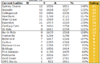
Above, Collingwood has a rating of 27, whilst GWS has a rating of 1. If Collingwood and GWS played 28 times, we would expect Collingwood to win 27. St Kilda has a rating of 12, whilst Carlton has a rating of 8 - if they played 20 games, we would expect St Kilda to win 12 of them. The above ratings are my opinion - there is no limit to how high a team can be rated: by giving the top teams higher numbers, there will be fewer upsets.
The second input is an adjustment that can be made to each game for home ground advantage, which adjusts the probability:

For a 'large' home ground advantage (e.g. travel to Perth), I have put an adjustment of '1', for short travel (e.g. Melbourne to Sydney), the adjustment is '0.5', and for a team with a minor advantage (e.g. an Etihad team playing at the MCG), the adjustment is '0.2' (since Geelong is the home team against Essendon at Etihad, the adjustment is negative). Each of these can be adjusted as desired by the user, and it can be for reasons other than home ground advantage (e.g. if one team has a winning streak against the other).
Once all the parameters are in as desired, the ladder is simulated. But to get full use out of the program, one should simulate the ladder multiple times. For instance, after simulating the ladder 20 times, I found Essendon made the top 4 five teams. The program requires Microsoft Excel. To simulate the ladder another time, simply press F9.
I hope that's enough explanation. A link to the program is below:
https://www.dropbox.com/s/t9x6e0yo7lohj9o/AFL ladder simulator.xlsx
(requires Microsoft Excel or equivalent)
Hopefully people find this useful. If anyone has any suggestions for how it can be improved, please let me know! Cheers.
Edit: there was a bug in the original program - the link is now fixed.
Edit 2: the program has been updated to include the finals series:
https://www.dropbox.com/s/do75kezkh7jx66x/AFL ladder simulator finals.xlsx
Everything else is the same, except there is now an additional input for finals experience to adjust a team's rating in the finals (e.g. Geelong have a relatively low weighting during the season, but a high level of finals experience, increasing their chances of winning in the finals). I tend to think home ground advantage counts for less in finals, and having the week off counts for more - I've programmed it so that the probability of winning in the finals is automatically updated for these factors.
In response to this, I have created a program which I have called the 'AFL Ladder Simulator'. It works by simulating the results for the rest of the season based on probability. For example, in this week's Collingwood vs Hawthorn match, each team has a 50% chance of winning, but in Fremantle vs Gold Coast, the probability of Fremantle winning is 96%. Scores are simulated for each match to construct the ladder.
The probabilities are based on two inputs, each of which can be edited according to the user's opinion. The first is a rating given to each team, shown in the gold column:
Above, Collingwood has a rating of 27, whilst GWS has a rating of 1. If Collingwood and GWS played 28 times, we would expect Collingwood to win 27. St Kilda has a rating of 12, whilst Carlton has a rating of 8 - if they played 20 games, we would expect St Kilda to win 12 of them. The above ratings are my opinion - there is no limit to how high a team can be rated: by giving the top teams higher numbers, there will be fewer upsets.
The second input is an adjustment that can be made to each game for home ground advantage, which adjusts the probability:
For a 'large' home ground advantage (e.g. travel to Perth), I have put an adjustment of '1', for short travel (e.g. Melbourne to Sydney), the adjustment is '0.5', and for a team with a minor advantage (e.g. an Etihad team playing at the MCG), the adjustment is '0.2' (since Geelong is the home team against Essendon at Etihad, the adjustment is negative). Each of these can be adjusted as desired by the user, and it can be for reasons other than home ground advantage (e.g. if one team has a winning streak against the other).
Once all the parameters are in as desired, the ladder is simulated. But to get full use out of the program, one should simulate the ladder multiple times. For instance, after simulating the ladder 20 times, I found Essendon made the top 4 five teams. The program requires Microsoft Excel. To simulate the ladder another time, simply press F9.
I hope that's enough explanation. A link to the program is below:
https://www.dropbox.com/s/t9x6e0yo7lohj9o/AFL ladder simulator.xlsx
(requires Microsoft Excel or equivalent)
Hopefully people find this useful. If anyone has any suggestions for how it can be improved, please let me know! Cheers.
Edit: there was a bug in the original program - the link is now fixed.
Edit 2: the program has been updated to include the finals series:
https://www.dropbox.com/s/do75kezkh7jx66x/AFL ladder simulator finals.xlsx
Everything else is the same, except there is now an additional input for finals experience to adjust a team's rating in the finals (e.g. Geelong have a relatively low weighting during the season, but a high level of finals experience, increasing their chances of winning in the finals). I tend to think home ground advantage counts for less in finals, and having the week off counts for more - I've programmed it so that the probability of winning in the finals is automatically updated for these factors.


 Its been removed


