
Remove this Banner Ad

Resource The NMFC History thread

🥰 Love BigFooty? Join now for free.

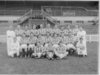
A shot of a packed Arden Street for the North v Brunswick VFA grand final in 1910
View attachment 417981

I remember that one!
a072d2582c5afe0184fbdec07618ead6.png
 
On the 24th of May 1947 at Arden Street North Melbourne staged one of the greatest comebacks in League history. Achieved against one of the strongest teams in the competition, it was an occasion where one player inspired a team to find something special.

The losers..well....they probably remember 1947 as the year they lost the Grand Final by a single point. But North, who were third bottom on the ladder at the end of the season could themselves remember a fantastic moment of football history.

Lead up

After Round 5, 1947, Essendon 6th on the ladder play North Melbourne bottom of the ladder at Arden Street. Essendon, the reigning premiers would have looked forward to an easy win. But unlike many that season, this was not their day.

In the two preceding matches, North Melbourne had lost badly (Round 4 v Fitzroy – lost by 101 points and Round 5 v Footscray lost by 41 points.). In both games North had not scored a goal until the final quarter The reigning premiers must have looked forward to an easy victory.

Teams

Essendon were led by Australian Football Hall of Fame legend Dick Reynolds and included a second Hall of Fame legend Bill Hutchison. They were a strong team evidenced by the fact they were reigning premiers and would end the home and away season in second place (14 wins) and go on to a tight Grand Final against strong Carlton side where they would go down by a single point.

North Melbourne

At North Melbourne, although a group of young players were coming through the seconds and thirds that would change North’s fortunes in the next few seasons, in 1947, North Melbourne struggled on the ladder and ended of the season in 10th with 4 wins. Keith McKenzie would win the club’s 1947 Best and Fairest and Sid Dyer finished as leading Goal kicker for the second season running with 47 goals.


B: Jack Lyons Jock McCorkell Neville Stibbard
HB: Les Reeves Kevin Dynon George Kokkin
C: Jim Malone Syd Dyer Reg Ryan
HF: Don Condon Les Foote Ted Jarrard
F: Alf Crump Chris Carroll Dick Molloy
Foll: Terry Walsh George Kennedy
Rov: Harry Somerville
Res: Harold Winberg Don Coulton
Coach: Bob McCaskill

Les Foote

For many people at the time, the best player in the North side was Les Foote. An Australian Football Hall of Fame inductee. Foote had played for the Shinboners since 1941 and was an experienced player. He had already won North’s best and fairest in 1945 and would win again in 1949 and 1950.
Foote was injured a number of times through the 1947 season. Newspapers record at least two concussions and another bad injury:
  • “Les Foote, of North Melbourne, is in bed with concussion, which he suffered on Saturday, but it is not serious, and he should be available this week.” – Argus 7-May-1947 p.9
  • “Les Foote, who was carried off the North ground on Saturday, was taken to hospital, but returned home at midnight. He was thought to have bruised kidneys, but has only bruised ribs and chest. He may be available again this week.” – Argus 16-Jun-1947 p14
  • “Les Foote, North Melbourne player in the carnival side, cannot play with his team tomorrow because he is still suffering from the face injury he sustained in Hobart.” – Argus 15-Aug-1947 p.17

Essendon

Essendon were led by Australian Football Hall of Fame legend Dick Reynolds and included a second Hall of Fame legend Bill Hutchison. They were a strong team evidenced by the fact they were reigning premiers and would end the home and away season in second place (14 wins) and go on to a tight Grand Final against strong Carlton side where they would go down by a single point.

B: Herbie Tonkes Cec Ruddell Bob McClure
HB: Norm McDonald Wally Buttsworth Harold Lambert
C: Bert Harper Bill Pearson Keith Rawle
HF: Bill Brittingham Gordon Lane Dick Reynolds
F: Jack Johnson Ted Leehane Ivan Goodingham
Foll: Harry Equid Percy Bushby
Rov: Bill Hutchiso
Res: Jack Jones Ray Bower
Coach: Dick Reynold


The Game
24-May-1947 - Round: 6 Arden Street (North Melbourne)

North Melbourne 2.2 (14) 4.7 (31) 7.8 (50) 15.12 (102)
Essendon 6.4 (40) 9.8 (62) 14.10 (94) 14.10 (94)

ES by 26 ES by 31 ES by 44 NM by 8

The game started predictably, Essendon extended their lead each quarter for the first three quarters, Argus Football writer Percy Taylor wrote that “North were 44 points behind at the start of the last quarter, and had shown little opposition to Essendon's methodical play. They had been defeated on the wings, their forwards were slow moving and stolid, and the defence weak.” (Argus 26-May-1947 p.14)

Essendon had a 44 Point lead at Three Quarter Time

At three Quarter Time Essendon led 14.10 (94) to 7.8. (50) a strong 44 point lead and North would have to double their score for the first three quarters in the final quarter even to have a chance. But this is what they did.

A snippet in the Argus hints at the what happened, “Les Foote, centre half-forward, was North's best. He was fast and clever, marking and kicking well. Then, in the vital last quarter, he was flung into the ruck.” (Argus 26-May-1947 p.14)....and Foote lifted the side


Argus 26-May-1947 p.14

Percy Taylor continued, “North then showed brilliant, concerted play that carried everything before them. They passed with precision, out marked opponents, and kicked accurately. Essendon cannot account for the fadeout. They thought they had the game in their keeping, and packed the defence. The pace and brilliance of North in that last quarter, however, were breathtaking, and swamped the opposition.” (Argus 26-May-1947 p.14)

North Melbourne kicked 8.4 (52) to zero for the quarter

Foote’s ruck work single handedly changed the game and inspired the team, there was no high wind or gale to blame, North who had scored 50 points in the first three quarters kicked 8.4 (52) to zero for the quarter in an astounding and memorable comeback.

An unknown writer on Wikipedia adds “ to get some perspective of Foote's astonishing performance as a ruckman on that day, at 182 cm he was dominating the four ruckmen Essendon had selected to play that day; namely, Ivan Goodingham (191 cm), Perc Bushby (189 cm), Bob McClure (188 cm), and Jack Cassin (183 cm ).

Aftermath

At the time this was a record in the VFL for final quarter comebacks. It was not until the Brisbane Bears turned around a 45 point margin to Hawthorn in 1995 that the record was broken. Today North’s effort is still the second highest in 110 years of League football.

Within a few years, a new group of young North players under Foote’s captaincy would reach the VFL Grand Final...the first time the club had reached a VFL Grand Final since moving from the VFA in 1925.

But on this day, a group of players, beaten hard for weeks before did not give up and found something special to give and achieved something great.
 

Log in to remove this Banner Ad

Arson and an elephant: The long history of Arden St footy ground
Christopher Talbot, Herald Sun
September 5, 2016 6:28pm

ARDEN Street has been the home of the Roos for more than 125 years.

It used to be called the North Melbourne Recreation Reserve and started out serving the Hotham Cricket Club until the Hotham Football Club — as North Melbourne was known then — moved to the ground in 1882.

Before then, the Hotham Football Club had been playing home matches at Royal Park, near the present site of the Melbourne Zoo.

The first game of footy was played at Arden Street on April 29, 1882, with Hotham beating Royal Park by two goals and nine behinds.

792f6b3cdfcabae4ffb094a41a412f08

Above: The first game at Arden Street reported in The Argus newspaper in 1882. North Melbourne was known as Hotham at the time, and they won by two goals and nine behinds.

When the Town of Hotham changed its name to North Melbourne in 1888, the football and cricket clubs followed suit.

Before long a war was being fought between the cricket and football clubs — both quibbling over their right to use particular parts of the ground — and by the late 1890s the two ended up in court over a dispute about the use of the cricket pavilion by a visiting football team.

The court eventually ruled that since it was Crown land, it was illegal to fence off any part of it for the benefit of either party.

By 1906 the first grandstand was built at the Fogarty Street side of the ground, at a cost of £850. There are still remnants of the old stand at the ground, including the concrete players’ race and the base of one of the external staircases.

0141e1d2c73419a38ff192b47b7fc68c

Above: Crowd at Arden Street watching the 1910 VFA Grand Final.
a96c855a1f34662e67fc655cfe804d81

Above: The old players’ race — which remains at the ground today — was part of Arden Street’s first grandstand built in 1906.

In 1921, the Essendon Football Club attempted to move to the ground after the East Melbourne Cricket Ground was closed, and the North Melbourne Football Club disbanded as it sought to amalgamate with Essendon.

But the State Minister for Lands stopped Essendon’s move, and they instead relocated to Essendon Recreation Reserve, and the re-formed North Melbourne returned the following season to Arden Street.

971c592c13ebf48be9e0b5796003f8e1

Above: North Melbourne Football Club in 1932, pictured at Arden Street.

In 1922, ownership of the ground was transferred to the football and cricket clubs and they set about making vast improvements for spectators and players, including installing hot showers in the change-rooms.

By 1925, North Melbourne joined the VFL and the club had record numbers of supporters — leading to a further upgrade of the ground with a new grandstand in 1928. It was at this time that it started to be referred to as Arden Street.

7f1b2cfb17006b46159be5aef9e7c350

Above: Aerial view of Arden St in the 1960s. The field had a greyhound racing track around the outside which was used for race meets between 1957 and 1962.
10bf4474e4b4695fe04bea1dc4ca6e8c

Above: The Arden Street grandstand, which was built in 1928.
28af5ba378435e68aa37bb6c538f9a6d

Above: The eight-inch wide, unbacked wooden seats in the Fogarty St grandstand.

Between 1957 and 1962, the Melbourne Greyhound Racing Association used Arden Street for race meetings on Monday nights. The dog track went around the perimeter, with the footy ovals in the centre.

The Greyhound races lead to the building of the betting ring behind the grandstand in 1928, which was subsequently used as a carpark when the dogs departed the track.

c8414d150b9883613f0336965f68f3c2

Above: Letter outlining North Melbourne’s move to Coburg City Oval. The move was intended to be long term but the Roos returned to Arden street within eight months.

In 1965, North Melbourne made a move away from its home of almost a century. Its playing and training base relocated from Arden Street to Coburg City Oval.

It was intended to be a permanent move, with the initial negotiations for a long-term lease of 40 years. However it was cancelled after only eight months, meaning North Melbourne was free to return to Arden Street in 1966, the North Melbourne Football Club says.

A new admin building and social club was built when the club returned, the first new buildings at the ground since the construction of the 1928 grandstand.

bc8b8ebf32ebf6c19b590d461d4d7031

Above: An elephant, spooked by the crowd, takes off around the boundary line before a football match between North Melbourne and Collingwood at the Arden St ground. Street. The elephant was promoting the Sole Brothers Circus in 1978.

While the 1970s marked North Melbourne’s first two premierships, Arden Street was more well remembered at the time for the infamous elephant incident.

Former marketing manager and Roo fullback Barry Cheatley described the incident in the Herald Sun in 2004.

“The elephant was part of a circus promotion we got involved in. We were playing Collingwood at Arden St in front of a (then) record crowd of 31,424 in 1978,” he said.

“The elephant came on at halftime and as he was leaving, complete with rider and handler, Collingwood ran onto the ground and a roar went up.

“It startled the elephant who broke into a jog as he headed towards the crowd and his handler stopped him a few feet before absolute carnage broke out.”

a4fbea5fc69a07f430e11dc17d966fe2

Above: North Melbourne's Kevin Dynon watches the flight of a ball he kicked in 1947. One of the iconic features of Arden Street was the gigantic gasometer that towered over the ground.

The North Melbourne Football Club continued to use the site as its home ground until 1985, when the club began using the Melbourne Cricket Ground for its home matches.

The last VFL match was played there on 17 August 1985 when North Melbourne defeated Richmond by 50 points. The record attendance at the ground is 35,116 in 1949, and the highest score was North Melbourne’s 29.19 (193) in 1983 versus Carlton. Pretty satisfying to be the highest scorer at your home ground.

In total, Arden Street hosted a total of 529 VFL matches.

North Melbourne continues to use Arden Street as its training ground — continuing the long relationship with the beloved ground.

7e0605513cbae0ecf7a256b1b8049000

Above and Below: The aftermath of a fire that destroyed buildings at the Kangaroos home ground at Arden Street in 2006.
d3de8d1ea33301fa10c5addb9188046b


An arsonist destroyed the club’s gym, offices and the betting ring in 2006 razing several portable buildings including the gymnasium, coaches’ offices, players’ lounge and the betting ring.

During the summer of 2012-2013, the Arden Street oval was resurfaced, increasing the ground dimensions to the same size as Etihad Stadium.
 
Last edited:
I wonder when they constructed the newer bigger version we knew as kids?

I don't actually know mate.

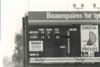
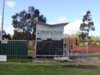
I assume the scoreboard went in to the N/E corner of the ground in the 1960's with the development of the Harold Henderson pavilion and Fogarty Street gates.
 
The score board that sat in the corner of Fogarty St & Macaulay Rd (circa 1993)

upload_2017-9-20_17-50-28.jpeg

Circa 1983

upload_2017-9-20_17-50-58.jpeg

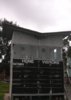
The old cricket scoreboard on the Macaulay Rd wing

upload_2017-9-20_17-52-2.jpeg
upload_2017-9-20_17-53-0.jpeg
 

Remove this Banner Ad

On the 24th of May 1947 at Arden Street North Melbourne staged one of the greatest comebacks in League history. Achieved against one of the strongest teams in the competition, it was an occasion where one player inspired a team to find something special.

The losers..well....they probably remember 1947 as the year they lost the Grand Final by a single point. But North, who were third bottom on the ladder at the end of the season could themselves remember a fantastic moment of football history.

Lead up

After Round 5, 1947, Essendon 6th on the ladder play North Melbourne bottom of the ladder at Arden Street. Essendon, the reigning premiers would have looked forward to an easy win. But unlike many that season, this was not their day.

In the two preceding matches, North Melbourne had lost badly (Round 4 v Fitzroy – lost by 101 points and Round 5 v Footscray lost by 41 points.). In both games North had not scored a goal until the final quarter The reigning premiers must have looked forward to an easy victory.

Teams

Essendon were led by Australian Football Hall of Fame legend Dick Reynolds and included a second Hall of Fame legend Bill Hutchison. They were a strong team evidenced by the fact they were reigning premiers and would end the home and away season in second place (14 wins) and go on to a tight Grand Final against strong Carlton side where they would go down by a single point.

North Melbourne

At North Melbourne, although a group of young players were coming through the seconds and thirds that would change North’s fortunes in the next few seasons, in 1947, North Melbourne struggled on the ladder and ended of the season in 10th with 4 wins. Keith McKenzie would win the club’s 1947 Best and Fairest and Sid Dyer finished as leading Goal kicker for the second season running with 47 goals.


B: Jack Lyons Jock McCorkell Neville Stibbard
HB: Les Reeves Kevin Dynon George Kokkin
C: Jim Malone Syd Dyer Reg Ryan
HF: Don Condon Les Foote Ted Jarrard
F: Alf Crump Chris Carroll Dick Molloy
Foll: Terry Walsh George Kennedy
Rov: Harry Somerville
Res: Harold Winberg Don Coulton
Coach: Bob McCaskill

Les Foote

For many people at the time, the best player in the North side was Les Foote. An Australian Football Hall of Fame inductee. Foote had played for the Shinboners since 1941 and was an experienced player. He had already won North’s best and fairest in 1945 and would win again in 1949 and 1950.
Foote was injured a number of times through the 1947 season. Newspapers record at least two concussions and another bad injury:
  • “Les Foote, of North Melbourne, is in bed with concussion, which he suffered on Saturday, but it is not serious, and he should be available this week.” – Argus 7-May-1947 p.9
  • “Les Foote, who was carried off the North ground on Saturday, was taken to hospital, but returned home at midnight. He was thought to have bruised kidneys, but has only bruised ribs and chest. He may be available again this week.” – Argus 16-Jun-1947 p14
  • “Les Foote, North Melbourne player in the carnival side, cannot play with his team tomorrow because he is still suffering from the face injury he sustained in Hobart.” – Argus 15-Aug-1947 p.17

Essendon

Essendon were led by Australian Football Hall of Fame legend Dick Reynolds and included a second Hall of Fame legend Bill Hutchison. They were a strong team evidenced by the fact they were reigning premiers and would end the home and away season in second place (14 wins) and go on to a tight Grand Final against strong Carlton side where they would go down by a single point.

B: Herbie Tonkes Cec Ruddell Bob McClure
HB: Norm McDonald Wally Buttsworth Harold Lambert
C: Bert Harper Bill Pearson Keith Rawle
HF: Bill Brittingham Gordon Lane Dick Reynolds
F: Jack Johnson Ted Leehane Ivan Goodingham
Foll: Harry Equid Percy Bushby
Rov: Bill Hutchiso
Res: Jack Jones Ray Bower
Coach: Dick Reynold


The Game
24-May-1947 - Round: 6 Arden Street (North Melbourne)

North Melbourne 2.2 (14) 4.7 (31) 7.8 (50) 15.12 (102)
Essendon 6.4 (40) 9.8 (62) 14.10 (94) 14.10 (94)

ES by 26 ES by 31 ES by 44 NM by 8

The game started predictably, Essendon extended their lead each quarter for the first three quarters, Argus Football writer Percy Taylor wrote that “North were 44 points behind at the start of the last quarter, and had shown little opposition to Essendon's methodical play. They had been defeated on the wings, their forwards were slow moving and stolid, and the defence weak.” (Argus 26-May-1947 p.14)

Essendon had a 44 Point lead at Three Quarter Time

At three Quarter Time Essendon led 14.10 (94) to 7.8. (50) a strong 44 point lead and North would have to double their score for the first three quarters in the final quarter even to have a chance. But this is what they did.

A snippet in the Argus hints at the what happened, “Les Foote, centre half-forward, was North's best. He was fast and clever, marking and kicking well. Then, in the vital last quarter, he was flung into the ruck.” (Argus 26-May-1947 p.14)....and Foote lifted the side


Argus 26-May-1947 p.14

Percy Taylor continued, “North then showed brilliant, concerted play that carried everything before them. They passed with precision, out marked opponents, and kicked accurately. Essendon cannot account for the fadeout. They thought they had the game in their keeping, and packed the defence. The pace and brilliance of North in that last quarter, however, were breathtaking, and swamped the opposition.” (Argus 26-May-1947 p.14)

North Melbourne kicked 8.4 (52) to zero for the quarter

Foote’s ruck work single handedly changed the game and inspired the team, there was no high wind or gale to blame, North who had scored 50 points in the first three quarters kicked 8.4 (52) to zero for the quarter in an astounding and memorable comeback.

An unknown writer on Wikipedia adds “ to get some perspective of Foote's astonishing performance as a ruckman on that day, at 182 cm he was dominating the four ruckmen Essendon had selected to play that day; namely, Ivan Goodingham (191 cm), Perc Bushby (189 cm), Bob McClure (188 cm), and Jack Cassin (183 cm ).

Aftermath

At the time this was a record in the VFL for final quarter comebacks. It was not until the Brisbane Bears turned around a 45 point margin to Hawthorn in 1995 that the record was broken. Today North’s effort is still the second highest in 110 years of League football.

Within a few years, a new group of young North players under Foote’s captaincy would reach the VFL Grand Final...the first time the club had reached a VFL Grand Final since moving from the VFA in 1925.

But on this day, a group of players, beaten hard for weeks before did not give up and found something special to give and achieved something great.
we had this here in the 1970's (when it comes to women hug and kiss players)

the kissing bandit.
 
mention was made in the Josh Kelly stuff last week about the tax law case involving Phil Kelly. This is an excerpt from court ruling. Few things to note, $120 per game and car payments is a fair way short of what his son could have earned next year. Second, $20k is a huge prize in 1978. Third, he won the Sandover without footy being his priority. And finally, hello Ron Joseph.
--
The taxpayer commenced playing football with some success as a young boy in junior football competitions in the country town of Busselton. In 1975 he came to Perth to attend the University of Western Australia and to undertake a degree in physical education. He duly enrolled at the university and commenced such course in 1975 and at the appropriate time of the year commenced pre-season football training with the university football club.

At about this time he was approached by a representative of the East Perth Football Club (hereafter called ``the club''), a member club of the WANFL, and was invited to train with that club's football team which invitation he accepted. He was selected to play for the club's team in the final ten WANFL games in the 1975 season having applied for and obtained a clearance from his Busselton football team to join and play for the club's team. He won the club's award that year for the best first-year player in its team. He continued to play for the club's team in the 1976 and 1977 seasons, over the same years continuing with his university studies. He was paid for each league match played by him and in 1977 was receiving $120 per league game, the club also contributing to lease payments payable on his motor vehicle.

In 1977 he failed to pass certain of the university subjects necessary for his degree and decided to repeat those subjects in the 1978 academic year whilst also doing his teaching diploma. At the end of 1977 he went to New Zealand during university vacation and whilst away came to the decision not to play league football during 1978 because of the encroachment on his study time that a commitment to league football made. On 14 February 1978 he wrote to the general manager of the club telling him of that decision and on arrival back in Perth confirmed with the general manager his intention not to play during the 1978 season.

At about this time the club appointed one Barry Cable coach of its team. The appellant describes Cable as a man who ``had achieved great things in football both in Perth and Victoria and was something of a legend in football''. The appointment of Cable as coach gave him some cause to consider again his decision not to play during 1978 because of ``the prospect of playing under such a great player and to learn off him as well'', but he took no steps to cancel the advice given by him to the club. Shortly afterwards he was approached by Cable who encouraged him to play in the 1978 season and suggested a meeting to discuss the matter with him. A meeting was held to which Cable also brought one Ron Joseph of the North Melbourne Football Club and at which both Cable and Joseph applied themselves to persuade the appellant to play for the club in 1978. The upshot was that he was persuaded to so play and also, at the invitation of Joseph, who told him that at a later stage he would like him to go to Victoria and play football there, signed a Form 4 committing himself to play for the North Melbourne football team should he wish to play in Victoria. For this Joseph paid him $4,000. The appellant says that at that time he had no belief that he would go to Melbourne and considered the $4,000 a ``handy way to get money to help me through my studies in 1978''.

He then started pre-season training with the club's team. In late March and before the commencement of the 1978 football season he became aware, through an announcement in the press, that TVW Enterprises Limited, which operated Channel 7 Television Station (hereafter referred to as ``Channel 7'') had agreed to pay $20,000 to the winner of the Sandover Medal which was and is a trophy awarded each year to the fairest and best player in the WANFL for the year in question, as determined by the umpires of the league matches played during that year. The appellant's evidence is to the effect that he did not consider himself a contender for the award and had no reason to think he was a contender as to then he had not achieved anything of any major significance in league football.

During the 1978 season he played in the league matches for the club's team being paid $150 per match, the club again contributing to the lease payments on his car. He had no written contract with the club but received some document from it to the effect that as long as he played league football for the club he would be paid. He says there was no commitment by him to play for the club and no restriction on him leaving it, other than that in accordance with league requirements a clearance was needed before he could play for any other club.

When football training conflicted with his university lectures (which occurred often two nights a week) he attended his lectures. His evidence was that his studies had priority and in fact he completed his degree and teaching diploma during the year 1978. He says that after reading the announcement of the $20,000 to be awarded he gave no further thought to the Sandover Medal. In 1978 there were a number of media awards, in the main based on votes cast for various players after each match which votes were progressively totalled over the season the count being made public each week. He did not receive or win any of those awards and in his words ``was not even ranked''. His own club had an award for the fairest and best league player in the club's team and he was runner up for that award. He was then invited to attend, as one of the representatives of the club, the function at which the Sandover Medal voting was to be counted.

Each club had a number of representatives at this function and officials also attended, the count being in public and televised. The count was of the votes cast by the Number 1 umpire at each league match during the season for the player each such umpire judged as fairest and best on the day in the match umpired by him, he at each such match voting for three players in order of merit. The procedure was that the umpire's votes were then sealed in an envelope and delivered to the WANFL where the envelope was kept unopened until the official count for the medal on the night of the award. On the count of votes in 1978 the appellant was found to have won the Sandover Medal. He was then presented not only with the Sandover Medal but with a cheque for $20,000 drawn and presented to him by Channel 7 by way of the said award. It is this sum that is the subject of the appeal.
 
If any has got a few hours to spare, go to you tube > Arden st. It leads you to so many old North games. The 1976 17 man, against the wind game is must viewing for all North supporters. It should be mandatory. The club should celebrated this more.

Anyway, I've just killed 5 hours and just tipped the iceberg.
 
I think that what Arden Street needs is a 'Big Elephant' model ... you know ... like the 'Big Pineapple' :D
 

🥰 Love BigFooty? Join now for free.


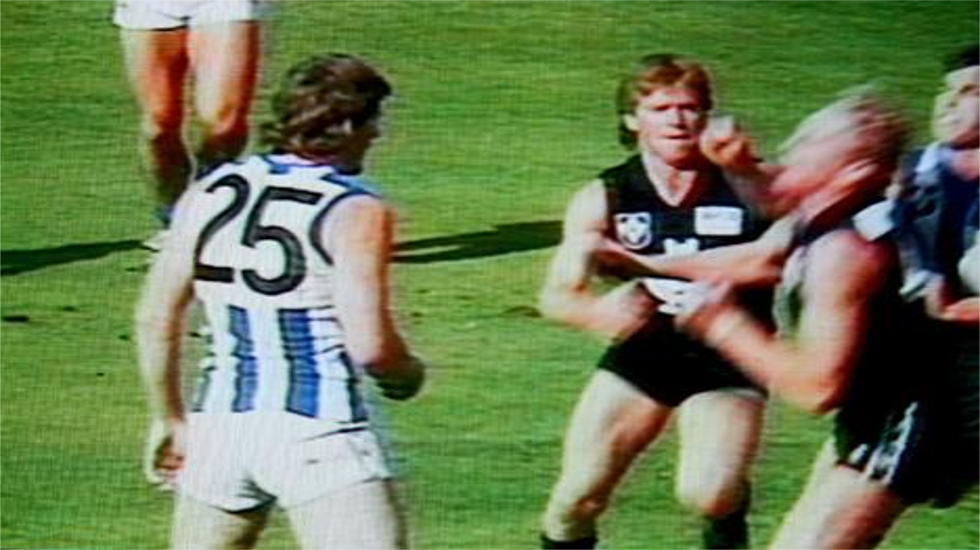
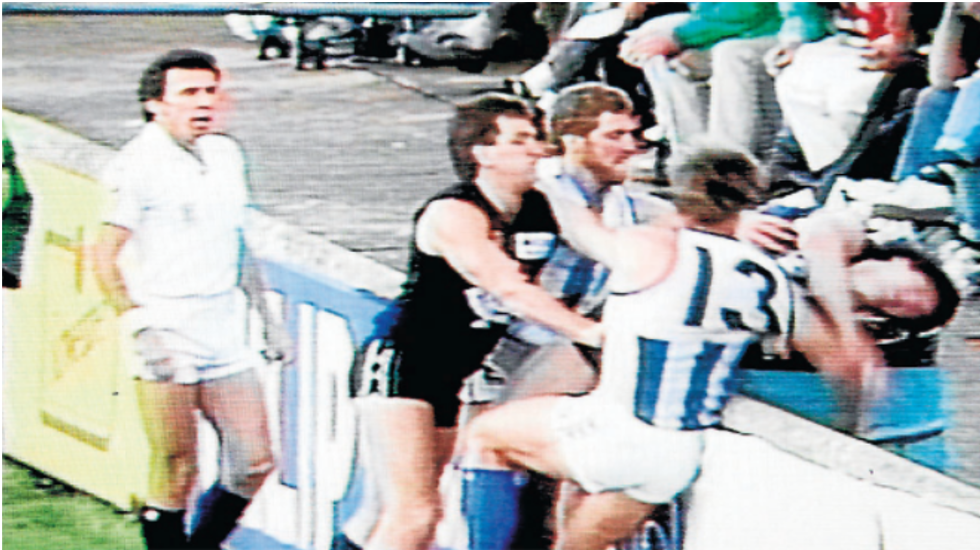
North Melbourne’s Alastair Clarkson (far right) belts Carlton defender Ian Aitken during the infamous “Battle of Britain” in 1987. Picture: CHANNEL 7

Thirty years on, an anniversary they’d rather not remember

Rohan Connolly

Some football anniversaries are days when those who run the game can puff their chests out full of pride. Others they’d prefer might just slip past unnoticed. And it’s fair to say October 11 is one of the latter, particularly this year.

Wednesday marks 30 years to the day Carlton and North Melbourne played a supposed “friendly” at the Oval in London so spiteful and loaded with unsavoury incident that it became known as the “Battle of Britain”.

And it’s still the cause of much rueful head-shaking from those involved three decades on.

In an age without video reviews, and umpires and a tribunal system far more lenient, the game nevertheless resulted in 16 charges, six of the seven players reported suspended for a total of 11 matches.

It featured a Carlton side that had just won the premiership and was interested in little more than a leisurely stroll on a holiday, up against a North Melbourne team humiliated by its 118-point thrashing in an elimination final weeks earlier, and, goaded ever since by its fiercely competitive coach John Kennedy, determined to hit back hard, no matter the occasion.

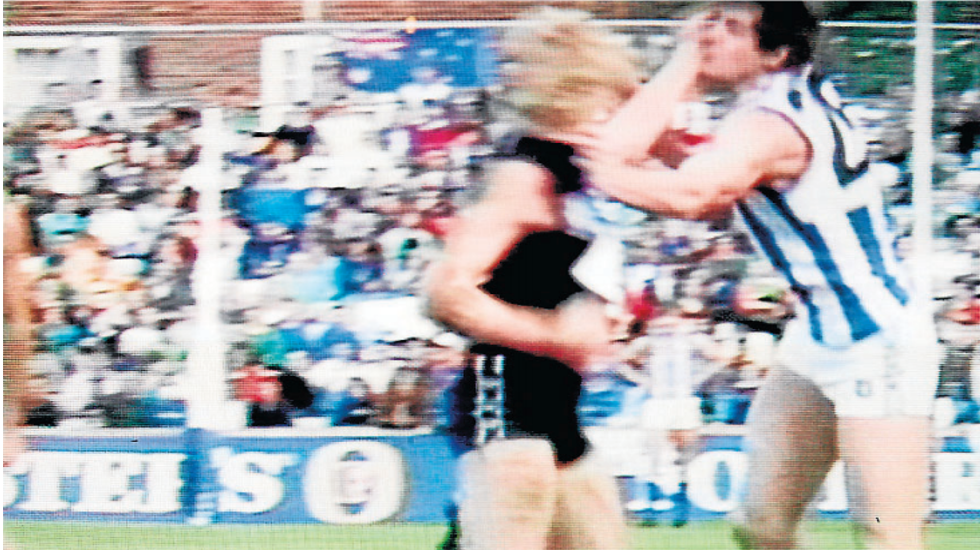
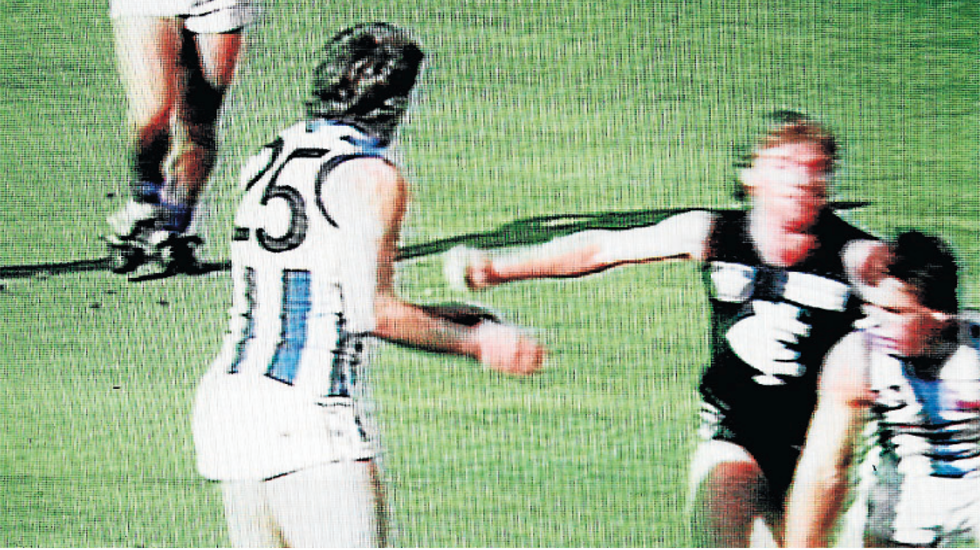
The fireworks started early after Kangaroos’ big man Donald McDonald struck Carlton’s David Rhys-Jones. McDonald then clashed with young Blue defender Ian Aitken, who promptly had his jaw broken after being king-hit by a swinging round-arm right from a 19-year-old North player, now Hawthorn coach, Alastair Clarkson.

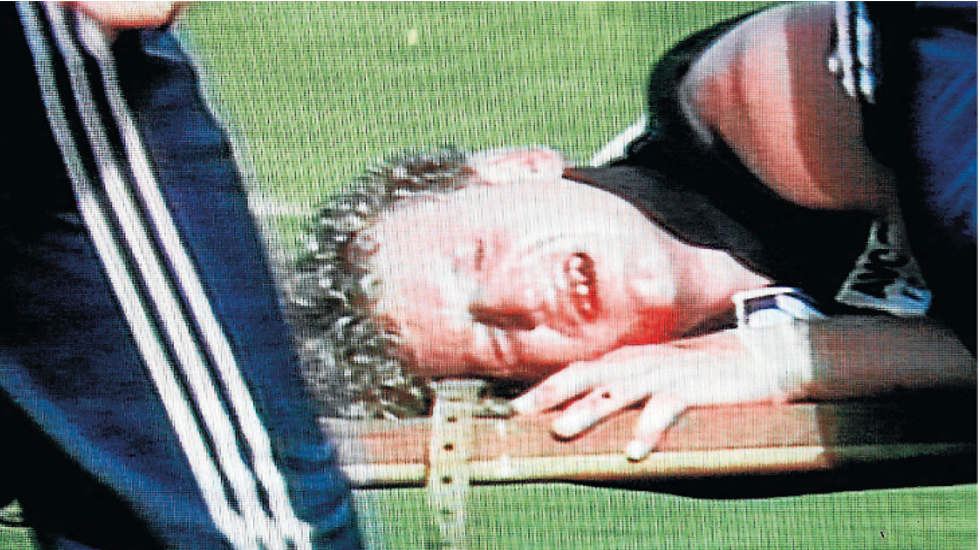
The young Blue key defender, rookie of the year and a premiership player in his debut season, was carted off semi-conscious on a stretcher, blood trickling from his mouth.

McDonald could still recall it vividly when I spoke to him about it 10 years ago.

“Rhys and I had been reported for hitting each other in the past. He took this really good mark, and I don’t know what got into my head, but I just gave him one, and he gave me one back, and it was on for young and old,” he said.

battle2c.png


The battle begins with a box-on between North Melbourne’s Donald McDonald and Carlton’s David Rhys-Jones. Picture: CHANNEL 7

“I was actually playing on Ian Aitken, and when play resumed, he ran off to receive the ball from Rhys. I was too tired from all the wrestling to chase him, so I tackled him to stop him running, so he starts throwing punches at me, and the next moment, Al Clarkson’s come in and just bloody belted him.”

From there, things got decidedly ugly. Carlton was incensed. Adrian Gleeson and Wayne Johnston lay into Clarkson as fights broke out everywhere, even in the coaches’ boxes, where Blues’ boss Robert Walls had hurled his walkie-talkie at Kennedy.

A furious Walls at half-time instructed that Clarkson not be allowed to walk from the ground. Amazingly, he did, despite being chased for most of the second half, at one stage, comically, around a goal umpire, by Carlton’s Rhys-Jones and Jim Buckley.

North strongman John Law had a huge cut opened up by Carlton’s Mark Edwards. “He got him a beauty, split him open like a pineapple,” Buckley told me two decades on. Young Blues skipper Stephen Kernahan was pushed backwards over a boundary fence by Law and Steve McCann, his head slamming against a rubbish bin.

“Wallsy was off his head,” Buckley recalled of the half-time break. “He said: ‘I don’t want Clarkson to walk off the ground’ and said he wanted me to do it. I’ve got no idea why.

“So just before they bounced the ball for the second half, I went up to Clarkson and we were into it, punching on for three or four minutes. I was knackered. I said to Rhys: ‘You take over, I’m stuffed’, so then Rhys was hammering the shit out of him, and the last thing I remember was him hiding behind the goal umpire down the other end.

“He copped a hell of a belting, and to his credit, he stuck it out. I went and saw him after the game and more or less apologised and took him up for a drink, because I think he was pretty shocked by it all, too.”

battle3a.png


Carlton’s Adrian Gleeson lines North Melbourne’s Alastair Clarkson up after the North little man had broken Ian Aitken’s jaw. Picture: CHANNEL 7

Buckley, even more so than his teammates, hadn’t exactly had the ideal preparation. A veteran by then, his bigger responsibility, as an employee of club president John Elliott’s CUB, which was sponsoring the game, was to arrive in London early to look after promotion.

“I wasn’t even supposed to play. I didn’t even have any boots,” he said. “We’d done all these lunches and promotions, and the night before, I’d been to this exclusive Arab club and got home about 6am. The next thing I know there’s a knock on the door at 9am, saying you’ve got to come to the team meeting, someone’s pulled out and they need you to play.”

How did he go? “Well, I had to go out and buy these soccer boots, which were heavy as buggery, let alone the gutful of piss I had in me … how do you reckon?” he laughed.

Not surprisingly, given the respective motivation levels, it was North Melbourne that ended up winning by 13 points. But, said, McDonald, even the victors were a little embarrassed.

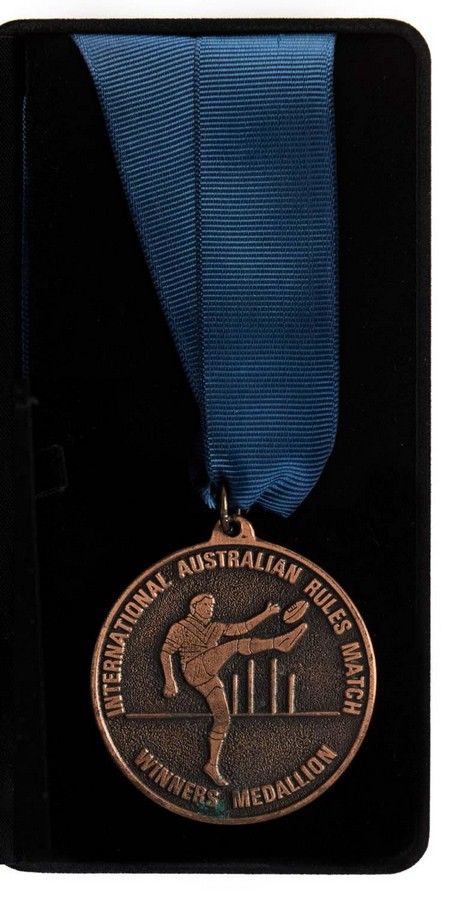
“After the game we had to go up to the committee room where both sides were presented with medals, and everyone’s got cuts all over their faces,” he said.

“I don’t think the Carlton boys were too happy. We were staying in the same hotel, and at one stage ‘Clarko’ and I were in the elevator going up, and Ian Aitken gets in with his jaw all swollen. It was a pretty quiet ride.”

A team in party mode had been jolted out of its lethargy and into white-hot anger by an opponent that had been brooding far too long. In hindsight, it was an accident waiting to happen. But there’d already been plenty even before game day. On two continents.

North Melbourne’ testy mood hadn’t been improved any, McDonald recalled, by a promotional dinner beforehand. “There was £5000 up for grabs, and Elliott got up and said: ‘We’ll just give it to our boys for the end-of-season trip, but I suppose North will need it to pay their players’.

“That was the arrogance of Carlton at the time. Our officials were just filthy, and got up and walked out, and I remember sitting there thinking: ‘How about these blokes?’ It didn’t help matters. There was a lot of animosity from us towards them.

battle4a.png


Carlton’s Ian Aitken is carried off with a broken jaw. The Blues’ best first-year player wasn’t the same player after the incident. Picture: CHANNEL 7

While North Melbourne worked itself into a frenzy, in Canada, Sydney was preparing to take on Melbourne in Vancouver. And the US promoters had gone a little overboard trying to sell their product. Newspaper ads for the game promoted the clash thus: “Balls. Brawls, Bloody Right”. “In Oz, it’s been legal for years. Aussie Rules football it’s organised mayhem. The roughest, toughest sport alive”.

Anyone who hadn’t got the idea by then had it driven home when Sydney ruckman John Ironmonger was photographed sitting on a footpath, tearing at a large piece of raw steak with his teeth.

In London, meanwhile, Carlton veteran Buckley was doing his best to make sure the “Fosterisation” of the normally staid cricketing venue was complete, down to the massive logo to be painted on the sacred turf.

“That was my main mission, because no signage had ever been put on the turf there before,” he recalled. “I’d sent the template, told them how to do it, with flat water-based paint, and given them plenty of time.

“But I went down there to see how they were going, and here they are trying to get it on with these little spray cans. It would have bloody taken them three years! I thought: ‘I’m going to get my arse kicked here’, so I rushed down to the nearest paint shop, matched up all the colours, got big brooms and brushes to put it on, and bought miners’ hats so they could work through the night so it would be ready.

“It looked magnificent, but the game starts, and by half-time, it’s all stuck to our boots, and all over everyone’s shorts and jumpers . No-one could get it off. The bloke in the shop had given me full gloss! They had this beautiful carpet in the rooms, and it was completely knackered, they ended up having to pull it all up.”

The turf, however, was a different story. “I reckon more than six months later, England was playing India in a Test match over there, and you could still see the logo,” Buckley chuckled. “I said to Elliott: ‘Well, you got your money’s worth’.”

The teams headed their separate ways, North Melbourne off to Vancouver to play Melbourne in the exhibition series “grand final”.

But the Roos, desperate to rejoin the rest of their list on the end-of-season trip in Los Angeles, had by now well and truly lost their fire. McDonald remembered at least four or five teammates mysteriously straining hamstrings during a pre-match training session.

battle6a.png


Carlton’s Stephen Kernahan is pushed over a fence by Roos Steve McCann and John Law, his head slamming into a rubbish bin. Picture: CHANNEL 7

Finally, the trip complete, North headed home, with no mobile phones or internet, still largely blissfully unaware of the furore unleashed in their absence. They’d soon find out. The VFL was flooded with complaints. Editorials had thundered about the disgraceful example conveyed of our game overseas. And McDonald had another battle on his hands.

“My mother-in-law was a mad Carlton supporter. She and her friends used go and sit in the Heatley Stand every week, and they were all ringing saying: ‘Your son-in-law is a disgrace, and we’re not talking to you anymore’. She rang my wife and said: ‘Your husband’s an animal’.”

By the time the tribunal finally sat to hear the litany of reports, more than a month had passed. The resultant penalties were by today’s standards, soft. Clarkson got four games for his hit on Aitken. Buckley and Edwards were rubbed out for two, Rhys-Jones, Johnston and McDonald one each, while Carlton’s Brad Shine was reprimanded.

For most of the players, any lingering animosity had well and truly evaporated. To the point that the players’ waiting room during the marathon hearings became a de facto social club. “They took about four hours to work out how to handle it,” said Buckley. “We were starving, mate. A mate of mine owned ‘Donnini’s’, so I gave him a ring and he sent in a massive serve of pasta and two boxes of Crown Lager.”

The Blues and Roos were friends again. Sort of. The legacy for some has lingered. Clarkson has apologised publicly several times for his part in the “Battle of Britain”, but has also claimed the experience was the making of him as a footballer, because, after surviving a team full of opponents determined to beat him to a pulp, “I’d never have to endure the same sort of horror”.

Aitken, who never again reached the heights of his debut season in his 66-game career, was succinct in his recollection more than a decade later of his injury.

“It was a pretty low act. Hitting someone from behind is as low as you can get. I’m sure he (Clarkson) regrets it, but I’m not interested in any apology. I don’t know him as a person and I don’t care to know him.”

The AFL learnt some hard lessons, too. To keep closer tabs on the promotion of its image, for one. That, sadly, the sublime skills and pace, strength and endurance required in our native game, aren’t necessarily as big an attraction for the punters outside Australia as the promise of some “biffo”.

And that, in the ongoing quest for long-lasting recognition of a brand overseas, you can’t go past some full gloss paint and a bit of famous turf.
 
1898-----AN EVENTFUL SEASON.


After being decimated by the 1896 breakaway, the VFA soldiered on with six teams—North Melbourne, Port Melbourne, Footscray, Brunswick, Richmond and Williamstown. From 1897 to 1899 it was basically a three horse race out of North, Port and Footscray.

North had not been able to use their home ground since 1896 due to huge and much needed improvements to it. These began in early 1897 and North had to use the East Melbourne ground for their home matches. The lack of a home ground affected the club financially and this, as well as internal trouble, was attributed to North failing to finish on top in 1897. Several matches that should have been won were lost, including the Round 3 shock loss to the newcomers Brunswick. North finished runners up to Port Melbourne.

1898 began well. After winning the first two games, the Round 3 match against Footscray at Footscray was postponed due to bad weather. This would be played in July—a week after Round 9. North went down by a solitary point having four more scoring shots and hitting the post three times. North won their Round 4 match and in the next five weeks won two and lost three. After 9 rounds were completed they were 5-4 and third on the table—12 points behind leaders Footscray, who would set the pace for most of the season.

Round 10 was eagerly looked forward to. North would be playing their first match at Arden St since 1896. The ground improvements were finally finished. However, heavy rain fell on the preceding Friday with further light showers on the Saturday. The ground Committee--the Council-- decided on the day that playing the match would cause damage to the newly improved surface they had paid for and informed North captain Dicky Houston of that. Unfortunately it was too late to inform the Port Melbourne team, who duly arrived at Arden St and claimed the match on forfeit—and four premiership points.

North went on to win their next five games, including impressive wins over Footscray and Port Melbourne. They finally got to play their first match at Arden St—against Richmond in Round 11—and had a good win.

On the eve of Round 15, North requested the VFA that they allow the forfeited match against Port Melbourne to be played, secretary A.Woodham explaining that the council's decision not to allow the match to proceed was not the club's fault and that it was too late to make alternative arrangements. The VFA agreed and decreed that the match be played on Saturday 27th August—the week after Round 15. Ironically North played Port the next day as part of the normal fixture. This meant that the two clubs would meet twice in successive weeks.

The decision did not please Port Melbourne. Losing the four points moved them from outright second and just one win behind leaders Footscay to equal second on the ladder with North on 36 points and 8 points behind Footscray. To make matters worse, North won both the Round 15 match (comfortably) and the postponed Round 10 match (by three points after almost squandering a good lead.) This put North two wins clear of Port and just one win behind Footscray.

A huge crowd attended the Round 16 match at Arden St where North had the chance to topple Footscray. They had done so in Round 13, but on this day they were well beaten. Footscray's best--and roughest-- player was Arthur Armstrong—a North Melbourne resident—which upset the crowd somewhat. Port Melbourne , meanwhile, had a rather easy win over Richmond, who chose to retire at three quarter time. North had blown their chance to be premiers, for the following week Footscray suffered a shock defeat to Port Melbourne, while North just managed to overcome Richmond, thanks to Richmond's inaccuracy.

So at the close of the season (bearing in mind there were no finals playoffs) the position of the top four teams was as follows:


Footscray (Premiers) 52 pts
North Melbourne 48 pts
Port Melbourne 44 pts
Richmond 32 pts

In the final two weeks of the season, Port Melbourne lodged protests against the two losses they had sustained against North on the following grounds:

1. A North player, Kelly, had played without obtaining a permit. Kelly, a former Fitzroy player (then a VFA club), had returned after a stint in Western Australia.Port argued that he needed a permit. This was debateable as Fitzroy were now in the VFL and there was no permit agreement between the two bodies.

2. Houston, the North Melbourne captain, had not obtained a caretaker's permit. Houston had the job as the curator at Arden St, (as he did later for Williamstown—a job he performed there until his death.) But he was not under the jurisdiction of the club, but under the North Melbourne council.

North regarded the protests as frivolous and unsportsmanlike, but when the meeting seemed disposed to rule against them ,they brought up their own technical point. Port Melbourne had not lodged the sum of three guineas for each of their protests as required by the rules. Cheques were deposited but then dishonoured by the bank. The meeting therefore voted 6-4 that the protests were informal. Had the protests been upheld Port Melbourne would have gained eight premiership points making them equal with Footscray.A play-off would have been necessary. Footscray naturally condemned Port's action, saying Port knew about both Houston and Kelly and should have protested before the games. Their actions would not improve their already bad reputation.

So North retained their second place on the table. A premiership still seemed tantalisingly close but not obtainable. North had many good players at the time--Houston, Sicily, the Launder brothers, Torpey, Rolent, Carlton, Graham and D. Noonan. Many of them would be gone by the time a premiership came the club's way.
 
Last edited:
The winners medallion issued to the winners of the infamous 1987 "Battle of Britain" exhibition match between North & Carlton

9dee6e59e16d43e5e3af8cc7ad2eced3.jpg
 
Last edited:

Remove this Banner Ad

Resource The NMFC History thread

🥰 Love BigFooty? Join now for free.

Back
Top