Remove this Banner Ad

Anthony Albanese - How long? -4-

  • Thread starter Thread starter Chief
  • Start date Start date
  • Tagged users Tagged users None

🥰 Love BigFooty? Join now for free.

There has been up to 70c variation for months just before
I'm talking about cheapest prices, not variations between suburbs or petrol stations. I always go to the cheapest one.

Before the war for epsteins friends, I hadn't paid over $1.85/L for probably a year or maybe even more.

Most of Jan/Feb I never paid over $1.55/L sometines even in the $1.40s
 
I'm talking about cheapest prices, not variations between suburbs or petrol stations. I always go to the cheapest one.

Before the war for epsteins friends, I hadn't paid over $1.85/L for probably a year or maybe even more.

Most of Jan/Feb I never paid over $1.55/L sometines even in the $1.40s

Even diesel, it's still cheaper than orange juice. Which grows on trees.
 
An out-of-the-ordinary reassurance of petrol supply is not going to be much reassurance.

It's been a huge blow for the west coast of WA, with the cyclone and people would have been holding off on trips.

Now you've got rate rises and petrol price increases. People will be staying at home a lot more, nationwide.
Inflation is too high, we need to raise interest rates and stop spending.

But also we need to cut fuel excise to make petrol cheaper and ensure people keep spending to boost the economy.

1775120467909.gif
 
Last edited:

Log in to remove this Banner Ad

Inflation is too high, we need to raise interest rates and stop spending.

But also we need to cut fuel excuse to make petrol cheaper and ensure people keep spending to boost the economy.

View attachment 2569686
Concerned over a looming supply shortage but cut tax to increase demand. Such dumb shit.
 
I'm talking about cheapest prices, not variations between suburbs or petrol stations. I always go to the cheapest one.

Before the war for epsteins friends, I hadn't paid over $1.85/L for probably a year or maybe even more.

Most of Jan/Feb I never paid over $1.55/L sometines even in the $1.40s
Yeah petrol is mostly discretionary for me I’m in the ‘always put 80 bucks worth in’ camp
 
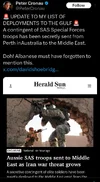
It's good that Albo made sure to say we're not involved yesterday and today again

Far be it for me to challenge the highly regarded journalistic integrity of the Herald Sun newspaper. But the 'Middle East' is not the same as being involved in the Iran conflict.

I's not a 'secret' that Australia (like many other Western/European nations) have military forces and assets in the Middle East for many years. And the PM announced three weeks ago that Australia was sending a RAAF Wedgetail reconnaissance aircraft, air to air missile systems and a large contingent of ADF personnel to the UAE at the request of the UAE and in support of the 24,000 Australian citizens working in the UAE.


No surprises that these resources would include SAS support. Unless there's more to this story that I'm not seeing?

Greens Senator David Shoebridge quoting the Herald Sun as his source for this story is the real surprise imo.
 
On the one hand it's the BS Herald Sun. On the other hand we have form in this regard.
I mean Pine Gap says we're directly involved

Sending the Wedgetail

Having personnel on the submarine that "were asleep"

It's like how they said we weren't involved in Gaza while sending F35 parts there
 
Far be it for me to challenge the highly regarded journalistic integrity of the Herald Sun newspaper. But the 'Middle East' is not the same as being involved in the Iran conflict.

I's not a 'secret' that Australia (like many other Western/European nations) have military forces and assets in the Middle East for many years. And the PM announced three weeks ago that Australia was sending a RAAF Wedgetail reconnaissance aircraft, air to air missile systems and a large contingent of ADF personnel to the UAE at the request of the UAE and in support of the 24,000 Australian citizens working in the UAE.


No surprises that these resources would include SAS support.
Yeah we've just got a bunch of military people in the region in countries involved in the war but we're not involved in the war

We're just providing intelligence support to the countries bombing Iran but aren't directly involved in the bombing because it's not us bombing.

We're supply parts to the bombers but they're not our bombs so we're not involved

We were on a submarine that sunk a ship but we weren't involved
 
Far be it for me to challenge the highly regarded journalistic integrity of the Herald Sun newspaper. But the 'Middle East' is not the same as being involved in the Iran conflict.

I's not a 'secret' that Australia (like many other Western/European nations) have military forces and assets in the Middle East for many years. And the PM announced three weeks ago that Australia was sending a RAAF Wedgetail reconnaissance aircraft, air to air missile systems and a large contingent of ADF personnel to the UAE at the request of the UAE and in support of the 24,000 Australian citizens working in the UAE.


No surprises that these resources would include SAS support. Unless there's more to this story that I'm not seeing?

Greens Senator David Shoebridge quoting the Herald Sun as his source for this story is the real surprise imo.
Do the SAS have some sort of anti missile and drone technology?
 
Far be it for me to challenge the highly regarded journalistic integrity of the Herald Sun newspaper. But the 'Middle East' is not the same as being involved in the Iran conflict.

I's not a 'secret' that Australia (like many other Western/European nations) have military forces and assets in the Middle East for many years. And the PM announced three weeks ago that Australia was sending a RAAF Wedgetail reconnaissance aircraft, air to air missile systems and a large contingent of ADF personnel to the UAE at the request of the UAE and in support of the 24,000 Australian citizens working in the UAE.


No surprises that these resources would include SAS support. Unless there's more to this story that I'm not seeing?

Greens Senator David Shoebridge quoting the Herald Sun as his source for this story is the real surprise imo.

Weird how we can have bases and troops everywhere, it's perfectly normal.
But if a Chinese boat does a lap of Australia in international waters our media and politicians all freak out.
 

Remove this Banner Ad

Yes. In support of deployed ADF resources. Google LAND 156 (ICARUS).
The SAS? Do we really not have specialists operating our anti projectile tech? But instead just get the SAS to operate it. That's surprising.
 
View attachment 2569864
It's good that Albo made sure to say we're not involved yesterday and today again

Middle East covers a huge bloody area and has a number of countries, some of which are friends and which we have established ties with and others which are not

What does the body of the report say rather than the head line?

We know tha RAAF are there with an AWAC and ground crew at the request of the UAE

The ADF may also have troops on the ground to protect Australian assets
 
LOL. Don't have access to get behind the paywall. But the headline from The Age tells me I'm entitled to some 'I told ya' points.

My question of Rob Harris (whoever he is) is this - 'Why don't you do your job and find out?' and THEN write an article that informs us all. That's what journalists are supposed to do, right?

View attachment 2569007
The point is you can’t leave it to the media as they are useless at passing information.
And the full impact of covid wasn’t known a few weeks in. Weren’t the media busy roasting China?
China had one of the lowest death rates in fact
 
If Australia is on their own fine - it is time to nationalise all the resources.

And the coalition can GAGF.

https://www.themonthly.com.au/karen...ead more&cid=fa0fdb6f7c357b65b83e00635d88f473

There was a moment a week ago when the penny finally dropped on why the Albanese government has struggled to be clearer with Australians about the fuel crisis and its implications. Aside from obvious constraints – including some politicians’ communication challenges and the need to avoid igniting panic – there’s something more fundamental making this crisis so hard to explain and even harder to manage.

Prime ministers and their colleagues can’t convey what they don’t know.

They can’t take Australians into their confidence if the United States doesn’t do the same. The US isn’t sharing its plans or intentions in ways that can be relied upon and it’s unclear exactly whose interests are being served, in either the short or longer term, through what President Donald Trump and others in his administration are doing and saying in relation to the Iran war.

Historically, this is not how it’s been with our most important security ally. It makes knowing how to respond both politically and through policy diabolically difficult.

The moment of clarity came when US Secretary of State Marco Rubio strode across the tarmac to speak to journalists at the Paris–Le Bourget airport on March 27 after meeting his G7 counterparts.

“Progress is going very well – obviously we have some work to do,” Rubio said of the state of military operations against Iran. “We have to finish the job, and we are finishing that job. I did describe to our allies, however, that immediately after this thing ends, and we’re done with our objectives, one of the immediate challenges we’re going to face is an Iran that may decide they’re going to set up a tolling system in the Strait of Hormuz. Not only is this illegal, it’s unacceptable. It’s dangerous to the world and it’s important that the world have a plan to confront it.”

Say what? Back that up a bit. The war will end when the United States’ objectives have been met – and those don’t include securing the Strait of Hormuz, the key to much of the world procuring the oil on which economies are still so dependent, including our own. Before the war, tankers were passing freely through the strait. So, at the end of the kinetic part of this conflict, which was supposed to make the world more secure, things could actually be worse than before it began.

Rubio said the US was “prepared to be a part of that plan” to secure the strait but didn’t have to lead it.

The Albanese government got the message. It was already working on contingencies for a much longer fuel crisis than first hoped.

The implication of Rubio’s comments didn’t seem to penetrate the public consciousness until four days later, when Trump wrote on his Truth Social media site that those countries relying on the strait for its oil supplies would need to either buy oil from the US or “build up some delayed courage, go to the Strait and just TAKE IT”.

In singling out the United Kingdom for refusing to contribute to the US–Israeli Operation Epic Fury against Iran, he made it plain he was targeting his traditional allies.

“You’ll have to start learning how to fight for yourself, the U.S.A. won’t be there to help you anymore, just like you weren’t there for us,” Trump wrote. “Iran has been, essentially, decimated. The hard part is done. Go get your own oil!”

In case anyone thought that might’ve been just a passing shot, Trump repeated the sentiments in his April 1 address to the nation.

For Australia, the implications of the US leaving it to others to sort out the strait are immense. That’s not just because it will add pressure to contribute further militarily, should some kind of broader, ongoing strait-focused operation emerge. It also means that the end of the war, which Trump has now said should come in about a fortnight – though he’s said that before – will absolutely not mean the end of the crisis.

The core message in Prime Minister Anthony Albanese’s own strangely anticlimactic Wednesday night address to the nation, which preceded Trump’s, was that the fuel crisis is going to go on, for months and possibly a lot longer. Buried in Albanese’s three-minute attempt at reassurance, with its request for people to live their lives but also do what they can to save fuel for those who really need it, was a reference to the possibility that “the global situation gets worse and our fuel supplies are seriously disrupted over the long term”.

That is a very bad scenario. He can’t be more explicit because he simply doesn’t know what’s going to happen. But the fact that he felt the need to state it says a lot about how possible it is.

When the first strikes on Iran were launched five weeks ago, the Albanese government initially calculated it would, indeed, be over fast. When it became evident that wasn’t going to be the case, it started drafting measures to deal with the vast tentacled impact of a full-blown oil supply shock on Australians and their economy. Those announcements have been rolling out over the past two weeks.

For all the legitimate debate about the detail of them, the politics have been revealing.

In Parliament on Tuesday, Albanese gave a shout-out to former Nationals leader turned One Nation MP Barnaby Joyce for working cooperatively with the government to try to solve problems emerging from the crisis, especially for farmers and others in regional areas reliant on fuel from independent suppliers. Joyce had contacted Albanese directly last Friday to raise concerns about major fuel suppliers freezing out the independents and leaving farmers unable to get fuel at all. The two spoke the next day about what might be possible. The government had already been working on an underwriting measure and it was announced on Monday. After Albanese praised Joyce for being constructive, the One Nation MP returned the compliment.

“I have to give credit where credit’s due,” Joyce told The Monthly this week. “The government and the PM were very, very good on this. They said they were on the same path. It surprised me how quickly they moved.”

Joyce subsequently criticised Albanese’s address to the nation for lacking substance. But that didn’t negate his praise. He argues that when people urgently need help, it’s more important to work with government than try to score political points.

The Coalition has taken a different approach. Opposition Leader Angus Taylor is making no concession for the fact that the US is leaving its allies, including Australia, in the dark.

“The truth is that this government hasn’t laid out a clear pathway forward,” Taylor told the Nine Network on Thursday morning. “We don’t know what the situation is.”

Earlier in the week, the Coalition proposed a cut to fuel excise. The government initially downplayed the idea then announced one, prompting Taylor and his colleagues to both claim credit for it and condemn the government for not also announcing savings measures to offset the cost.

When the necessary legislation went before parliament on Tuesday, shadow treasurer Tim Wilson tried unsuccessfully to attach an amendment containing six points that again claimed credit and criticised the government, without including any further proposals. Proposed amendments by independents Monique Ryan and Nicollette Boele, and the Greens, while also making various criticisms, all included ideas for further action.

It’s a contrast with the support the then Albanese-led opposition offered the Morrison government during the emergency phase of the Covid-19 pandemic.

“I ask them to really think through the way that they’re behaving during what is a real challenge and what they’d have thought if we’d have behaved like this during Covid,” Albanese said in Question Time on Tuesday, accusing the Coalition of being irresponsible. “It’s just absolutely extraordinary.”

Albanese has acknowledged these are different times and the pandemic delivered hard lessons that must be heeded.

“People’s financial stress and anxiety about the world was compounded by being cut off from family and friends and community,” he said of the pandemic, addressing the National Press Club on Thursday. “And trust in government and institutions was eroded by rules that seemed both completely inflexible and constantly changing. Our focus is keeping Australia moving and keeping Australia open.”

That’s why he is appealing to Australians to pull together and do their bit, to try and look after each other and regain some small sense of control over a situation in which he acknowledges we have very little. He wants to avoid fuel rationing and other compulsory punitive measures that could make the hardship and public disillusionment worse.

But expecting those feeling the pinch of this crisis to prioritise the greater good and put others’ needs before their own is an increasingly big ask. And that’s especially so when the world leader who started it all is doing the opposite.
 
If Australia is on their own fine - it is time to nationalise all the resources.

And the coalition can GAGF.

https://www.themonthly.com.au/karen-middleton/2026-04-02/detail-short-supply?utm_medium=email&utm_campaign=The Monthly Daily - Wed 1 April 2026&utm_content=The Monthly Daily - Wed 1 April 2026+CID_fa0fdb6f7c357b65b83e00635d88f473&utm_source=EDM&utm_term=Read more&cid=fa0fdb6f7c357b65b83e00635d88f473

There was a moment a week ago when the penny finally dropped on why the Albanese government has struggled to be clearer with Australians about the fuel crisis and its implications. Aside from obvious constraints – including some politicians’ communication challenges and the need to avoid igniting panic – there’s something more fundamental making this crisis so hard to explain and even harder to manage.

Prime ministers and their colleagues can’t convey what they don’t know.

They can’t take Australians into their confidence if the United States doesn’t do the same. The US isn’t sharing its plans or intentions in ways that can be relied upon and it’s unclear exactly whose interests are being served, in either the short or longer term, through what President Donald Trump and others in his administration are doing and saying in relation to the Iran war.

Historically, this is not how it’s been with our most important security ally. It makes knowing how to respond both politically and through policy diabolically difficult.

The moment of clarity came when US Secretary of State Marco Rubio strode across the tarmac to speak to journalists at the Paris–Le Bourget airport on March 27 after meeting his G7 counterparts.

“Progress is going very well – obviously we have some work to do,” Rubio said of the state of military operations against Iran. “We have to finish the job, and we are finishing that job. I did describe to our allies, however, that immediately after this thing ends, and we’re done with our objectives, one of the immediate challenges we’re going to face is an Iran that may decide they’re going to set up a tolling system in the Strait of Hormuz. Not only is this illegal, it’s unacceptable. It’s dangerous to the world and it’s important that the world have a plan to confront it.”

Say what? Back that up a bit. The war will end when the United States’ objectives have been met – and those don’t include securing the Strait of Hormuz, the key to much of the world procuring the oil on which economies are still so dependent, including our own. Before the war, tankers were passing freely through the strait. So, at the end of the kinetic part of this conflict, which was supposed to make the world more secure, things could actually be worse than before it began.

Rubio said the US was “prepared to be a part of that plan” to secure the strait but didn’t have to lead it.

The Albanese government got the message. It was already working on contingencies for a much longer fuel crisis than first hoped.

The implication of Rubio’s comments didn’t seem to penetrate the public consciousness until four days later, when Trump wrote on his Truth Social media site that those countries relying on the strait for its oil supplies would need to either buy oil from the US or “build up some delayed courage, go to the Strait and just TAKE IT”.

In singling out the United Kingdom for refusing to contribute to the US–Israeli Operation Epic Fury against Iran, he made it plain he was targeting his traditional allies.

“You’ll have to start learning how to fight for yourself, the U.S.A. won’t be there to help you anymore, just like you weren’t there for us,” Trump wrote. “Iran has been, essentially, decimated. The hard part is done. Go get your own oil!”

In case anyone thought that might’ve been just a passing shot, Trump repeated the sentiments in his April 1 address to the nation.

For Australia, the implications of the US leaving it to others to sort out the strait are immense. That’s not just because it will add pressure to contribute further militarily, should some kind of broader, ongoing strait-focused operation emerge. It also means that the end of the war, which Trump has now said should come in about a fortnight – though he’s said that before – will absolutely not mean the end of the crisis.

The core message in Prime Minister Anthony Albanese’s own strangely anticlimactic Wednesday night address to the nation, which preceded Trump’s, was that the fuel crisis is going to go on, for months and possibly a lot longer. Buried in Albanese’s three-minute attempt at reassurance, with its request for people to live their lives but also do what they can to save fuel for those who really need it, was a reference to the possibility that “the global situation gets worse and our fuel supplies are seriously disrupted over the long term”.

That is a very bad scenario. He can’t be more explicit because he simply doesn’t know what’s going to happen. But the fact that he felt the need to state it says a lot about how possible it is.

When the first strikes on Iran were launched five weeks ago, the Albanese government initially calculated it would, indeed, be over fast. When it became evident that wasn’t going to be the case, it started drafting measures to deal with the vast tentacled impact of a full-blown oil supply shock on Australians and their economy. Those announcements have been rolling out over the past two weeks.

For all the legitimate debate about the detail of them, the politics have been revealing.

In Parliament on Tuesday, Albanese gave a shout-out to former Nationals leader turned One Nation MP Barnaby Joyce for working cooperatively with the government to try to solve problems emerging from the crisis, especially for farmers and others in regional areas reliant on fuel from independent suppliers. Joyce had contacted Albanese directly last Friday to raise concerns about major fuel suppliers freezing out the independents and leaving farmers unable to get fuel at all. The two spoke the next day about what might be possible. The government had already been working on an underwriting measure and it was announced on Monday. After Albanese praised Joyce for being constructive, the One Nation MP returned the compliment.

“I have to give credit where credit’s due,” Joyce told The Monthly this week. “The government and the PM were very, very good on this. They said they were on the same path. It surprised me how quickly they moved.”

Joyce subsequently criticised Albanese’s address to the nation for lacking substance. But that didn’t negate his praise. He argues that when people urgently need help, it’s more important to work with government than try to score political points.

The Coalition has taken a different approach. Opposition Leader Angus Taylor is making no concession for the fact that the US is leaving its allies, including Australia, in the dark.

“The truth is that this government hasn’t laid out a clear pathway forward,” Taylor told the Nine Network on Thursday morning. “We don’t know what the situation is.”

Earlier in the week, the Coalition proposed a cut to fuel excise. The government initially downplayed the idea then announced one, prompting Taylor and his colleagues to both claim credit for it and condemn the government for not also announcing savings measures to offset the cost.

When the necessary legislation went before parliament on Tuesday, shadow treasurer Tim Wilson tried unsuccessfully to attach an amendment containing six points that again claimed credit and criticised the government, without including any further proposals. Proposed amendments by independents Monique Ryan and Nicollette Boele, and the Greens, while also making various criticisms, all included ideas for further action.

It’s a contrast with the support the then Albanese-led opposition offered the Morrison government during the emergency phase of the Covid-19 pandemic.

“I ask them to really think through the way that they’re behaving during what is a real challenge and what they’d have thought if we’d have behaved like this during Covid,” Albanese said in Question Time on Tuesday, accusing the Coalition of being irresponsible. “It’s just absolutely extraordinary.”

Albanese has acknowledged these are different times and the pandemic delivered hard lessons that must be heeded.

“People’s financial stress and anxiety about the world was compounded by being cut off from family and friends and community,” he said of the pandemic, addressing the National Press Club on Thursday. “And trust in government and institutions was eroded by rules that seemed both completely inflexible and constantly changing. Our focus is keeping Australia moving and keeping Australia open.”

That’s why he is appealing to Australians to pull together and do their bit, to try and look after each other and regain some small sense of control over a situation in which he acknowledges we have very little. He wants to avoid fuel rationing and other compulsory punitive measures that could make the hardship and public disillusionment worse.

But expecting those feeling the pinch of this crisis to prioritise the greater good and put others’ needs before their own is an increasingly big ask. And that’s especially so when the world leader who started it all is doing the opposite.
Hastie said as much. By by Angus, learned nothing from the Sussan Bondi shooting fail
 

🥰 Love BigFooty? Join now for free.

On the one hand it's the BS Herald Sun.
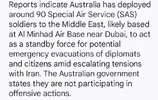
For the record here's the full context of this 'secret' deployment from the Herald Sun/Saily Telegraph story:

1775172622788.webp

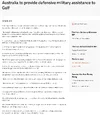
These were the support soldiers mentioned in the Albanese press release of 10 March.

Screenshot 2026-04-03 at 10.04.30 am.webp

So no 'secret' and fully disclosed weeks ago.

Not shocked to see Murdoch press using it as clickbait BS more than 3 weeks later.

Greens Senator Shoebridge linking to it as a gotcha for his supporter base without that context is disappointing and makes him just as culpable for the tired political BS from others he is trying to highlight.
 
Hastie said as much.
Many think Hastie will be the next Liberal PM. Very shrewd, calculated and forthright who presents and articulates his case well. Exactly what a rapidly growing restless section of the Australian voting public is after.

 
Weird how we can have bases and troops everywhere, it's perfectly normal.
There are an estimated 115-120,000 Australian citizens living and working in the UAE where the ADF assets and forces have been sent - by far the largest contingent of Australians living adjacent to the Iran conflict area.

Reckon it's not unacceptable for the Australian Government to provide military support and assistance to protect them (and an important crude supplying ally of course ;)).

Part of the reason many are there of course is because of the very high standard of living, high tax free per capita incomes and to escape Australia's income taxes But that's another story.
 
Everything is workshopped to death these days. They've taken the human factor out of everything and politicians are the same.

In an era of gotcha politics where just a word out of place becomes a headline I just it's to be expected that they would script everything - including emotions.

Remember that time in the 2022 election campaign when Albo was crucified for not remembering what the cash rate was in a press conference?

The days of warts and all Hawke or Keating style off the cuff speeches are long gone.

That speech could be easily replaced by AI. Maybe it was.

This is one of the mistakes mainstream politicians make when faced by the likes of Trump. Trump goes to campaign rallies and says random shit until he gets the reaction he wants from the crowd. Whereas, mainstream politicians try saying all the right things, this leaves mainstream politicians sounding unoriginal and wooden. Albo can throw witty one liners, telling Dutton to "sit down boofhead"
 
This is one of the mistakes mainstream politicians make when faced by the likes of Trump. Trump goes to campaign rallies and says random shit until he gets the reaction he wants from the crowd. Whereas, mainstream politicians try saying all the right things, this leaves mainstream politicians sounding unoriginal and wooden. Albo can throw witty one liners, telling Dutton to "sit down boofhead"

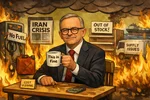
Or it could be that he thinks we are dumb?


file_00000000fce071faaed96a491599302e.webp
 
This is one of the mistakes mainstream politicians make when faced by the likes of Trump. Trump goes to campaign rallies and says random shit until he gets the reaction he wants from the crowd. Whereas, mainstream politicians try saying all the right things, this leaves mainstream politicians sounding unoriginal and wooden. Albo can throw witty one liners, telling Dutton to "sit down boofhead"
while at the same time demanding more respect in Parliament :shrug:
 

Remove this Banner Ad

Remove this Banner Ad

🥰 Love BigFooty? Join now for free.

Back
Top Bottom