Remove this Banner Ad

Cricket History Thread

🥰 Love BigFooty? Join now for free.

Joined
Feb 6, 2013
Posts
12,592
Reaction score
17,479
AFL Club
Hawthorn
G'day Bigfooty cricket. Have been browsing British Pathe's impressive archive of cricket snippets for a while and cricket videos on youtube in general, and thought why not share this with people who actually know something about cricket to get their input? In the absence of a place I thought bigfooty was the next best thing (lol jk), but seriously, thought it might be cool to have a cricket history thread where we go through games of the past and share pictures, videos, and writing relevant to the games of the period in order to gain an understanding and appreciation of the different periods of the grand old game. (Incidentally it will also help me keep track of these c

If the thread lasts long enough to get to the era of massive amounts of ODI's and games that have spectators who are still alive it could be cool to go through as it happened (like posting highlights the day the game happened), but since international cricket was pretty sparse it will be more compressed for the early period. Since the early 1800's era when bowling overarm and scoring off balls down legside was frowned upon is so far removed from the modern sport, and the international games back then weren't Tests until some Aussie retrospectively went back and deemed which games should be Tests, I don't think going all the way back to 1877 is going to generate much discussion, so instead I think a decent starting point is the 1920-21 Ashes, the first tour after WW1 roughly 100 years ago.

However for the grand opening of the thread please see some clips of prehistoric cricket:
Some footage of an elderly WG Grace holding a bat, an absolute unit. Think the other person is the great Ranjitsinhji, inventor of the leg glance.


Photo of Ranji where I think he is playing his leg glance:
kumar-shri-ranjitsinhji-sussex-and-england-circa-1905-picture-id98743118

W. G. Grace's autobiography is available for free from archive.org here: https://archive.org/details/wgcricketingremi00grac

A book which from memory is an introductory text on the sport by the Australian Captain who captained us in the series where the Ashes name originates Billy Murdoch is also available on archive.org: https://archive.org/details/in.ernet.dli.2015.503529

Some footage from the 1905 Ashes. Has the players going out to the field, a team photo, and then some 'staged' cricketing:


The first bat I'm fairly sure is Joe Darling, who played for Australia for about ten years as opener and in the middle order, captained Australia, and was reportedly a solid fielder (although I suspect a solid fielder for the 1900's was not going to give Jonty Rhodes a run for his money). Averaged 28.56 which was respectable for the era. Second or third bat might be Victor Trumper, I can't really recognize any of them though as they lack distinctive moustaches. The keepr looks to be the Australian keeper Jim Kelly.

Some more really early footage, Ranji and CB Fry batting in 1901:


Some cricket in Aus in 1910. Also some footage of the SA side having their team photo taken (one of them gets slapped in the face or something by one of the others which is pretty funny).


The slap:

712172
 
Last edited:
Pathe unfortunately does not seem to have any footage of the 1920-21 Ashes, probably as there wasn't a British camera crew sent to Australia for the series, but I like to think that there was but the footage was destroyed as Australia absolutely thrashed them, whitewashing them 5-0 with one innings victory.

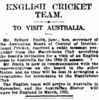
After the hiatus cause by the first World War it seems cricketing relations between Australia and England were reestablished around March of 1920, with Sydney Smith of the Australian board inviting the MCC to tour Australia. The invitation was accepted and it was arranged for England to tour Australia in November 1920 and Australia to tour England in March 1921:
709103
(from Sydney Morning Herald, 27 Mar 1920, p 13)

An introduction to the English touring side.

Here is a photo of the english touring team:


They were:
Arthur Dolphin, age 35, specialist keeper. Had not played Test cricket prior to this series. Scored 442 runs at 17.00 with two 50's, and took 34 catches and 30 stumpings in the 1920 County Season.

Bill Hitch, age 34, right arm fast bowler. Debuted in Test cricket in 1911. Took 107 wickets at 23.16 in the 1920 County Season. Test stats going into this series:

Charles Parker, age 38, left arm spinner. Third highest FC wicket taker of all time helped by pitches of the time, once took three hattricks in a county season. Had not played Test cricket prior to this series. Took 125 wickets at 15.79 in the 1920 County Season.

Here is some footage of an old Parker at training with Gloucestershire int he 30's:


Frank Woolley, age 33, allrounder, left handed bat and left arm spinner/medium pacer. Ludicrous amount of runs and wickets in county cricket. Debuted in Test cricket in 1909. Took 185 wickets at 14.23 and scored 1924 runs at 40.93 with five 100's and nine 50's in the 1920 County Season. Test stats going into this series:

Jack Russell, age 33, right hand opening batsman. Had not played Test cricket prior to this series. Scored 2432 runs at 44.21 with three 100's and twenty 50's in the 1920 County Season.

Footage of Russell batting here:


Abe Waddington, age 27, left arm fast medium bowler, ahead of the curve as he sledged and argued with umpires. Had not played Test cricket prior to this series, and had not debuted in FC until 1919 due to WW1. Took 141 wickets at 16.79 in the 1920 County Season.

Herbert Strudwick, age 40, specialist keeper (in the extreme), debuted in Test cricket in 1910. Scored 273 runs at 9.75 and took 52 catches and 15 stumpings in the 1920 County Season. Test stats prior to this series:

Here is some footage of Strudwick keeping:


Wilfred Rhodes, age 43, allrounder, right hand bat and left arm spinner, longest playing cricketer in the sport playing a staggering 1110 FC matches (and he missed years of cricket due to the World Wars). Debuted in Test cricket way back in 1899. Scored 1123 runs at 28.07 with one 100 and eight 50's and took 161 wickets at 13.18 in the 1920 County season. Test stats prior to this series:

E. Rockley Wilson, age 41, right arm spinner, left FC cricket at 23 and played club cricket due to lower workload until returning when he was 34. Had not played Test cricket prior to this series. Took 64 wickets at 13.84 in the 1920 County Season.

Johnny Douglas (c), age 38, allrounder right hand bat and right arm fast medium. Noted as a stodgy batsman even by the standards of the time. Debuted in Test cricket in 1911 as Captain of the side and aside from one Test in 1912 captained England from then on. Scored 1328 runs at 32.39 with two 100's and six 50's and took 147 wickets at 21.38 in the 1920 County Season. Test stats prior to this series:

Percy Fender, age 28, allrounder right hand bat right arm medium/legspin. Had not played Test cricket prior to this series. Broke his leg in 1919 so did not make his postwar cricket return until 1920. Scored 841 runs at 20.51 with one 100 and four 50's and took 124 wickets at 21.40 in the 1920 County Season.

Jack Hobbs, age 38, right hand opening bat, needs no introduction. Debuted in Test cricket in 1908. Scored 2827 runs at 58.89 with eleven 100's and thirteen 50's and also took 17 wickets at 11.82 with a five-for in the 1920 County Season. Test stats before this series:
Here is some footage of Hobbs playing a few shots for the camera in 1932:


Harry Howell, age 30, right arm fast bowler. Had not played Test cricket prior to this series, and debuted in FC cricket in 1913, shortly before WW1. Took 161 wickets at 17.91 in the 1920 County Season.

Here is some closeup footage of Howell from 1924:


Patsy Hendren, age 31, right hand bat. One of the alltime leading FC run and century scorers. Had not played Test cricket prior to this series. Scored 2520 runs at 61.46 with six 100's and fourteen 50's in the 1920 County Season.

Some footage of an old Hendren playing for Middlesex in the 30's:


Young Jack Hearne, age 29, allrounder right hand bat and right arm legspin (googly). Debuted in Test cricket in 1911. Scored 2148 runs at 55.07 with six 100's and twelve 50's and took 142 wickets at 17.83 in 1920 County Season. Test stats prior to this series:

Harry Makepeace, age 39. Right hand bat. Had not played Test cricket prior to this series. Scored 1762 runs at 41.95 with three 100's and eleven 50's in the 1920 County Season.

Cec Parkin, age 34, right hand offspinner. Had not played Test cricket prior to this series. Took 64 wickets at 17.35 in the 1920 County Cricket season.

Other cricketers who were considered but ultimately were unable to tour were:

Reggie Spooner, age 40, right hand bat. Was offered the captaincy but declined to tour. Debuted in Tests in 1905 and played his last Test in 1912. Scored 167 runs at 27.83 with two 50's in the 1920 County season, playing just three games.

Vallance Jupp, age 29, allrounder right hand bat and right hand offbreak/medium fast. Was selected but unable to travel to Australia. Had not played Test cricket prior to this tour. Scored 1444 runs at 28.31 with three 100's and four 50's and took 111 wickets at 18.56 in the 1920 County Season. Bill Hitch was selected in his stead.

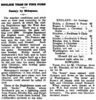
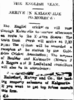
A notable event of the tour was an outbreak of typhoid on the ship the team was travelling on during their voyage to Australia which resulted in the English being quarantined in Fremantle. A picture:


Attachments

  • Argus 1921 newspaper.png
    Argus 1921 newspaper.png
    287.5 KB · Views: 172
Last edited:
Pathé is honestly amazing.

Some footage from the 1905 Ashes. Has the players going out to the field, a team photo, and then some 'staged' cricketing:


The first bat I'm fairly sure is Joe Darling, who played for Australia for about ten years as opener and in the middle order, captained Australia, and was reportedly a solid fielder (although I suspect a solid fielder for the 1900's was not going to give Jonty Rhodes a run for his money). Averaged 28.56 which was respectable for the era. Second or third bat might be Victor Trumper, I can't really recognize any of them though as they lack distinctive moustaches. The keepr looks to be the Australian keeper Jim Kelly.


Third is def Trumper.
 
Moving Ceylon game to new post as England squad post was getting too big:

Before arriving in Australia the English side visited Sri Lanka (then Ceylon) for one day. After arriving Captain Johnny Douglas expressed optimism regarding their coming tour:
709116
From The Telegraph, 13 Oct 1920

They played a tour game against the Sri Lankan side which was limited to one day due to the English travel schedule: https://web.archive.org/web/2016011...rchive.com/Archive/Scorecards/135/135519.html

Ceylon were bowled out for 122 in 35 overs with Frank Woolley taking three wickets, and Dolphin taking four stumpings as keeper. England batted 72 overs scoring 108 and losing nine wickets. and the game was drawn. Wilfred Rhodes top scored making 42.

A report on the match:
709121
From The Sun, 13 Oct, 1920

After the game a reporter spoke to Jack Hobbs and expressed that the English bowling was very weak. Hobbs noted that Hitch had not played (I think from what Hobbs says about Hitch 'following on' that he was selected late and did not sail with the rest of the squad) and would strengthen the bowling lineup. After the game Douglas praised the Ceylon fielding effort, and noted that his side had not practiced.
709130
From Daily Telegraph 14 Oct, 1920

In addition to the lack of match practice and confinement of sailing another report cited excessive heat and poor light as reasons for Englands batting collapse.
709141
From Daily Herald, 15 Oct, 1920

Another argued that the pitch as well as a lack of drive were responsible for the batting collapse:
709146
From Referee, 20 Oct, 1920

Whatever the case it is unlikely that England paid much mind to this inauspicious start to their tour.
 

Attachments

  • Colombo Tour Game Report 2.png
    Colombo Tour Game Report 2.png
    398.4 KB · Views: 176
  • Colombo Tour Game Report 4.png
    Colombo Tour Game Report 4.png
    309.4 KB · Views: 171

Log in to remove this Banner Ad

Yeah Richard Pryor dont think just because no one is replying we're not interested. I think we're just in awe of your research, its epic!
 
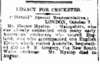
An interesting cricketing related news item that was reported on 11 Oct. Minor FC wicket keeper Hector Hyslop, who played just 9 FC games, but did tour Australia once in 1886 for a series which did not receive Test status left 50 pounds to Syd Gregory, the Australian captain who played Tests for over twenty years (1890 to 1912) accumulating a then record of 58 matches. According to a quick google this adjusts to 2,195.26 pounds in current currency so it was quite a significant gesture.
709800
From Adelaide Daily Herald, 11 Oct 1920

Another interesting cricket article from late 1920 is one in which the author tentatively raises a concern about the length of cricket matches, expressing that baseballs short games have an advantage, although he goes on to brag about the lack of betting and corruption in cricket (one hopes that the writer did not survive to see Marsh and Lillee making beer money in the Ashes):
709815
Excerpt from longer article in Western Argus, Oct 12, 1920

Regarding the tour, it appears there was some concern about covering the costs of the tour, which was budgeted to be 14,732 pounds (which comes to 646,810.50 pounds today, which according to google is $1,150,381.58. A report in a West Australian paper mentions that the secretary of the Vic Cricket Assoc. "anticipated gate receipts would not cover Victoria's share of the expense", which I think is basically the guy grumbling that Victoria is subsidizing the West Australian games.

Another interesting bit of information from the same report is that a newfangled piece of technology was going to be introduced to Australian cricket during the tour. Pitch covers! The pitches were to be covered prior to the Tests if necessary presumably for the first time in Australia. The report mentions that a game at Lords recently used covers DURING a match, but I get the impression that this was seen as a bridge too far:
709812
From Perth The Daily News, Oct 12 1920

As mentioned earlier England's first game scheduled for the tour in Australia was a game against Western Australia, At this time West Australia was not apart of the Sheffield Shield, instead playing intermittent FC matches against the eastern states, which explains why the earlier report mentions that England would be playing South Australia after arriving in Aus with the West Australian game being mentioned as an afterthought. In preparation for playing England WA played scratch match for the selectors benefit, coincidentally beginning on the same day England played Ceylon (October 11).:
709810
From Brisbane The Daily Mail, 11 Oct 1920

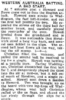
Unfortunately the scan at trove of the article newspaper on the first day of this match is quite illegible so I will instead quote it. From reading the report my main impression is that it is lucky nobody was severely injured during the match:
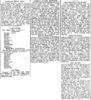
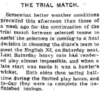
The trial match arranged by the W.A.C.A. between selected teams was spoilt by the weather conditions on Saturday morning. Heavy rain rendered the wicket unfit for play at the appointed time and it was 3.30 p.m. before a start could be made at all. Even then the water could still be squeezed out of the ground and foothold was difficult. It was decided to let each side bat half time in order to see as many of the men as possible playing under the trying conditions. Winning the toss Christian decided to let his side have first try and in the time allotted them they got 69 for 6 wickets.

Howard was in 55 minutes and Meek, Renfrey and Christian in getting double figures showed acquisition of early form. Sundries topped scored for them with 16. Buttsworth, who bowled rather well, secured the wickets.

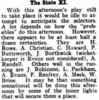
Rowe's team made a reply of 65 for 5 wickets. Randall is 26 not out and Rowe notched 21. Both men showed promising form. Randall was in for one hour and exhibited greater defensive powers than usual. Alan Evans with 2 for 5 off 5 overs bowled ably and Packham got two wickets at moderate cost.

The game will be continued next week end when both sides will complete their innings.

Another report was considerably more critical, noting that the fielding was exceptionally poor (with the ball being rolled back to the keeper) and describing the bowlers as "trundlers":
709824
From The West Australian, Oct 14, 1920

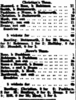
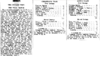
The scorecard of the first day:
709816
From The West Australian, 11 Oct 1920

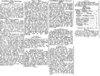
After the first day a reporter noted that Rowe, Christian, Howard, Buttsworth, and Borthwick were likely locks for the England game, with Robinson, Packham, Evans, Renfrey, Meek and Brine looking to be the others selected.
709826
From The WA Record, Oct 16, 1920

The next weekend had better conditions, and both sides completed their first and second innings:
From Perth, The Daily News, Oct 18, 1920

709820
From The West Australian, Oct 18, 1920

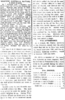
The Western Australian side for the game against England was selected and reported by the 18th of October, two days after the practice games second day:
709828
From Perth Daily News, Oct 18, 1920

To put the information in the above into a similar format as used for the England squad. Stats are from above article and are for club cricket 1919-20.

Western Australia XI, 1920
1. Harold Rowe (c), age 37. Debuted for WA in FC in 1905, and was Premiership player for West Perth in the WAFL the same year. Scored 12,045 runs in West Australian cricket which is the record. Would notably go on to successfully lobby for WA to enter the Sheffield Shield as an administrator. Scored 448 runs at 49.70 in WA cricket for 1919-20

2. Arthur Christian, age 43. Debuted in FC cricket for Victoria in 1904 and played for them until 1906. Moved to WA in 1907. Wrote columns for the West Australian on cricket which were compiled and published as Hints to Cricketers in 1934 which is freely available here. A brief overview of his career in WA from that publication:
Arthur Christian came to Western Australia in 1907, and for 14 seasons was the best all-round player in the State. Among outstanding performances were his double of 73 and 57 runs against South Australia in April, 1909, and taking 7 wickets for 144 and 4 for 56 in South Australia's second innings which was declared at 5 for 116. Playing against Victoria in 1910 he scored 31 and 97 and took 4 for 149 when Victoria made the big total of 563.

In all he played 34 innings for Western Australia to score 793 runs and took 82 wickets at 25.7.

CLUB CRICKET N WESTERN AUSTRALIA

Batting: 207 innings, 33 not out, 6,655 runs, average 38.3
Bowling: 3,000 overs, 522 maidens, 8,578 runs, 995 wickets, 8.6 average.
On two occasions he took over 100 wickets in a season, a feat equalled only by "Bobbie" Selk.

Scored 339 runs at 39.80 and took 59 wickets at 9.40 in WA cricket for 1919-20

3. Harry C. Howard, nicknamed Tim, age 35. Debuted for WA in FC in 1905. Played cricket in WA well into his 40s. Seems to have been regarded as a slow batting stonewaller. Scored 491 runs at 54.05 in WA cricket for 1919-20

4. Robert Blundell, age 24. Had not made FC debut as of this match. Also played football for West Perth. Fought in WWI with the 108th Howitzer Battery of the 3rd Division and the Australian Flying Corps *. Became paralyzed losing the use of both legs in the 1930s, was killed in a car accident in 1940 -. Rowe rated him as the best fielder of early WA cricket*, he generally fielded at cover point*. Scored 268 runs at 17.80 and took 27 wickets at 17.70 in WA cricket for 1919-20,

5. Leslie Renfrey, age 27. Had not made FC debut. Fought in WWI*. Also played baseball*. Scored 217 runs at 19.70 and took 21 wickets at 21.20 in WA cricket for 1919-20

6. Fred Buttsworth, age 40. Had not made FC debut. Scored 108 runs at 15.40 and took 50 wickets at 11.80 in WA cricket for 1919-20 (noted as the quickest of the WA bowlers in a report on the scratch match). His sons Wally and Fred both played for West Perth and Essendon in football and WA in FC cricket.

7. G. Borthwick (wk) did not ever play for WA in FC. Seems to have become an umpire by the 1950s? although may be different person*. Scored 185 runs at 11.50 in WA cricket for 1919-20

8. Leonard Packham, age 29. Had not made FC debut. Scored 241 runs at 17.20 and took 12 wickets at 35.00 in WA cricket for 1919-20

9. H. Nurse did not ever play for WA in FC. Scored 30 runs at 5.00 and took 31 wickets at 8.50 in WA cricket for 1919-20, debuted in the middle of that season (see article in next post).

10. Alfred Randell, age 36, who debuted for WA in 1912. Would eventually serve as Chairman of the WACA. Wrote the foreword to Christian's Hints to Cricketers. Scored 369 runs at 30.70 in WA cricket for 1919-20

11. Allan Evans, age 23. Had not made FC debut, but had played footy for Perth in the WAFL since 1917. Scored 244 runs at 24.40 and took 7 wickets at 16.50 in WA cricket for 1919-20

12. Andrew Meek age 31. Had not made FC debut. Scored 184 runs at 10.80 and took 21 wickets at 22.30 in WA cricket for 1919-20

The player who the article argues was robbed of a spot was Charles Robinson, age 41, played FC cricket for Tasmania from 1912 to 1914.
 

Attachments

  • Day 2 pre-report.png
    Day 2 pre-report.png
    91.9 KB · Views: 166
Last edited:
The tour match between England and West Australia was scheduled to take place over three days, Oct 23rd, 25th and 26th. Amusingly schoolboys specifically were not permitted to use the grandstand.
710226
From Perth Daily News, Oct 15, 1920

In anticipation of the arrival of the English team a reporter from the Melbourne Herald who was to accompany the English for their whole tour arrived in Perth on October 19th:
710265
From Perth Daily News, Oct 19, 1920

An anecdotal reaction from a WA fan was recorded in the form of a letter to the editor, which condemned the selectors, lamenting (at length) the omission of Robinson and a Smith who played for North Perth, criticizing the records of Rowe, Randell, Howard, Christian in order to make his case, and concluding that the selectors are biased flogs selecting based on their club loyalties. Truly an epic ye olde melte that would no doubt have been on a 1920's bigfooty. It's even signed MID FIELD which seems like a username:
710296
From Perth Daily News, Oct 19, 1920


The English team was to arrive in Australia at Fremantle on the 21st of October. There was a sort of response to the Victorian cricket officials comment that WA was unlikely to recoup the cost of the match in a WA newspaper, with an article calling for those complaining WA didn't play regular FC cricket to put their money where their mouth was and rock up to the game:
710273
From The WA Record, Oct 16, 1920

A WA net session shortly before the tour match was reported on by a local paper. It also lamented that Robinson wasn't selected. Regarding the men in the side it noted that Packham was a big hitter, but needed to pull his head in the game. It also notes that Meek was selected on the back of his performance in the practice match. It also reports some opposition to Evans selection, the youngest player in the side, but defends it on the basis of his fielding:
710293
From Perth Daily News, Oct 19, 1920

As the arrival of the English approached it seemed excitement began to ratchet up for WA cricket fans, especially seeing as they were to be the first to see English cricketers in action since the beginning of WWI. Local businesses also seemed enthusiastic with a full entertainment itinerary being filled by local entertainment establishments:
710299
From The West Australian, Oct 20, 1920

Harold Rowe was interviewed at a net session on the 20th. He added his voice to the chorus lamenting Robinson's omission from the side, so I feel that it is pretty conclusive that Robinson did in fact get screwed by the selectors. Rowe also notes that Nurse only debuted in the middle of the previous season, rating him as an unknown quantity. He also noted that the side was very green (as a positive) and that it had not had any match practice. One gets the sense that this West Australian team were the proverbial lambs to the slaughter:
710302
From Perth Daily News, Oct 20, 1920

In light of the recent addition of numbers to Test uniforms for the upcoming Ashes it is interesting to see a letter to the editor in which someone suggests that players be allocated numbers on the tour match programme, and displayed on the scoreboard as players come out to bat so that spectators would know who the Englishmen were (presumably the scoreboard could not accommodate surnames at this time). Another letter in the same segment is a Tasmanian adding fuel to the "Justice for Robinson" fire by providing his pre-war stats in the Tasmanian competition":
710303
From Perth Daily News, Oct 20 1920

I think I've just about reached the limit for files added to a post for this one, I think the next one will actually be able to cover the tour game.
 
I've got a scrapbook that I bought which is Bodyline by Larwood, a series of articles he wrote for a newspaper directly after the series and presents quite a different view of him to the reluctant participant that we have now. He describes the "effeminate outcry" from certain critics and describes Woodfull's famous quite about two teams playing cricket as being unworthy of him. I've also got one full of clippings from the 53 Ashes tour, I'll try to scan them and put them up here.
 
There is a good preview of the England/WA match with player profiles available here which I think is a little too large to post as an image here.

The English cricketers finally got to Australia on October 21st, however disaster struck. A passenger who had been aboard the ship carrying the English team was diagnosed with Typhus after disembarking in Colombo, which resulted in the team being quarantined after arriving in Fremantle, which put the scheduled game against WA in jeopardy:
711692
From Kalgoorlie Miner, Oct 21 1920


Another report suggested that if the quarantine lasted too long the team would likely set sail for Adelaide.
711695
From Geraldton Guardian, Oct 21, 1920

The reason that this setback endangered the fixture altogether was that the English team needed to depart WA for South Australia in order to make their fixture against South Australia. Douglas noted that the side wanted to play the match and would do so as soon as the quarantine was over, schedule permitting.

Another item of interest next to this article was a response to the person who earlier suggested that players receive numbers which be printed on a cricket record and displayed on the scoreboard. My assumption that this meant that scoreboards did not accomodate names is incorrect, as the secretary of the WACA helpfully notes that while this was the case in England where the cricket boards made bank by essentially holding the player names ransom by selling cards, we Australians were in fact able to portray player names on the scoreboard:
711694
From Perth Daily News, Oct 21, 1920

A profile on Douglas was published on the 22nd, noting the nickname the Australian crowds had heckled with him (based on his initials JWHT).
711697
From Call, Oct 22 1920

The WACA reached out to see if the quarantine could be lifted to allow the match to take place:
711696
From Perth Daily News, Oct 21, 1920

On the 22nd representatives of the WACA went out to the ship the English team were on and negotiated via shouting up to the ship, which resulted in progress. The English were to remain in quarantine, but ashore.
711699
From Perth Daily News, Oct 22 1920

Also on the 22nd a reporter seems to have snuck aboard the ship and was able to interview Douglas:
711701
From Perth Daily News, Oct 22 1920

Douglas also gave an interview from the side of the ship available here, and the article also includes some valuable commentary on the state of English cricket and some statistical notes. The quotes of Douglas, which seem a little pessimistic.:
Speaking from the ship's side Mr. Douglas stated that all his men were well, though rather tired of the confinement enforced by shipboard travel. Three of the party - Messrs. Hobbs Hendren, and Strudwick had been rather "off colour" during the voyage, but Mr. Douglas anticipated that a few days' shore exercise would see them in their normal condition.

What are your anticipations of your Australian games? Mr. Douglas was asked
"It is impossible to prophesy," replied Mr. Douglas, smilingly, "but we are very optimistic. We are proud of having a very strong side, and I need not assure you that we intend to intend doing all we can to take the 'ashes' back with us. Can we reproduce the form we displayed in England. I am sure our team will render an excellent account of itself.

Is cricket popular in England?
"It has never been so popular as it is to-day. Of course, you can understand that the preparation of a team for the Australian tour aroused tremendous interest which is being sustained. The eyes of practically all the British public are centred upon the team we bring you, and, of course cricket gets a tremendous fillip from that interest. I can only say this: Our team is good. We want to keep the 'ashes,' but may the best team have them."

...

When spoken to of Barnes, and the statement made in certain quarters in England that his inclusion should have been effected at any cost, Mr. Douglas remarked: "I should have liked Barnes to have been with us because from what he has already done in Australia I believe he would have been successful. There is this to consider however: Barnes is not a young man, and we have a strenuous programme ahead. I preferred to bring out younger players who are likely to develop into great batsmen or bowlers than those who must, in a comparatively short time, drop out of first-class cricket.

"This is one of the reasons I was so delighted when an invitation was sent to V. W. C. Jupp, the young Sussex player, to become a member of the team. I knew that if he could see his way clear I would have another fine all-round cricketer in the side. I have a very high opinion of Jupp; as a matter of fact, I believe him to be a coming England test match player. There is not a branch of the game at which he is not an adept - batting, bowling, and fielding, either close to the wicket or in the outfield.

"What is my opinion of the batting? Tell your readers that I regard it as very powerful. The players we have who have not yet samples Australian wickets will soon be accustomed to them. That sounds dogmatic doesn't it? Nevertheless, I am confident it will be so. I do not assert or prophesy, that they will repeat their scoring powers as demonstrated in England this summer, but I encourage the hope that they will; and do not be surprised if some do even better.

"On the other hand, do not be surprised if some fail short of their past achievements. Every batsman who comes to Australia for the first time has to unlearn something, and that is more difficult than to learn something. What he must learn are certain scoring strokes that are sure run-getters in England. They do and will not pay here, and the brainy batsman will soon sense on that fact, and think out others that will serve his purpose equally well. It has been said that with three such left-handed bowlers in the team as Woolley, Rhodes, and Waddington, we should be able to get the Australians out without any great difficulty. Those who said that had never been to Australia. Most of the wickets in this country are very fast, how fast only those who have played on them can realise. The Australian batsmen never give anything away. You have to get them out by skill and cunning, and it is a curious fact that generally left-hand slow bowlers have met with outstanding success, because it is so seldom that they have a wicket that helps them in the least degree.

"I consider myself fortunate in my colleagues. A nicer lot of fellows and a finer lot of sportsmen have never been got together. While I will not prophesy about what we shall do, I have no hesitation in predicting that we shall always put our full weight into every match we play.

"My message to the Australian cricketing public is this: 'We have come out strong in hope.' I need not emphasise that we shall do our very best. We trust that we shall retain the 'ashes,' but if we do not we shall lose them to some of the finest sportsmen in the world."

England went into onshore quarantine at Woodmans point where they were able to begin practicing on a makeshift pitch:
711703
From The West Australian, Oct 23 1920

A photo of some of the English team in quarantine ashore:
''

In order to not waste the efforts made to organize a match a 'WA A' team of sorts was selected at short notice to play the WA cricketers. The fans of the time would have been pleased to see Robinson get another chance to show his stuff, and Rowe likely would have been quite pleased given he had expressed that the team lacked match practice heading into the England game:
711707
From The West Australian, 23 Oct 1920

The WA Next Best side was

Dolph Heinrichs, age 37, born in Germany, played football for East and Nort Fremantle beginning his WAFL career in 1899. Had not debuted for WA yet.

Charles Robinson, age 41, see above

William Stokes, age 34, had not debuted for WA yet.

T. Healy, may be Eric Healy age 32, had not debuted for WA yet.

A. Meck, never played FC cricket for WA

H. Rose, never played FC cricket for WA

F. Halliday, never played FC cricket for WA

A. Watts, never played FC cricket for WA

A.D. Hill, never played FC cricket for WA

G. Jameson, never played FC cricket for WA

E. Smith, never played FC cricket for WA

V. Murphy, never played FC cricket for WA

H. Guy, never played FC cricket for WA

R. Clarke (12th man), never played FC cricket for WA

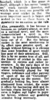
On an unrelated note, I found this fascinating article regarding bowlers pace. With rudimentary techniques Charlie Turner, a medium-fast bowler of the 1880's and 90's was timed at 55.5 mph (a gentle 89.31 kph), and the writer estimates that the true fast bowlers could have gotten it up to over 60 mph (96kph):
711709
From Gnowangerup Star and Tambellup-Ongerup Gazette, Oct 23 1920
 
Last edited:
Remove this Banner Ad

In the WA v Next Best match the WA side batted all of the first day.
711734
From The West Australian, Oct 25 1920

The highlight of the first day was Rowe scoring twelve off an over.:
711730
From Perth Daily News Oct 23 1920

On the second day the WA XI got up to 400 with Rowe tonning up. Robinsons supporters would have been pleased with his showing with the ball, taking 6-for, but he was bowled for six opening the Next Best's first innings, damaging the arguments that he was required to strengthen WA's batting. The Next Best's poor showing was unlikely to have dislodged anyone from the WA side:
711739
From The West Australian, Oct 27 1920

On the 24th NSW also played an intra-state match in preparation for the English, which is of far greater interest as it has actual ramifications for the Ashes squad on Australias side, but will cover in a different post.

On the 25th the WACA announced that the game was cancelled, and that instead Douglas would try and organize for England to play WA at the end of the tour:
711735
From The West Australian, 25 Oct 1920

However the quarantine situation evidently resolved itself earlier than expected as by the 27th the match had been uncancelled and scheduled as a one day game for the 30th. This was quite the gesture from the English, as they were departing WA by train in the evening immediately following the game!:
711741
From Perth Daily News, Oct 27 1920

The enthusiasm which had dissipated built back up:
711748
From Call, 29 Oct 1920

Here is another report of the second WA intra-state match in light of the England game going ahead:
711746
From Western Mail, 28 Oct 1920

A more detailed report of the intrastate match is available here. Apparently Rowe only edged one delivery to the slips, but his century was otherwise chanceless.


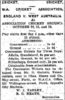
The new innovation mentioned earlier, pitch covers, were put into action ahead of the England match, which could perhaps be the first time a pitch was covered ahead of a game in Australia?:
711743
From Perth Daily News, Oct 28, 1920

On the 29th the English finally 'arrived' in Australia, leaving quarantine. Hundreds came to see them practice in the nets ahead of tomorrows game:
711749
From Perth Daily News, Oct 29 1920

In order to maintain hype it seems a film of the English team was also shown at a theatre on the eve of the match (unfortunate that Pathe does not have this):
711750
From The West Australian, Oct 29 1920
 
Hitch had not yet arrived in Aus, having been selected late. The WA selectors disappointed fans by leaving Robinson out despite his 6-for against the WA Best XI:
711751
From Perth Daily News, Oct 29 1920

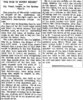
The following day England finally took the field for the first time on Australian shores since the beginning of WWI before a crowd about 3000 strong (perhaps shrunk slightly by conflicting reports about whether or not the game was still happening). Douglas won the toss and England went in to bat. A play by play report of their innings:
711756

711757
From Perth Daily News, Oct 30 1920

The highlights for WA were the youngster Nurse taking a 5-for and silencing critics who thought Robinson should have had his spot, and the veteran Christian who took three. Highlights for England were the legendary Hobbs passing 50, and first-time tourers Hendren passing 50, and Makepeace making a century.

After a sporting declaration, giving the WA crowd a chance to see their men bat and England bowl, England had a very strong bowling start:
711762
From Perth Daily News, Oct 30 1920
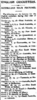
Scorecard of the match

All in all a fair trouncing of the WA side, which makes the truncated nature of the match perhaps a blessing in disguise. WA's bowling effort was fairly respectable for a side of players who had largely not played FC cricket against a Test batting lineup. England perhaps took some heart given the concerns over their bowling being weak, but may have regarded this as reflecting more on the quality of the WA batsmen than anything else. In any case for England it was probably a heartening, but largely inconsequential, start to their tour ahead of their tour games against Australias actual FC teams.

Portrait of Makepeace, also an international soccer player for England, the top scorer of the match:
''
 

Attachments

  • WA innnings start.png
    WA innnings start.png
    134.1 KB · Views: 152
A post-match report noted that the game had pulled 500 pounds (roughly 39,000 Aus dollars today), with another report estimating from 7,000 to 8,000 attending the match in total. It also described the WA batting effort as creditable:
From Perth Sunday Mirror, Oct 31 1920

The English team departed directly after the match and set off for the East, arriving in Kalgoorlie on the 31st:
From Boulder Evening Star, Oct 30 1920

This swift departure was required as England was scheduled to play their more important tour game (with actual FC status) against Australia on November 5th, for which they were likely to need more than a single net session:
711980
From Pilbarra Goldfield News, Oct 19 1920

With the extremely uncomfortable and grueling conditions with which this Ashes tour got off too one can forgive Spooner for declining to captain the English touring side.

Next will focus on the NSW intra-state match, and the opening of the Sheffield Shield season, which happened during the debacle that was trying to have WA play England.

A photo of some of the England players taken during the train voyage from Perth to SA:
''
 
Caricature of Johnny Douglas from 1920 ahead of the Ashes. An amusing anecdote is in the article the picture accompanies, apparently when W.G. Grace first saw Rockley Wilson (spinner who was apart of the touring squad) he described him as the worst bowler he'd ever seen.
713691
From Referee, Oct 20 1920
 
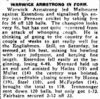
On the Australian side of the Ashes, the earliest lock for the squad was the Captain. Allrounder and renowned big unit Warwick Armstrong, age 41, who was to captain Australia. Frank Iredale, who played 14 Tests for Australia in the 1890's averaging about 37, wrote the following profile of the Captain:
713692
From Perth Daily News, Oct 19, 1920

In the leadup to the Ashes it seems in early October he played a club game for Melbourne, taking 5 for 56:
713693
From Referee, Oct 20, 1920

The big man himself in 1921:
''

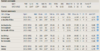
His stats as of 1920
 

🥰 Love BigFooty? Join now for free.

Have some free time looming so to stave off the existential dread of solitude I might fire this baby back up again.

In the meantime thought I would plug this wikipedia article I just finished up on 1920's SA cricketer Dave Pritchard: https://en.wikipedia.org/wiki/David_Pritchard_(cricketer)

It's pretty interesting to me how the more things change the more they stay the same. Was Pritchard unjustly robbed of a Test career by parochial selectors too scared of an unorthodox maverick in the Test team? Or was he an agricultural slogger who had a couple of lucky seasons and cashed in on a sub-par grade competition? You be the judge!
 
Have some free time looming so to stave off the existential dread of solitude I might fire this baby back up again.

In the meantime thought I would plug this wikipedia article I just finished up on 1920's SA cricketer Dave Pritchard: https://en.wikipedia.org/wiki/David_Pritchard_(cricketer)

It's pretty interesting to me how the more things change the more they stay the same. Was Pritchard unjustly robbed of a Test career by parochial selectors too scared of an unorthodox maverick in the Test team? Or was he an agricultural slogger who had a couple of lucky seasons and cashed in on a sub-par grade competition? You be the judge!

100 years before his time!
 
Hope this is appropriate for this thread. On October 5 and 6 of 1868, the Gentlemen of Middlesex played a second-class match against a team of 22 players called The Clowns. The Clowns played in full theatrical costume although the match itself was thought to be a farce. However, the idea of a Clown team proved popular and by 1875 there were three Clown teams touring around England.
 
Hope this is appropriate for this thread. On October 5 and 6 of 1868, the Gentlemen of Middlesex played a second-class match against a team of 22 players called The Clowns. The Clowns played in full theatrical costume although the match itself was thought to be a farce. However, the idea of a Clown team proved popular and by 1875 there were three Clown teams touring around England.


They reformed during the 1990s and just wore the England national uniform
 

Remove this Banner Ad

Remove this Banner Ad

🥰 Love BigFooty? Join now for free.

Back
Top Bottom