
Remove this Banner Ad

Mid East Israel attacks Iran. What are the likely consequences? How will it be resolved?

🥰 Love BigFooty? Join now for free.

What in my post was "cooked"?

Example or withdraw please.
I am not just referring to one particular post.
Every post you make is cooked to smoking point with Zionist ideology and therefore completely false narratives.

You haven't bothered to reply to my post in which I exposed your absurd lies that Iran is the main threat of violence and destablisation in the Middle East, rather than Israel and the US.
 
Netanyahu has played Trump from the start and he is not about to stop. His goal is always war - and Netanyahu will do everything he can to drag Trump into it.
Unfortunately, this is totally inverted.
Trump and Netanyahu are working together. Far from Netanyahu "playing Trump", Trump and Netanyahu together are implementing plans that US imperialism has been incubating for decades: ie the destruction of the ayatollah regime (which replaced their darling proxy, the Shah and for which they have been seeking revenge ever since) and the reorganisation of the Middle East under the hegemony of US imperialism and its sidekick Israel.

Likewise, Biden was working with Netanyahu in the same manner. Biden tried to cover his tracks by occasionally weeping crocodile tears about the horrific loss of life in Gaza, while at the same time bankrolling the IDF.

Trump has continued from where Biden left off. Trump has openly declared that Gaza will become US real estate once his buddy Netanyahu has ethnically cleansed it.

Israel is fundamentally a beachead of US imperialism in the Middle East. At all times they work in tandem. Everything Netanyahu does is first submitted to and then approved by the US administration , first Biden, now Trump.
 

Log in to remove this Banner Ad

obviously not on you. but there are enormous numbers who it will. and if you lifted your gaze, you'd know diaper donny loathes it when people with a following don't adore him.
Trump is a representative of the US financial oligarchy. He is not fundamentally driven by narcissistic considerations.
Yes, he is a narcisstic, backward , fascist goon, but he is a representative of the US capitalism which has embarked on a course of military violence to offset its economic declien.

The Catholic Church is not an opponent of imperialism. Like all religions in the contemporary period, it acts to defend capitalism by pretending that there is a solution through the love of god, the will for peace , the embrace of the Holy Spirit.

But millions of people, who are still influenced by this, as the barbarism of Trump and imperialism is more and more on display, will start to see through this charade. The salvation of mankind won't come from divine intervention, it will come when millions of people become clear that they themselves are the ones who must intervene to change history.
 
Trump is a representative of the US financial oligarchy. He is not fundamentally driven by narcissistic considerations.
Yes, he is a narcisstic, backward , fascist goon, but he is a representative of the US capitalism which has embarked on a course of military violence to offset its economic declien.

The Catholic Church is not an opponent of imperialism. Like all religions in the contemporary period, it acts to defend capitalism by pretending that there is a solution through the love of god, the will for peace , the embrace of the Holy Spirit.

But millions of people, who are still influenced by this, as the barbarism of Trump and imperialism is more and more on display, will start to see through this charade. The salvation of mankind won't come from divine intervention, it will come when millions of people become clear that they themselves are the ones who must intervene to change history.
He did just say on camera that Netanyahu has no ****ing idea what he is doing. Has any US president ever said anything like this about Israel
 
^The Iranian regime made the mistake of believing that he was intending to carry out negotiations with Iran. This turned out to be a ruse to lull them into a false sense of security so that Israel could carry out a surprise attaack which killed high ranking Iranian government officials, negotiators, and army commanders.

Trump is the contemporary Hitler. he is a total political criminal, everything he says is a lie and potentially an act of perfidy. International law for him means absolutely nothing. He has discarded any consideration of it.

That is the difference between him and Biden. Biden, while funding genocide, tried to maintain the pretence that his administration observed international law. Trump has shredded the facade. He is openly proceeding like Hitler's regime: a completely criminal regime which does not abide by any principles of international law.
 
Last edited:
Netanyahu has played Trump from the start and he is not about to stop. His goal is always war - and Netanyahu will do everything he can to drag Trump into it.

Bibi is trying to warmonger to stave off the corruption charges coming when he leaves office and Trump is a moron who knows no better.
 
Yes, impending corruption charges have definitely been a factor in Netanyahu's machinations. But beyond that, he is a representative of the Zionist ruling class, which in turn is a servant of US imperialism. The Zionist state would collapse overnight if US imperialism cut off all funding, military assistance, political support.

He has been permitted to get away with avoiding these charges simply becaues he is such a willing accomplice of Israeli capitalism in its role as the lapdog of US imperialism in the Middle East.

But the motivation of avoiding corruption charges is still not the fundamental impulse explaining the actions of Netanyahu and his fascist accomplices in the current Israeli government.

They are bought and paid agents of US imperialism. The Zionist bourgeoisie bases its continued economic survival on the support of US imperialism. Hence the Zionist regime has been acting at all times in sync with Washington.

It is an open secret that Israel intelligence was well aware of the impending Hamas attack on Oct 7 2023, and allowed it to happen (even stood down their border security on the day) to create a pretext for "solving the Palestinian problem".

Naturally the US gave them full political cover. Who can forget Biden going on international media screaming about the deaths of Israeli babies at the hands of Hamas terrorists? These Goebbels like lies were then dutifully publicised by the capitalist media, until Biden was forced to admit that in fact he had seen no such evidence.

Now Netanyahu and Trump are operating together with the aim of effecting regime change in Iran, in order to allow the unrestrained domination of this country by US imperialism.

The current "ceasefire" that Trump has proclaimed will no doubt in the near future turn again into its very opposite, because of the extreme criminality and duplicity of the Netanyahu - Trump nexus.
 

Remove this Banner Ad

Text from it if you can't locate it online.

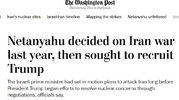
Netanyahu decided on Iran war last year, then sought to recruit Trump​


By Gerry Shih, Warren P. Strobel and Souad Mekhennet

JERUSALEM — In the fall, long before President Donald Trump embarked on an effort to resolve concerns over Iran’s nuclear program through negotiations, Prime Minister Benjamin Netanyahu had already set Israel on the road to war, according to current and former Israeli officials.

After Israel decimated Iran’s air defenses in a missile skirmish and crippled its main ally, Hezbollah, in October, Netanyahu issued a general order to prepare for a strike, the current and former officials said. Israeli intelligence officials began huddling to compile lists of dozens of Iranian nuclear scientists and military leaders who could be targeted for assassination. Israel’s air force began to systematically take out air defenses in Lebanon, Syria and Iraq to clear the skies for future bombing runs against Iran.

Meanwhile, Israeli officials were pursuing another track in their preparations — to sway Washington. Israeli officials have long believed that military action with U.S. participation to target the Iranian nuclear program would be more effective than Israel going alone. On Saturday, Trump indeed joined the conflict, ordering U.S. forces, including B-2 strategic bombers, to strike three Iranian nuclear sites.

Throughout the fall, the Israelis had met with their Biden administration counterparts to discuss intelligence collected by both countries in the summer that showed Iranian nuclear scientists were gathering to resume theoretical research on weaponization, according to three people with knowledge of the matter. But U.S. intelligence analysts did not conclude that the Iranian leadership had made such a decision — an assessment U.S. spy agencies revisited and maintained throughout the spring under the new Trump administration and up until the time Israel launched strikes, said five people familiar with the conclusions.

In private conversations, however, senior Israeli government officials said they had already decided by March, weeks before Netanyahu met Trump in the Oval Office on April 7, to strike Iran with or without U.S. participation by June at the latest, said two people with knowledge of the matter. The reasoning was that Iran would have rebuilt its air defenses by the latter half of the year, one of the people said.

Ultimately, when Netanyahu finally launched his surprise attack on Iran in the early hours of June 13 while Trump’s negotiations were still underway, the decision was not so much driven by new intelligence indicating an Iranian sprint for a nuclear weapon or any imminent threat to Israel. Rather, Israel seized on what it saw as a unique opportunity to execute plans, carefully laid months and years in advance, to heavily damage a weakened Iran that had long waged a bloody proxy conflict with Israel and to set back Iranian nuclear and missile programs, Israeli and U.S. officials and advisers to both governments say.

Whether or not Netanyahu had enough evidence of Iranian progress toward a nuclear weapon to justify an attack has been the subject of intense debate globally and raises questions about the strikes’ permissibility under international law. In recent days, the issue has appeared to generate friction inside the U.S. administration, with Trump repeatedly dismissing the assessment delivered in March by Director of National Intelligence Tulsi Gabbard that Iran’s leadership has not ordered the development of a nuclear weapon and telling reporters that he personally believed that Iran was “very close” to a bomb.

Netanyahu, who has argued for decades that Iran was on the verge of acquiring nuclear weapons and should be halted by military strikes, has acknowledged in recent interviews that Iran was still months or a year away from a weapon. What was undisputed, he has said, was that Iran had enriched large amounts of uranium to a level well beyond what is required for civilian use and built up a dangerous arsenal of ballistic missiles.

Israel’s calculus for attacking Iran was driven by a sense of both opportunity and necessity, said an Israeli official who, like many others quoted in this article, spoke on the condition of anonymity to discuss internal deliberations.

“It is true there was no better time: Israelis have never been more well-practiced, and Iran and their proxies have never been weaker,” said the Israeli official. “But that’s not enough for us to operate. The reason we operated is necessity and understanding there is no alternative. What if they break out [toward a nuclear weapon] and there is no way for us to notice? There is no safety zone left.”

U.S. intelligence agencies beginning late last year picked up on Israeli preparations for an attack and warned Washington policymakers that Israel was likely to strike in the first six months of 2025.

But Netanyahu’s plan was unexpectedly delayed when he was summoned to Washington to meet Trump and told that the United States would enter direct negotiations with Iran to solve the problem diplomatically. The prime minister’s strong inclination to strike, however, remained unchanged, said a person with knowledge of the thinking of top Israeli officials.

Going into the spring, there was also concern among Israeli officials that any potential deal between Trump envoy Steve Witkoff and Iran would still allow Iran to eventually possess a bomb, an Israeli official added. And, a former senior Israeli official said, the Israelis had been anticipating the scheduled retirement of Gen. Michael E. Kurilla, the U.S. Central Command chief who had helped make war plans with Israel throughout the spring.


In an interview Tuesday with pro-government Channel 14 television, Netanyahu said that he had decided on the exact timing of the strike only two weeks earlier, but that he had made the “difficult” decision to carry out the operation “several months ago” and began fleshing out the plan and its element of surprise in April.

The key was to eliminate the nuclear experts, Netanyahu said: “Those were my instructions: We’re going after the scientists, take them out.”

In Israel, the majority of the security establishment and political parties have supported Netanyahu’s decision to execute what they consider a preventative strike. For decades, a bedrock of Israeli strategic thinking has been the “Begin Doctrine,” named after former prime minister Menachem Begin, who defended Israel’s 1981 bombing of the Osirak nuclear reactor in Iraq as “anticipatory self-defense” against a potential enemy making a weapon of mass destruction.

But a minority of those have questioned the wisdom of carrying out a surprise attack while Trump was still pursuing the diplomatic route — and, they say, without proof that the Iranians had decided to construct a nuclear weapon.

“We should have given the political route a chance,” said Danny Citrinowicz, a former head of the Iran desk in the research department of Israeli military intelligence. “Now, we got operational achievements but the risks are enormous. We’ve never fought with a country like Iran. We find ourselves not knowing where the [highly enriched uranium] or centrifuges are. If we had an agreement, we would at least have less unknowns.”

Since Trump pulled out of the Obama-era nuclear deal with Iran in 2018, Iran has sharply increased its stockpile of near-weapons-grade enriched uranium, according to the International Atomic Energy Agency. But intelligence agencies have debated whether Iran has resumed its effort to build a weapon — known as Project Amad — that was halted by Ayatollah Ali Khamenei, Iran’s supreme leader, in 2003.

Last year, U.S. intelligence officials, including CIA Director William J. Burns, reviewed new intelligence and concluded that Iranian scientists were revisiting previously suspended nuclear weapons research, exploring paths that could allow them to more quickly make the leap to a crude nuclear bomb — if Khamenei so chose, three people familiar with the matter said. Israeli officials then came to the same realization.

But U.S. intelligence officials did not conclude that Khamenei had changed his stance and sanctioned a bomb, said former U.S. and Israeli officials with knowledge of the matter. “We knew they could speed up their timeline if they decided to change course,” a former senior U.S. official said.

The Israelis were more alarmed. The “main difference” between U.S. and Israeli views “was tactical and not substantial,” said a senior Israeli official. “We did see that Iran was advancing with a project,” the Israeli official added. “It wasn’t like [Iran] had a timeline, but the route that they had chosen was very concerning and dangerous. And some of the experts here had huge concerns.”

Jacob Nagel, a longtime adviser to Netanyahu on Iranian nuclear issues and a senior fellow at the Foundation for Defense of Democracies, said Iranian scientists were working in academic settings, and there was never a “smoking gun” showing they had broken new ground on aspects of weaponization that were prohibited under the 2015 nuclear agreement, such as a multi-point detonation device used to trigger a nuclear explosion. But they were conducting research seemingly surreptitiously on topics that were difficult to justify as having only civilian applications, Nagel said. He added that Khamenei “probably knew what they were doing.”

At one point, the Biden administration asked Iran about the scientists’ activities, but the scientists carried on, which further fueled Israeli suspicions going into the spring, Nagel and another Israeli official said.

As Israeli officials geared up in recent months to strike while hoping the U.S. would join, Israel made another push with the Trump administration as part of regular intelligence sharing. U.S. intelligence officials did not see anything startlingly new, according to two people with knowledge of the matter.

But Israeli officials believed intelligence showed the scientists were revisiting studies in several alarming areas, including the multi-point detonation device, the production of plastic explosives and experiments on neutron radiation, according to one person who was briefed by Israeli officials in recent weeks.

Israeli officials acknowledged that they still assessed Khamenei had not ordered the production of a nuclear weapon, the person said, adding: “I don’t believe the Israeli [intelligence community] shaded their intel for political purposes, but I do believe in Netanyahu taking the inch and running a mile with it.”

In Washington, Trump came to believe that Iran was striving for a bomb, going beyond what analysts in his own intelligence agencies concluded. His CIA chief, John Ratcliffe, argued that the assessment dating back to 2007 that Khamenei had not ordered construction of a nuclear weapon was of limited value, said two people familiar with Ratcliffe’s views. Iran, he said, was like a football team that had gone 99 yards down the field, and there was no way it would not try for a nuclear touchdown.

Ariel Levite, a former senior Israeli national security official overseeing arms control, said it was reasonable to reach different analytical conclusions while working from the same set of collected intelligence.

“This is really hairsplitting,” said Levite, who is now at the Carnegie Endowment for International Peace. “You haven’t seen them packaging the warhead, but you’ve seen them working on shortening the period it would take to put it together and drive their threshold status to the extreme proximity to nuclear weapons. Does that reflect that a decision was already made by the supreme leader of, ‘Let’s go there’? Or was it merely [raising] preparedness to do so? It leaves things in the realm of interpretation.”

Richard Nephew, a lead U.S. negotiator with Iran under the Obama administration, said the real division appears not to have been between U.S. and Israeli intelligence analysts but between the spies and the politicians, who interpreted the intelligence in a more alarming fashion.

“It may be that the U.S. and Israeli intelligence services were on the same page, but they weren’t on the same page as their political leadership,” said Nephew, now at the Washington Institute for Near East Policy.

Nephew said it was not surprising that Iran would edge back toward the option of a bomb after suffering a series of strategic setbacks. By last fall, Israel had dealt staggering blows to allied Iranian groups such as Hamas and Lebanon-based Hezbollah, and had destroyed much of Iran’s air defenses in airstrikes in October, leaving it largely exposed.

In recent months, Israeli intelligence officers were tracking the locations of various members of the scientist group, and Israeli air force pilots were training to simultaneously strike the Iranian scientists and military officers in their homes, an Israeli official said. By this month, Israeli pilots had honed their capability to use new software and munitions to carry out dozens of strikes simultaneously — a capability they did not possess even a few years ago, said Matan Kahana, an Israeli lawmaker who was an air squadron commander.

An Israeli official said that Israel’s external intelligence service, the Mossad, had spent years collecting intelligence about each of the scientists who would be targeted for assassination and their roles in Iran’s nuclear program. Much of the agency’s knowledge about the Iranian program came from agents who were recruited and handled by the Mossad and worked inside the Natanz and Fordow facilities.

The Mossad also unfurled an elaborate, covert mission that included smuggling and installing kamikaze drones and missile launchers inside Iran itself, an Israeli official said. There was a risk that the covert operation could have been discovered, and that consideration partly influenced the timing of the June 13 attack but not Netanyahu’s strategic decision, made months earlier, to set it in motion, Israeli government officials and advisers said.

Today, the question of what intelligence Israel possessed about the activities of the Iranian scientists is “not relevant anymore” after Netanyahu decided to carry out their assassination and to cripple Iran’s missile program and military leadership, Nagel argued.

Since June 13, Israel has killed 10 key scientists and the U.S. and Israeli strikes have set back Iran’s quest for a bomb, Israeli officials say.

“All the scientists who were sneaking around,” Nagel said, “most of them are now sneaking around in hell.”

Strobel and Mekhennet reported from Washington.
 
Text from it if you can't locate it online.

Netanyahu decided on Iran war last year, then sought to recruit Trump​


By Gerry Shih, Warren P. Strobel and Souad Mekhennet

JERUSALEM — In the fall, long before President Donald Trump embarked on an effort to resolve concerns over Iran’s nuclear program through negotiations, Prime Minister Benjamin Netanyahu had already set Israel on the road to war, according to current and former Israeli officials.

After Israel decimated Iran’s air defenses in a missile skirmish and crippled its main ally, Hezbollah, in October, Netanyahu issued a general order to prepare for a strike, the current and former officials said. Israeli intelligence officials began huddling to compile lists of dozens of Iranian nuclear scientists and military leaders who could be targeted for assassination. Israel’s air force began to systematically take out air defenses in Lebanon, Syria and Iraq to clear the skies for future bombing runs against Iran.

Meanwhile, Israeli officials were pursuing another track in their preparations — to sway Washington. Israeli officials have long believed that military action with U.S. participation to target the Iranian nuclear program would be more effective than Israel going alone. On Saturday, Trump indeed joined the conflict, ordering U.S. forces, including B-2 strategic bombers, to strike three Iranian nuclear sites.

Throughout the fall, the Israelis had met with their Biden administration counterparts to discuss intelligence collected by both countries in the summer that showed Iranian nuclear scientists were gathering to resume theoretical research on weaponization, according to three people with knowledge of the matter. But U.S. intelligence analysts did not conclude that the Iranian leadership had made such a decision — an assessment U.S. spy agencies revisited and maintained throughout the spring under the new Trump administration and up until the time Israel launched strikes, said five people familiar with the conclusions.

In private conversations, however, senior Israeli government officials said they had already decided by March, weeks before Netanyahu met Trump in the Oval Office on April 7, to strike Iran with or without U.S. participation by June at the latest, said two people with knowledge of the matter. The reasoning was that Iran would have rebuilt its air defenses by the latter half of the year, one of the people said.

Ultimately, when Netanyahu finally launched his surprise attack on Iran in the early hours of June 13 while Trump’s negotiations were still underway, the decision was not so much driven by new intelligence indicating an Iranian sprint for a nuclear weapon or any imminent threat to Israel. Rather, Israel seized on what it saw as a unique opportunity to execute plans, carefully laid months and years in advance, to heavily damage a weakened Iran that had long waged a bloody proxy conflict with Israel and to set back Iranian nuclear and missile programs, Israeli and U.S. officials and advisers to both governments say.

Whether or not Netanyahu had enough evidence of Iranian progress toward a nuclear weapon to justify an attack has been the subject of intense debate globally and raises questions about the strikes’ permissibility under international law. In recent days, the issue has appeared to generate friction inside the U.S. administration, with Trump repeatedly dismissing the assessment delivered in March by Director of National Intelligence Tulsi Gabbard that Iran’s leadership has not ordered the development of a nuclear weapon and telling reporters that he personally believed that Iran was “very close” to a bomb.

Netanyahu, who has argued for decades that Iran was on the verge of acquiring nuclear weapons and should be halted by military strikes, has acknowledged in recent interviews that Iran was still months or a year away from a weapon. What was undisputed, he has said, was that Iran had enriched large amounts of uranium to a level well beyond what is required for civilian use and built up a dangerous arsenal of ballistic missiles.

Israel’s calculus for attacking Iran was driven by a sense of both opportunity and necessity, said an Israeli official who, like many others quoted in this article, spoke on the condition of anonymity to discuss internal deliberations.

“It is true there was no better time: Israelis have never been more well-practiced, and Iran and their proxies have never been weaker,” said the Israeli official. “But that’s not enough for us to operate. The reason we operated is necessity and understanding there is no alternative. What if they break out [toward a nuclear weapon] and there is no way for us to notice? There is no safety zone left.”

U.S. intelligence agencies beginning late last year picked up on Israeli preparations for an attack and warned Washington policymakers that Israel was likely to strike in the first six months of 2025.

But Netanyahu’s plan was unexpectedly delayed when he was summoned to Washington to meet Trump and told that the United States would enter direct negotiations with Iran to solve the problem diplomatically. The prime minister’s strong inclination to strike, however, remained unchanged, said a person with knowledge of the thinking of top Israeli officials.

Going into the spring, there was also concern among Israeli officials that any potential deal between Trump envoy Steve Witkoff and Iran would still allow Iran to eventually possess a bomb, an Israeli official added. And, a former senior Israeli official said, the Israelis had been anticipating the scheduled retirement of Gen. Michael E. Kurilla, the U.S. Central Command chief who had helped make war plans with Israel throughout the spring.


In an interview Tuesday with pro-government Channel 14 television, Netanyahu said that he had decided on the exact timing of the strike only two weeks earlier, but that he had made the “difficult” decision to carry out the operation “several months ago” and began fleshing out the plan and its element of surprise in April.

The key was to eliminate the nuclear experts, Netanyahu said: “Those were my instructions: We’re going after the scientists, take them out.”

In Israel, the majority of the security establishment and political parties have supported Netanyahu’s decision to execute what they consider a preventative strike. For decades, a bedrock of Israeli strategic thinking has been the “Begin Doctrine,” named after former prime minister Menachem Begin, who defended Israel’s 1981 bombing of the Osirak nuclear reactor in Iraq as “anticipatory self-defense” against a potential enemy making a weapon of mass destruction.

But a minority of those have questioned the wisdom of carrying out a surprise attack while Trump was still pursuing the diplomatic route — and, they say, without proof that the Iranians had decided to construct a nuclear weapon.

“We should have given the political route a chance,” said Danny Citrinowicz, a former head of the Iran desk in the research department of Israeli military intelligence. “Now, we got operational achievements but the risks are enormous. We’ve never fought with a country like Iran. We find ourselves not knowing where the [highly enriched uranium] or centrifuges are. If we had an agreement, we would at least have less unknowns.”

Since Trump pulled out of the Obama-era nuclear deal with Iran in 2018, Iran has sharply increased its stockpile of near-weapons-grade enriched uranium, according to the International Atomic Energy Agency. But intelligence agencies have debated whether Iran has resumed its effort to build a weapon — known as Project Amad — that was halted by Ayatollah Ali Khamenei, Iran’s supreme leader, in 2003.

Last year, U.S. intelligence officials, including CIA Director William J. Burns, reviewed new intelligence and concluded that Iranian scientists were revisiting previously suspended nuclear weapons research, exploring paths that could allow them to more quickly make the leap to a crude nuclear bomb — if Khamenei so chose, three people familiar with the matter said. Israeli officials then came to the same realization.

But U.S. intelligence officials did not conclude that Khamenei had changed his stance and sanctioned a bomb, said former U.S. and Israeli officials with knowledge of the matter. “We knew they could speed up their timeline if they decided to change course,” a former senior U.S. official said.

The Israelis were more alarmed. The “main difference” between U.S. and Israeli views “was tactical and not substantial,” said a senior Israeli official. “We did see that Iran was advancing with a project,” the Israeli official added. “It wasn’t like [Iran] had a timeline, but the route that they had chosen was very concerning and dangerous. And some of the experts here had huge concerns.”

Jacob Nagel, a longtime adviser to Netanyahu on Iranian nuclear issues and a senior fellow at the Foundation for Defense of Democracies, said Iranian scientists were working in academic settings, and there was never a “smoking gun” showing they had broken new ground on aspects of weaponization that were prohibited under the 2015 nuclear agreement, such as a multi-point detonation device used to trigger a nuclear explosion. But they were conducting research seemingly surreptitiously on topics that were difficult to justify as having only civilian applications, Nagel said. He added that Khamenei “probably knew what they were doing.”

At one point, the Biden administration asked Iran about the scientists’ activities, but the scientists carried on, which further fueled Israeli suspicions going into the spring, Nagel and another Israeli official said.

As Israeli officials geared up in recent months to strike while hoping the U.S. would join, Israel made another push with the Trump administration as part of regular intelligence sharing. U.S. intelligence officials did not see anything startlingly new, according to two people with knowledge of the matter.

But Israeli officials believed intelligence showed the scientists were revisiting studies in several alarming areas, including the multi-point detonation device, the production of plastic explosives and experiments on neutron radiation, according to one person who was briefed by Israeli officials in recent weeks.

Israeli officials acknowledged that they still assessed Khamenei had not ordered the production of a nuclear weapon, the person said, adding: “I don’t believe the Israeli [intelligence community] shaded their intel for political purposes, but I do believe in Netanyahu taking the inch and running a mile with it.”

In Washington, Trump came to believe that Iran was striving for a bomb, going beyond what analysts in his own intelligence agencies concluded. His CIA chief, John Ratcliffe, argued that the assessment dating back to 2007 that Khamenei had not ordered construction of a nuclear weapon was of limited value, said two people familiar with Ratcliffe’s views. Iran, he said, was like a football team that had gone 99 yards down the field, and there was no way it would not try for a nuclear touchdown.

Ariel Levite, a former senior Israeli national security official overseeing arms control, said it was reasonable to reach different analytical conclusions while working from the same set of collected intelligence.

“This is really hairsplitting,” said Levite, who is now at the Carnegie Endowment for International Peace. “You haven’t seen them packaging the warhead, but you’ve seen them working on shortening the period it would take to put it together and drive their threshold status to the extreme proximity to nuclear weapons. Does that reflect that a decision was already made by the supreme leader of, ‘Let’s go there’? Or was it merely [raising] preparedness to do so? It leaves things in the realm of interpretation.”

Richard Nephew, a lead U.S. negotiator with Iran under the Obama administration, said the real division appears not to have been between U.S. and Israeli intelligence analysts but between the spies and the politicians, who interpreted the intelligence in a more alarming fashion.

“It may be that the U.S. and Israeli intelligence services were on the same page, but they weren’t on the same page as their political leadership,” said Nephew, now at the Washington Institute for Near East Policy.

Nephew said it was not surprising that Iran would edge back toward the option of a bomb after suffering a series of strategic setbacks. By last fall, Israel had dealt staggering blows to allied Iranian groups such as Hamas and Lebanon-based Hezbollah, and had destroyed much of Iran’s air defenses in airstrikes in October, leaving it largely exposed.

In recent months, Israeli intelligence officers were tracking the locations of various members of the scientist group, and Israeli air force pilots were training to simultaneously strike the Iranian scientists and military officers in their homes, an Israeli official said. By this month, Israeli pilots had honed their capability to use new software and munitions to carry out dozens of strikes simultaneously — a capability they did not possess even a few years ago, said Matan Kahana, an Israeli lawmaker who was an air squadron commander.

An Israeli official said that Israel’s external intelligence service, the Mossad, had spent years collecting intelligence about each of the scientists who would be targeted for assassination and their roles in Iran’s nuclear program. Much of the agency’s knowledge about the Iranian program came from agents who were recruited and handled by the Mossad and worked inside the Natanz and Fordow facilities.

The Mossad also unfurled an elaborate, covert mission that included smuggling and installing kamikaze drones and missile launchers inside Iran itself, an Israeli official said. There was a risk that the covert operation could have been discovered, and that consideration partly influenced the timing of the June 13 attack but not Netanyahu’s strategic decision, made months earlier, to set it in motion, Israeli government officials and advisers said.

Today, the question of what intelligence Israel possessed about the activities of the Iranian scientists is “not relevant anymore” after Netanyahu decided to carry out their assassination and to cripple Iran’s missile program and military leadership, Nagel argued.

Since June 13, Israel has killed 10 key scientists and the U.S. and Israeli strikes have set back Iran’s quest for a bomb, Israeli officials say.

“All the scientists who were sneaking around,” Nagel said, “most of them are now sneaking around in hell.”

Strobel and Mekhennet reported from Washington.
This article is a complete waste of space. The US has been planning for decades to eliminate the Iranian regime.

Netanyahu recruited no one.

The US recruited Israel decades ago.
 
I am not just referring to one particular post.
Every post you make is cooked to smoking point with Zionist ideology and therefore completely false narratives.

You haven't bothered to reply to my post in which I exposed your absurd lies that Iran is the main threat of violence and destablisation in the Middle East, rather than Israel and the US.


Ok then let me address your post.

The Islamist regime of Iran is the world's leading state sponsor of terrorism. The biggest victims of their violence is their own citizens. Khamenei has openly stated that there is “justification to kill all the Jews and annihilate Israel, and Iran must take the helm." That's why we aren't going to let them have a bomb.

Please provide one example of "absurd lies" that I have stated; or as you succintly put it;

i have never seen you outline a "raw fact".
All of your "facts" are cooked.

Gethelred Do the rules of misinformation still apply?
 
Ok then let me address your post.

The Islamist regime of Iran is the world's leading state sponsor of terrorism. The biggest victims of their violence is their own citizens. Khamenei has openly stated that there is “justification to kill all the Jews and annihilate Israel, and Iran must take the helm." That's why we aren't going to let them have a bomb.

Please provide one example of "absurd lies" that I have stated; or as you succintly put it;


Gethelred Do the rules of misinformation still apply?
Amazing that you should appeal to the moderator to arbitrate for misinformation, when multiple posts on this thread prove that you are the major source of it.
 
Amazing that you should appeal to the moderator to arbitrate for misinformation, when multiple posts on this thread prove that you are the major source of it.

You continue to personally attack me.

You continue to attack my posting.

You continually refuse to provide evidence despite multiple requests.

Can you please provide evidence too substantiate your claims?
 
You continue to personally attack me.

You continue to attack my posting.

You continually refuse to provide evidence despite multiple requests.

Can you please provide evidence too substantiate your claims?
I have already, and you haven't responded to it.
 

🥰 Love BigFooty? Join now for free.

Why the sudden capitulation by both Israel and Trump/US?

Has Iran already reached the stage where they have nukes??

My thought:

Iran’s ballistic missiles were penetrating Israeli missile defences at a greater rate than the U.S./Israel anticipated. Israel was running out of interceptors, and they would have exhausted their batteries whilst Iran would have plenty of missiles in reserve.

Israel hit Iranian targets but failed to knock out their nuclear production capability. They needed America to do that. Even before the strike there were doubts if the “Bunker Busters” could take out Fordow and Natanz.

Either tactical nuclear weapons to destroy the mountain facility or a temporary ground invasion of those facilities would be needed. Neither was palatable to the U.S. Plus Iran was openly talking about closing the Strait of Hormuz. Hello global recession.

A limited strike (with the Iranians being given a heads up, perhaps unintentionally, to remove their enriched uranium) was done to save face. A quick withdraw and now Trump takes credit for a “ceasefire”.

Israel goes back to killing in Palestine with U.S. aid. Iran now rushes to achieve a deployable weapon. And they both re-arm and prep for the next round.
 
Ok then let me address your post.

The Islamist regime of Iran is the world's leading state sponsor of terrorism. The biggest victims of their violence is their own citizens. Khamenei has openly stated that there is “justification to kill all the Jews and annihilate Israel, and Iran must take the helm." That's why we aren't going to let them have a bomb.

Please provide one example of "absurd lies" that I have stated; or as you succintly put it;


Gethelred Do the rules of misinformation still apply?
Iran isn't in the top 10 for state sponsors of terrorism.

How many civilians have been killed by Iranian proxy groups? Less than 1,000?

How many civilians have been killed by Saudi-sponsored, US-sponsored, Israel-executed, Nigerian, UAE, Taliban or Russian terrorism? Thousands? Tens of thousands? Hundreds of thousands.
 

Remove this Banner Ad

Mid East Israel attacks Iran. What are the likely consequences? How will it be resolved?

🥰 Love BigFooty? Join now for free.

Back
Top