Remove this Banner Ad

Scott Morrison - How Long? (Part 1 - Continued in Part 2)

🥰 Love BigFooty? Join now for free.

Status
Not open for further replies.
Guarantee IF Labor win we'll be seeing less armed forces ads on the box.
First thing Labor did last time was cut the defence budget (10%ish) first thing the Libs did was restore the cuts while telling us we had a debt and deficit disaster.
Hard to cut now with the ongoing budget sabotages of planes and subs
 
Morrison made some good comments about ‘reducing tribalism’ and ‘disagreeing better’. I’d like to take him at those words but his actions certainly haven’t matched them to date. In particular, his comment that ‘one person’s gain isn’t another’s loss’. Would have sounded better if not for his comments on International Women’s Day that ‘he wants women to get ahead but not at the expense of others (men)’.
 
Morrison made some good comments about ‘reducing tribalism’ and ‘disagreeing better’. I’d like to take him at those words but his actions certainly haven’t matched them to date. In particular, his comment that ‘one person’s gain isn’t another’s loss’. Would have sounded better if not for his comments on International Women’s Day that ‘he wants women to get ahead but not at the expense of others (men)’.
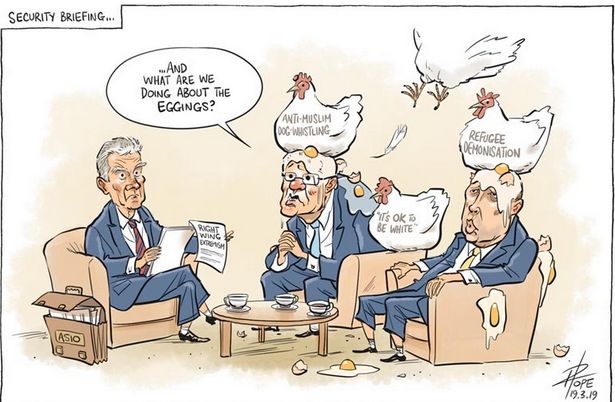
He's one of the Coalitions chief dogwhistlers, this is him getting on the front foot before people can bring up his years of fear mongering.
 
jKy0O8Q.jpg
 

Log in to remove this Banner Ad

I am a long term labour supporter, I have never voted for the Conservatives, and I have been voting for 60 years.
My one concern with Bill Shorten, where does he stand on defence? Will he continue with the build up of the RAN? I am sure he will follow Rudd with the 12 submarines. but what else will Bill do with defence? It appears that the ADF will be in for interesting times in the region in the future.

This from April last year:

https://www.defenceconnect.com.au/k...ts-support-behind-australian-defence-industry
Opposition spokesman for defence Richard Marles has tipped the Labor Party to fully support the ongoing development of Australia's defence industry.
In a speech to the National Press Club, Marles revealed he is expecting the party to back the industry at the upcoming ALP National Conference in Adelaide this July.
Marles said the party's support for the industry will be based on four pillars:
  1. Providing the ADF with the world’s best capability in order to keep our sailors, soldiers and aviators safe and successful on behalf of our nation;
  2. Providing Australia with the sovereign capability to maintain and sustain the ADF and all of its equipment;
  3. Building technological capability and workforce skills within Australia’s broader industrial base; and
  4. Enabling Australia to project its strategic weight through an exporting defence industry.
"At its best Australian industry is as capable as any in the world. If we believe we have or can develop the world’s best capability in any given area then this is reason alone for Australia to have a defence industry so that the ADF can have access to the best," Marles said.

The former parliamentary secretary for Pacific Island Affairs and parliamentary secretary for Foreign Affairs has called on Australia to follow in the footsteps of Israel as it looks to develop a defence industry focused largely on exports.
"At the heart of Israel’s rationale for a defence industry is a fundamental confidence in its own ability to build the best in order to make the IDF the best," he said.
"A dull acceptance of Australian industry inferiority, without any attempt to improve it, is inexcusable."
Marles said Australia's success with the Bushmaster, Nulka and the Jindalee Operational Radar Network bear testament to what could be accomplished should Australia make a commitment to having a national defence industry.
"The decision to have a national defence industry is not lightly made. If you want to have a national defence industry then as a nation, at every level, we have to commit to it," Marles said.
"The visit to Israel left me deeply impressed by what that nation had achieved but more than a little discombobulated about the state of Australia’s endeavours in developing our own defence industry."
Elbit Systems, Rafael and Israeli Aerospace Industries are some of Israel's leading defence companies. Around 80 per cent of the revenue of each of these companies is currently export based.
The latest Stockholm International Peace Research Institute (SIPRI) report looking at trends in international arms transfers has Israel ranked in eighth place, while Australia sits in 19th. Defence Industry Minister Christopher Pyne and the Turnbull government earlier this year committed to getting Australia in the top 10 with its new Defence Export Strategy.
However, Marles has lashed the current practices within Defence's Capability Acquisition and Sustainment Group (CASG), arguing it does not allow for the development of a strong export based Australia's defence industry.
He said this "orthodoxy" was seen most recently with the Offshore Patrol Vessels procurement. In November the government announced it had reconfigured the tender for the OPVs, selecting German designer Lürssen and its teaming partners ASC and Civmec, but pairing it with Western Australia's Austal.
Marles labelled this mix of bids a mistake and said the government abandoned the government's commitment to developing Australia's defence industry capability.
"Given the current orthodoxy in the way in which CASG procures for the ADF, an orthodoxy which does not prioritise the development of Australian defence industry, and an orthodoxy which has not been altered by this government despite its rhetoric, this decision is wholly to be expected," Marles told the National Press Club.
"And yet do we imagine for one moment this is how it would have worked in Israel or Britain? Can we imagine either country so easily accepting the loss of this defence industry development opportunity? And can we imagine them allowing a situation to develop where the choice became one of a superior foreign capability over an inferior domestic option but nevertheless a development opportunity?"


This from last years national conference:

The security of the nation and its people
10. The first responsibility of an Australian government is to protect the security of the Australian people and the integrity of Australian territory. This imperative is central to Labor’s foreign, defence and national security policies.

11. Labor recognises that newly competitive power relationships are challenging traditional security settings and the rules-based global order. Unresolved territorial disputes and pre-emptive claims to oceanic features give rise to potential flashpoints in our region. Growing military capability in Asia is increasing the potential for regional conflicts. The rise of extremists in the Middle East and Africa, and the export to our region of their perverse ideology, threatens Australia's and the region’s security and potential prosperity.

12. Labor also recognises that national security imperative encompasses the safeguarding of Australia’s sovereignty. Australia’s democracy and democratic institutions and democratic practices, including the rule of law and freedom of expression, are core to our national interests.

Security Planning and Coordination
32. Australia needs a properly integrated national security policy, continually reviewed and adapted as required to meet changing security threats. Labor will enhance our national security by:  Re-appointing an appropriately resourced and empowered National Security Adviser, which was abolished under the Coalition Government; Creating a strategic policy framework for national security;  Reviewing the new Home Affairs portfolio arrangements to ensure they are fit for purpose, best meeting Australia’s domestic security needs, and make any adjustments where required; and  Improving Australia's national crisis management arrangements.

33. Labor will ensure our defence forces, security agencies, police and emergency services are always appropriately resourced and given the necessary powers to respond to the security challenges we face as a nation. Labor will work closely with our neighbours, international allies and international institutions to meet the security challenges posed by terrorism.

34. Labor will always work responsibly and constructively to improve our national security laws and to ensure our security agencies and police can employ the powers they already have, and can acquire such additional powers they may need to meet the changing national security threats we face as a nation. Labor will ensure the powers that our security agencies and police have to fight terrorism and other threats to our national security are consistent with the long-standing values and hardwon liberties that help to define Australia as a democratic nation upholding the freedoms and the privacy of its citizens. Recognising the importance of transparency and accountability measures to safeguard freedoms and privacy, Labor will support the oversight role of entities including:  The Independent National Security Legislation Monitor;  The Inspector-General of Intelligence and Security;  The Commonwealth Ombudsman; and  The Parliamentary Joint Committee on Intelligence and Security.

35. Labor totally repudiates the manipulation of fear, sectarianism or racism for political gain and any derogation of the democratic values we are fighting to defend. Australia needs national unity and cohesion to respond to the threat of terrorism. Australia's counter-terrorism laws and other measures should not divide the Australian community or marginalise any part of it. Australia needs a national approach including engagement with local communities as valued contributors to and core components of our multicultural society, and partnership between Australian governments to address domestic terrorism.

36. The global nature and reach of various terrorist organisations means Australia will increasingly rely on global intelligence exchange-as well as support-for an expanding range of UN and multilateral measures to combat terrorist financing and outlaw terrorist organisations.

37. Labor will ensure Australia's cyber security arrangements are able to meet the challenges presented by the electronic environment, which is presenting additional opportunity and vulnerabilities for individuals, business and government, with sophisticated attacks coming from criminal groups and foreign governments.

38. Labor will work with industry to ensure there are sufficient measures in place to reduce the risk of toxic agents that could be weaponised or otherwise used as chemical or biological weapons. We will work to strengthen Australia’s arms control and proliferation measures.

Strength, sustainability and self-reliance in defence
39. The foundation of Labor's defence policy is the principle of Australian self-reliance. Australia's armed forces need to be able to defend Australia against credible threats without relying on the combat forces or capabilities of other countries.

40. Notwithstanding this commitment to a self-reliant defence policy, Labor recognises the importance of strong bilateral and multilateral defence relationships in providing for Australia's defence. Where appropriate, Labor will strengthen existing defence ties with our key allies and through the UN, as well as building new and strengthening existing relationships within the lndo- Pacific region.

41. Labor believes in an Australia Defence Force (ADF) that possesses the capability to make contributions to international operations led by Australia's key allies or the UN that meet Australia's broader national strategic objectives. Those contributions will be drawn from the forces and capabilities that are developed for the defence of Australia and for operations in our region.

42. Labor will ensure that ADF capability development is directly related to Australia's strategic interests and that appropriate regular strategic reviews are undertaken with public reports published.

43. Labor is committed to maintaining a strong, modern, and efficiently managed defence organisation that possesses the personnel, equipment and skills that are needed to meet the demands placed upon it by the Australian Government.

44. Labor is committed to achieving and maintaining spending on defence at two per cent of GDP.

Defence cooperation with Australia's neighbours
53. Labor is committed to Australia comprehensively engaging with other nations in the lndo-Pacific region, as part of its efforts to foster and preserve peace, prosperity, stability and security in the region. These efforts are fundamental to Australia's own national security.

54. Labor recognises the importance of both bilateral and multilateral defence relationships in achieving security for Australia and creating and maintaining stability in Australia's strategic environment.

55. Security of the Pacific nations is essential for regional security and Australia's own defence. Labor supports the 'Pacific Maritime Security Program', the deployment of Navy personnel, surveillance assets and patrol boats in Pacific Island Countries to protect their sovereignty from threats such as smuggling, illegal, unrecorded and unregulated fishing and terrorism.

56. Labor will ensure that defence cooperation does not contribute to any suppression or violation of human rights or democratic freedoms. Labor will closely monitor the human rights performance of foreign military and security forces with which Australia engages in defence cooperation. A key objective of Australia’s defence engagement under Labor will be to promote the professionalisation of military forces, adherence to the rules of armed conflict, and respect for the rule of law and human rights.

Allied use of Australian facilities
57. Labor supports the use of facilities In Australia by the armed forces of friendly countries for combined exercises, training and goodwill visits, provided that in times of peace:  Use of Australian ports by foreign warships does not extend to the home porting of any of those vessels in Australia;  Staging of military aircraft through Australian airfields or airspace shall only be for such purposes as may be agreed beforehand by the Australian Government;  No nuclear, biological or chemical weapons may be stored or stationed in Australia; and  Nuclear powered vessels visit only those ports which have been determined as being suitable for those vessels and provided also that all other safety precautions and conditions that are deemed necessary by the relevant Australian authorities are complied with by the vessels concerned; and, appropriate environmental safeguards are in place.

Defence Industry
The need for an Australian defence industry
58. Labor is committed to fostering a strong national defence industry. This requires a national consensus about the need for an Australian defence industry and a commitment to building this industry on the part of: the major political parties, the Department of Defence, the Australian Defence Force (ADF), other tiers of government, vocational and tertiary institutions, the existing defence industry itself and the relevant unions. In short, the building of an Australian defence industry must become a national mission.

The rational for an Australian defence industry
59. To create this national mission the need for an Australian defence industry must be built upon a clear rationale. Accordingly Labor believes Australia needs a defence industry in order to:  Provide the ADF with the worlds best capability in order to keep our sailors, soldiers and aviators safe and successful on behalf of our nation;  Provide Australia with the sovereign capability to maintain and sustain the ADF and all of its equipment;  Enable Australia to project its strategic weight through an exporting defence industry; and  Build technological capability and workforce skills within Australias broader industrial base.

The worlds best capability
60. Australias technical and industrial sector produces excellent high technology products. Our existing defence industry has designed, developed or produced content for land vehicles, surface ships, submarines and aviation which is regarded as the best in the world. Accordingly Labor believes an Australian defence industry producing equipment for the ADF means that Australias sailors, soldiers and aviators will be equipped with the best.

61. Labor is committed to cooperative leading edge science and engineering research that brings together industry, tertiary institutions and government that not only secures military capability but drives industry and export opportunities.

Sovereign capability
62. Modern military equipment which Australia acquires is complex and often includes content from around the world. A contemporary view of sovereign capability means being able to maintain and sustain the equipment which the ADF operates. Labor is committed to ensuring Australia has a defence industry which will always be able to provide our nation with this sovereign capability. We will require equipment to be manufactured in Australia to the greatest extent possible.  Labor believes that greater export opportunities will help to sustain Australian defence industry over the long term and improve our economic ability to invest in superior defence capability.

63. In addition, Labor is committed to identifying areas of critical national capability which are fundamental to maintaining Australias defence sovereignty.

Strategic weight
64. Labor believes that having a strong, sustainable, defence industry with the capacity to export is key to building Australias regional and global strategic weight.

65. The strategic weight provided by an exporting defence industry complements the Page:36 of 37 role played by the ADF in enhancing Australias reputation as a capable and reliable international partner. Labor believes that together, defence industry and the ADF both play a role in seeing Australia be taken seriously.  Labor will look to develop and implement policies that support the export potential of the Australian defence industry and enhance its global competitiveness. Labor will ensure that all defence exports comply with the relevant legislative requirements and are only made to countries that share Australias values, particularly with respect to democratic practices, the rule of law and the protection of human rights.

Australian industrial capability
66. As a high technology industry, Labor believes in the potential for defence industry to build technological capability and workforce skills within Australias broader industrial base.

67. Labor will drive more responsive and efficient procurement processes within the Department of Defence to facilitate a strong, strategic partnership with industry. Fostering and drawing on the innovation and entrepreneurship of Australian companies is a crucial element in achieving this aim.

68. Labor will ensure that the Australian Defence Organisation has the appropriate science and engineering expertise to work with and support defence industry, based on medium to long term requirements.

69. Consistent with Australias international obligations, Labor will maximise the participation of Australian companies, particularly SMEs, in defence procurement and services contracts. Labor will support SMEs to ensure:  They have access to information regarding defence procurement;  They are more easily able to partner with large defence contractors in major defence contacts; and  Are not precluded from contracts to supply goods and services to the Department of Defence.

70. Labor will ensure that contractual obligations arising from such arrangements are enforced.

71. Labor will implement initiatives to facilitate the development of the skilled workforce to support a sustainable defence industry, including support for an effective apprenticeship, cadetship, training and education regime. As part of this, Labor will further invest in skilling our defence industry workforce, including mandating skills transfer as part of any major defence projects led by foreign primes, to ensure Australian defence industry is best placed to compete for projects internationally.

72. Labor will ensure that the Department of Defence is a smart buyer, with the capacities and staffing necessary to ensure that the nations acquisition and sustainment decisions deliver value for money
 
He's one of the Coalitions chief dogwhistlers, this is him getting on the front foot before people can bring up his years of fear mongering.
He's good at trying to manipulate anything and everything to try and get himself to come out smelling of roses.
 
Morrison made some good comments about ‘reducing tribalism’ and ‘disagreeing better’. I’d like to take him at those words but his actions certainly haven’t matched them to date. In particular, his comment that ‘one person’s gain isn’t another’s loss’. Would have sounded better if not for his comments on International Women’s Day that ‘he wants women to get ahead but not at the expense of others (men)’.
In early 2011, it was reported that whilst he was the Opposition spokesman on Immigration he "urged the shadow cabinet to capitalise on the electorate's growing concerns about "Muslim immigration", "Muslims in Australia" and the "inability" of Muslim migrants to integrate. Mr Morrison's suggestion was made at a meeting in December at which shadow ministers were asked to bring three ideas for issues on which the Coalition should concentrate its political attack during this parliamentary term." (SMH 17/2/2001) he is reported to have told that shadow cabinet meeting that the Coalition should ramp up its questioning of "multiculturalism" and appeal to deep voter concerns about Muslim immigration and "inability" to integrate.

This was at around the same time that he criticised the cost of bringing asylum-seekers to Sydney to attend funerals of loved ones killed in the Christmas Island tragedy in December of 2010. When he was accused of being insensitive and cruel, he offered this , "The timing of my comments over the last 24 hours was insensitive and was inappropriate. I have to show a little more compassion than I did yesterday: I am happy to admit that.", in other words, "I didn't say anything wrong, I just said it at the wrong time."

How can we take anything that comes out of his mouth as being sincere?
 
Frydenberg's a lot safer than Porter. If Frydenberg loses the Coalition are down to around 30-40 seats and Morrison pretty much can't stay on. Trouble is apart from him there's few other senior Liberals who are in the Lower House and are leadership potential.

Frydenberg is very safe on paper, if he suffers an 8% drop in his primary he will still hold easily but if the Liberals primary vote drops 8% in Higgins, Flinders or Warringah then those seats will probably fall.
 
I wonder who will replace Scott Morrison when he inevitably falls on his sword after an election loss approximately two months from now.

Josh Frydenberg? Some chance that he won't win his seat. Christian Porter perhaps? Porter seems to fit the suit. Cupboard's getting a bit bare in terms of senior Liberals: no Bishop, no Dutton (touch and go whether he loses his seat), no Pyne ...

Disregarding their respective chances of holding their seats at the upcoming election, Christian Porter is much better suited to leader than Frydenberg is. In fact, I think Josh would be a disaster.

If not Porter, then Angus Taylor.
 
Disregarding their respective chances of holding their seats at the upcoming election, Christian Porter is much better suited to leader than Frydenberg is. In fact, I think Josh would be a disaster.

If not Porter, then Angus Taylor.
Frodo, Porter and Taylor.
A throwback to the "Great Liberal Party Bumbling Idiot Era" of Gorton, McMahon, Snedden.
 
A throwback to the "Great Liberal Party Bumbling Idiot Era" of Gorton, McMahon, Snedden.

As a Western Australian, I lived through Porter as our State Treasurer - the guy is certainly no bumbling idiot, and in fact is very precise with his wording while also having a common touch with his speech. 2 most important things for any politician!
 

Remove this Banner Ad

As a Western Australian, I lived through Porter as our State Treasurer - the guy is certainly no bumbling idiot, and in fact is very precise with his wording while also having a common touch with his speech. 2 most important things for any politician!
He's just another hypocritical antediluvian right-wing dingbat culture warrior.
 
Last edited:
Disregarding their respective chances of holding their seats at the upcoming election, Christian Porter is much better suited to leader than Frydenberg is. In fact, I think Josh would be a disaster.

If not Porter, then Angus Taylor.
Lol if that’s the leading talent it’s going to be a long stint in opposition
 

🥰 Love BigFooty? Join now for free.

Disregarding their respective chances of holding their seats at the upcoming election, Christian Porter is much better suited to leader than Frydenberg is. In fact, I think Josh would be a disaster.

If not Porter, then Angus Taylor.

porter is a drunk
 
Status
Not open for further replies.

Remove this Banner Ad

Remove this Banner Ad

🥰 Love BigFooty? Join now for free.

Back
Top Bottom